

Coating Service Overview
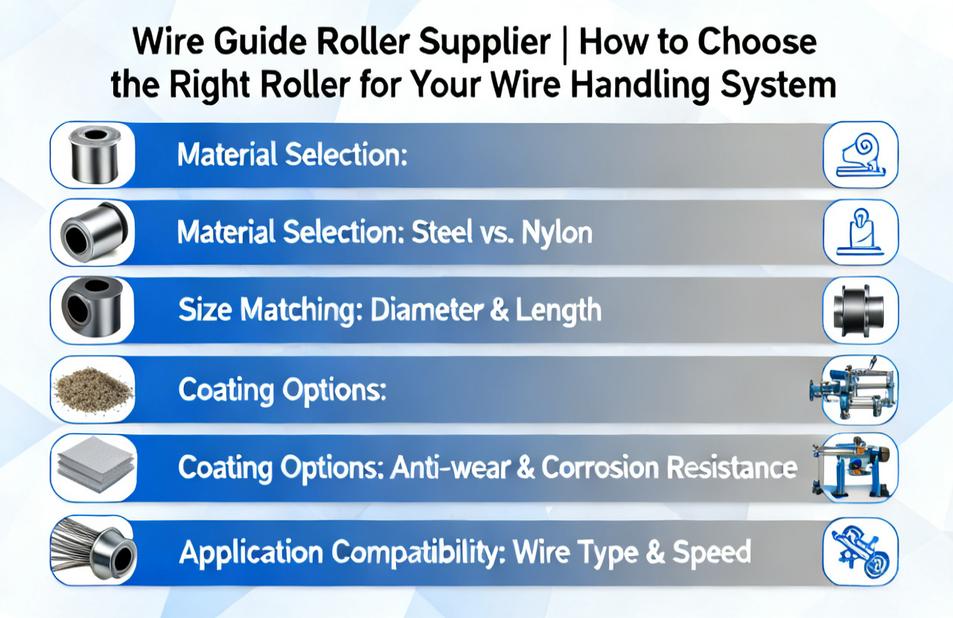
A wire guide roller supplier provides the precision components that keep wire, cable, and flexible cord moving smoothly through drawing, stranding, winding, and feeding equipment. In simple terms, a wire guide roller is a rotating wheel with a grooved or flat surface that redirects, tensions, or supports wire without causing abrasion, kinking, or deflection. These rollers are essential in wire and cable manufacturing, coil winding, textile machinery, automotive harness assembly, and any industrial process where continuous wire travel must be controlled. For procurement teams, finding a reliable supplier is not just about price. It is about matching roller geometry, material, bearing type, and mounting style to the actual wire diameter, line speed, and environmental conditions of the machine. This guide explains what overseas buyers should evaluate before placing an order.
What a Wire Guide Roller Does in a Production Line
Wire guide rollers serve several functions depending on where they are installed. In pay-off and take-up stations, they guide wire from a spool into the process line. In multi-wire stranding machines, they separate and position individual conductors. In coil winding equipment, they maintain consistent tension and prevent the wire from jumping out of its path. In robotic cable management and automated harness assembly, they protect flexible cable from sharp bends that reduce conductor life.
A roller that is poorly matched to the application can cause surface scratches, ovality, tension fluctuations, and premature wire breakage. That is why experienced buyers treat the guide roller as a critical wear part rather than a commodity item. The right supplier will ask about wire material, diameter range, line speed, and ambient conditions before recommending a specification.
Key Design Features Buyers Should Examine
Groove Profile and Roller Diameter
The groove profile must match the wire or cable cross-section. V-grooves are common for single solid wire, while U-grooves or radius grooves suit stranded cable and flexible cord. The roller diameter affects the bend radius, which in turn influences fatigue life. A supplier should be able to recommend a minimum roller diameter based on the wire type and the number of bending cycles expected.
Bearing Type and Rotation Smoothness
Wire guide rollers typically use ball bearings, needle bearings, or plain bushings. Sealed ball bearings are common in dusty or high-speed environments, while open bearings may be used where lubrication can be maintained. The bearing choice affects drag torque, noise, and service life. Buyers should confirm whether the roller is designed for continuous rotation or intermittent indexing.
Mounting and Shaft Configuration
Rollers can be supplied with integral shafts, through-holes for customer-supplied axles, or stud-mounted configurations. The mounting method must match the machine frame and adjustment mechanism. A supplier that offers multiple mounting options can reduce the need for custom brackets and simplify replacement.
Materials and Construction
The roller body material is selected based on wire hardness, chemical exposure, and operating temperature. Common options include hardened steel, stainless steel, aluminum alloy, engineering plastics such as POM or nylon, and polyurethane-coated steel. Hardened steel rollers resist wear in high-volume drawing operations. Stainless steel rollers suit humid or corrosive environments. Plastic and polyurethane rollers are used where the wire surface must be protected from marking or where noise reduction is important.
Surface finish also matters. A polished groove reduces friction and helps prevent debris accumulation. Some rollers are coated with hard chrome or ceramic to extend service life in abrasive applications. Buyers should ask the supplier for material options and understand the trade-offs between wear resistance, weight, and cost.
Industrial Applications and Matching to Equipment
Wire guide rollers are used across many industries. In wire and cable manufacturing, they guide conductor and insulation through drawing, annealing, and stranding lines. In coil winding, they maintain wire position on the bobbin. In textile machinery, they guide yarn and thread. In automotive wire harness production, they protect cable during cutting and crimping. In 3D printing and automated welding, they guide filament or filler wire.
Matching a roller to equipment requires more than measuring the wire diameter. Buyers should consider line speed, acceleration, wire tension, ambient temperature, and the presence of dust, oil mist, or coolant. A supplier with application experience can help select the correct roller width, groove radius, and bearing clearance for the specific machine model.
How to Choose a Wire Guide Roller Supplier
When evaluating potential suppliers, look beyond the product catalog. A capable manufacturer or factory should be able to review your application details and recommend a suitable standard roller or propose a custom design. Ask about their production process, quality control procedures, and ability to maintain consistent tolerances across repeat orders.
Consider these factors during supplier selection:
- Technical support: Can the supplier interpret drawings, samples, or machine specifications?
- Material and coating options: Do they offer the materials needed for your environment?
- Customization capability: Can they produce non-standard groove profiles, diameters, or mounting configurations?
- OEM and private label support: Can they manufacture to your drawing or brand requirements?
- Quality consistency: How do they control groove dimensions, roundness, and bearing fit?
- Communication and lead time: Do they respond clearly and provide realistic production schedules?
A supplier that only quotes a price without asking about the application may not be the best long-term partner. The most reliable suppliers ask questions first and recommend second.
Customization and OEM Options
Many wire guide roller applications require a non-standard solution. Customization may include specific groove radii, special shaft lengths, alternative bearing types, or unique mounting flanges. Some suppliers also offer OEM manufacturing, where the roller is produced to the buyer’s drawing and branded for resale or integration into a larger assembly.
When requesting a custom roller, provide as much detail as possible: wire diameter, wire material, line speed, tension range, ambient conditions, mounting dimensions, and any existing part number. If a sample is available, sending it to the supplier can reduce miscommunication. A factory with in-house machining and assembly capabilities is often better positioned to handle custom work than a trading company that outsources production.
Buying Considerations and Common Pitfalls
Price should be evaluated together with service life and replacement frequency. A lower-cost roller that wears quickly can increase downtime and labor costs. Buyers should also confirm whether the quoted price includes bearings, shafts, or mounting hardware. Packaging and labeling requirements matter for inventory management, especially for OEM buyers who need barcodes or custom boxes.
Another common pitfall is assuming that all rollers with the same outer diameter are interchangeable. Groove profile, bearing clearance, and dynamic balance can vary significantly between suppliers. Always request dimensional drawings and, where possible, test samples before committing to a large order.
Frequently Asked Questions
What information should I provide when requesting a quote for wire guide rollers?
Provide the wire or cable type and diameter, line speed, tension range, ambient temperature, mounting dimensions, and the quantity required. If you have an existing part number or sample, include that as well. This helps the supplier recommend a standard roller or propose a custom design.
Can wire guide rollers be customized for a specific machine?
Yes. Many manufacturers offer custom groove profiles, roller diameters, shaft configurations, and material options. Custom rollers are common in wire and cable machinery, coil winding equipment, and automated assembly systems where standard parts do not fit.
How do I evaluate the quality of a wire guide roller supplier?
Review their technical support, material options, tolerance control, and ability to handle OEM or custom orders. Ask for dimensional drawings, sample availability, and references from similar industrial applications. Consistent quality across repeat orders is a key indicator of a reliable supplier.
What materials are commonly used for wire guide rollers?
Common materials include hardened steel, stainless steel, aluminum, engineering plastics, and polyurethane-coated steel. The choice depends on wire hardness, operating environment, and whether surface protection or noise reduction is required.
Conclusion
Selecting the right wire guide roller starts with understanding the application, not just the part number. Groove profile, roller diameter, bearing type, and material all affect performance and service life. A supplier that asks detailed questions and offers both standard and custom options can help you reduce downtime and maintain consistent wire handling quality. If you are sourcing wire guide rollers for a specific machine or production line, share your specifications with a qualified manufacturer or supplier and request a technical recommendation based on your actual operating conditions.
