

General Machinery
In the general machinery manufacturing and equipment maintenance indus…
In the general machinery manufacturing and equipment maintenance industries, the surface performance of components directly affects machine efficiency, service life, and maintenance costs.
Whether it is pumps, valves, compressors, fans, conveyors, packaging machines, printing equipment, textile machinery, plastic processing machines, or automated production systems, critical components are constantly exposed to harsh working conditions, including friction wear, impact loads, corrosive media, high temperatures, dust erosion, and long-term continuous operation.
Many mechanical failures do not start from structural damage, but from surface degradation. Common problems include wear, scratches, corrosion, oxidation, dimensional deviation, sealing failure, and increased clearance between moving parts.
For example:
- Shafts may wear after long-term rotation.
- Bushings and bearing seats may lose dimensional accuracy due to friction.
- Pump and valve sealing surfaces may fail because of erosion and corrosion.
- Rollers and guide wheels may suffer from surface abrasion.
- Transmission components may experience fatigue and contact damage.
Although these problems occur only on the surface, they can eventually lead to reduced efficiency, increased vibration, higher noise levels, unstable operation, and unexpected downtime.
To improve component performance, more companies are adopting advanced surface engineering technologies such as tungsten carbide coating, ceramic coating, HVOF coating, plasma spraying, thermal spray coating, wear resistant coating, corrosion resistant coating, and high temperature protective coating.
By applying a high-performance coating layer onto component surfaces, manufacturers can significantly improve:
- Wear resistance
- Corrosion resistance
- High-temperature stability
- Oxidation resistance
- Erosion resistance
- Operating reliability
This allows components to achieve longer service life while reducing maintenance costs and improving production efficiency.
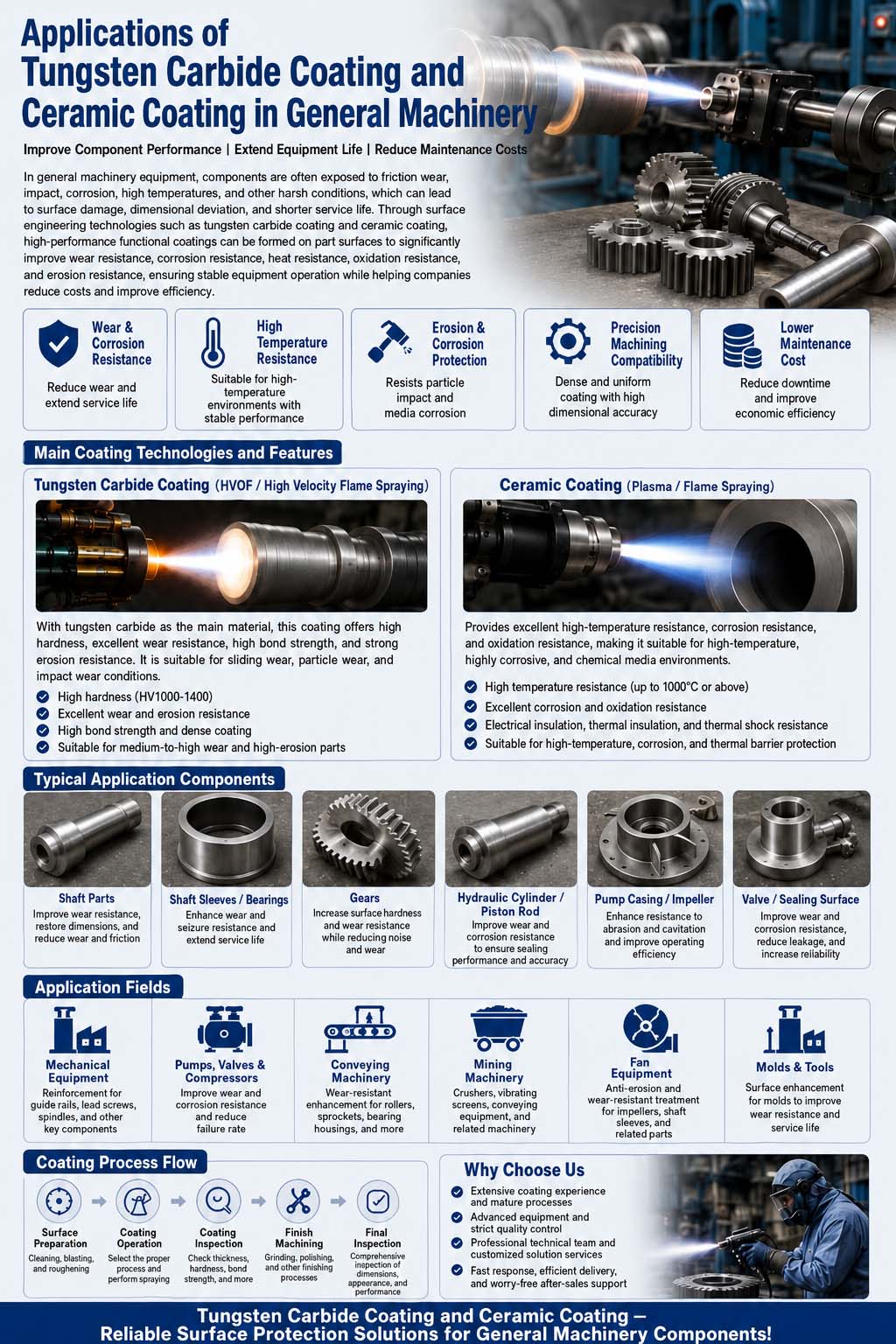
Why General Machinery Needs Tungsten Carbide and Ceramic Coatings?
General machinery covers a wide range of applications with different operating conditions. Some components operate at high speed, some experience heavy loads, while others are exposed to corrosive chemicals, high temperatures, or continuous friction.
Although each application has different requirements, the ultimate goal is the same:
Longer service life, higher reliability, and fewer maintenance interruptions.
Traditional solutions include:
- Using high-strength materials
- Welding repair
- Hard chrome plating
- Surface hardening
- Component replacement
However, these methods have limitations.
Complete replacement of high-performance materials can be expensive. Welding repair may cause thermal deformation and require additional machining. Conventional surface treatments may not provide sufficient protection in severe wear or corrosion environments.
Thermal spray technology provides a more flexible solution.
It allows engineers to select different coatings according to actual failure mechanisms:
- Tungsten carbide coating for severe wear and abrasion
- Ceramic coating for corrosion, high temperature, and insulation requirements
- Thermal spray repair for restoring worn dimensions
For general machinery manufacturers, coating technology is suitable for both new component surface enhancement and repair/reconditioning of used parts.
Advantages of Tungsten Carbide Coating in Machinery Applications
Tungsten carbide coating is one of the most widely used wear-resistant surface technologies.
Usually applied through High Velocity Oxygen Fuel (HVOF) spraying, tungsten carbide powder is accelerated at high speed onto the component surface, forming a dense coating with:
- High hardness
- Strong bonding strength
- Excellent wear resistance
- Superior erosion resistance
- Stable friction performance
Tungsten carbide coatings are ideal for components exposed to:
- Mechanical friction
- Sliding wear
- Particle erosion
- Heavy-load contact
Typical applications include:
- Shafts
- Shaft sleeves
- Hydraulic rods
- Pistons
- Guide wheels
- Rollers
- Pump shafts
- Mechanical seals
- Valve sealing surfaces
- Wear sleeves
By applying tungsten carbide coatings, components can maintain better dimensional accuracy and longer operating life.
Pump and Valve Components
Pump shafts, sleeves, sealing rings, valve seats, and valve cores are often damaged by fluid erosion and mechanical wear.
Tungsten carbide coating improves:
- Surface hardness
- Erosion resistance
- Sealing reliability
- Service life
Conveyor and Roller Systems
Rollers, guide wheels, and transmission shafts frequently contact materials, belts, or chains.
Wear-resistant tungsten carbide coatings help reduce:
- Surface abrasion
- Slipping
- Dimensional changes
- Production instability
Packaging, Printing and Textile Machinery
Precision rollers and guide rollers require excellent surface quality and wear resistance.
After tungsten carbide spraying combined with grinding and polishing, components can achieve:
- Better surface stability
- Higher precision
- Longer service intervals
Advantages of Ceramic Coating in Machinery Applications
Ceramic coating uses thermal spray technology to apply ceramic materials such as:
- Aluminum oxide
- Chromium oxide
- Zirconia
- Titanium oxide
onto metal surfaces.
Compared with tungsten carbide coatings, ceramic coatings provide superior performance in:
- High-temperature resistance
- Chemical corrosion resistance
- Electrical insulation
- Oxidation protection
- Anti-stick properties
Ceramic coatings are widely used for:
- Corrosion-resistant components
- High-temperature parts
- Insulating components
- Chemical processing equipment
- Food machinery parts
- Heating rollers
- Guide rollers
- Mold surfaces
- Special functional components
Corrosion Protection Applications
In chemical pumps, corrosion-resistant valves, and fluid transportation equipment, components are exposed to aggressive chemicals.
Ceramic coatings create a protective barrier between the metal substrate and corrosive media, improving component durability.
High Temperature Applications
Components such as:
- Heating rollers
- Thermal processing fixtures
- Drying equipment
- Furnace accessories
often suffer from oxidation and thermal degradation.
Ceramic coatings provide:
- High-temperature protection
- Oxidation resistance
- Improved operating stability
Insulation and Anti-Stick Applications
For automated equipment, electronics manufacturing, film processing, and food machinery, surface properties such as insulation, cleanliness, and chemical stability are important.
Ceramic coatings can provide customized solutions for these special requirements.
How to Choose Between Tungsten Carbide Coating and Ceramic Coating?
The selection depends on actual operating conditions.
Choose Tungsten Carbide Coating When:
Components mainly experience:
- Abrasion
- Friction
- Particle erosion
- Heavy mechanical contact
- Surface scratching
Typical applications:
- Shafts
- Rollers
- Pump shafts
- Shaft sleeves
- Hydraulic rods
- Valve sealing surfaces
- Mechanical seals
Choose Ceramic Coating When:
Components require:
- Corrosion resistance
- High-temperature protection
- Electrical insulation
- Chemical stability
- Anti-stick performance
Typical applications:
- Chemical equipment
- High-temperature rollers
- Pipes
- Furnace components
- Insulating parts
For applications involving both wear and corrosion, customized composite coating solutions may be required.
Professional thermal spray manufacturers evaluate:
- Base material
- Temperature
- Load
- Speed
- Chemical environment
- Failure mechanism
- Surface accuracy requirements
before selecting the proper coating system.
Typical Thermal Spray Applications in General Machinery
1. Shafts and Bearing Seats
Shafts, pump shafts, motor shafts, and transmission shafts often suffer from wear at bearing and sealing areas.
Thermal spray repair can:
- Restore dimensions
- Improve hardness
- Enhance wear resistance
- Reduce replacement costs
After precision grinding, coated shafts can meet strict assembly requirements.
2. Bushings and Wear Sleeves
Bushings are common wear components in mechanical systems.
Tungsten carbide coatings improve:
- Wear resistance
- Scratch resistance
- Service life
Ceramic coatings are suitable for applications requiring corrosion or temperature resistance.
3. Pump and Valve Components
Pump and valve parts experience:
- Fluid erosion
- Corrosion
- Mechanical wear
Coatings improve:
- Leakage prevention
- Sealing performance
- Equipment reliability
4. Rollers and Guide Wheels
Industrial rollers include:
- Conveyor rollers
- Pressure rollers
- Guide rollers
- Traction rollers
- Heating rollers
Tungsten carbide coatings improve wear resistance, while ceramic coatings provide corrosion resistance, insulation, and temperature protection.
5. Hydraulic Rods and Pistons
Hydraulic components require excellent surface durability.
Tungsten carbide coating improves:
- Wear resistance
- Scratch resistance
- Seal protection
For corrosive environments, additional corrosion-resistant coating solutions can be applied.
6. Gears and Transmission Components
Gears, chains, couplings, and transmission parts experience continuous contact stress.
Wear-resistant coatings can:
- Improve surface durability
- Reduce friction
- Extend service life
- Repair worn dimensions
7. Fans, Compressors and Rotating Equipment
Fan blades, compressor sleeves, rotors, and sealing rings require:
- High precision
- Wear resistance
- Stable operation
Proper coatings help reduce erosion and corrosion damage.
Benefits of Thermal Spray Coating for Machinery Companies
For machinery manufacturers and equipment users, thermal spray coating is more than surface treatment. It is a functional technology that improves performance and reduces total operating costs.
Longer Component Life
Coatings reduce:
- Wear
- Corrosion
- Oxidation
- Surface damage
and extend component service cycles.
Lower Maintenance Costs
Many components fail only because of surface damage.
Thermal spray repair can restore dimensions and avoid expensive replacement.
Improved Equipment Stability
Protective coatings reduce:
- Vibration
- Leakage
- Noise
- Efficiency loss
Customized Solutions
Thermal spray technology can be adapted according to:
- Drawings
- Samples
- Materials
- Operating conditions
making it suitable for customized and non-standard components.
Choosing a Professional Thermal Spray Manufacturer
When selecting a tungsten carbide coating supplier or ceramic coating manufacturer, companies should consider:
Advanced Technology Capability
A reliable supplier should have experience with:
- HVOF coating
- Plasma spraying
- Thermal spray processing
Machining Capability
Many coated parts require:
- Grinding
- Polishing
- Precision machining
- Dimension restoration
Integrated coating and machining capability improves quality and delivery efficiency.
Engineering Experience
A professional manufacturer should recommend coatings based on actual working conditions rather than simply offering standard materials.
Quality Control
Important inspection factors include:
- Coating thickness
- Bond strength
- Surface roughness
- Dimensional accuracy
Conclusion
General machinery operates in increasingly demanding environments, making surface protection technology essential for improving equipment reliability.
Tungsten carbide coating provides excellent wear resistance for shafts, rollers, pump parts, seals, and mechanical components.
Ceramic coating offers outstanding protection against corrosion, high temperatures, oxidation, and special functional requirements.
By selecting the right thermal spray solution, companies can:
- Extend component life
- Reduce downtime
- Lower maintenance costs
- Improve equipment performance
With the development of high-efficiency, high-precision, and low-maintenance machinery, technologies such as HVOF coating, tungsten carbide coating, ceramic coating, wear resistant coating, and corrosion resistant coating will continue to play an increasingly important role in modern industrial manufacturing.
