

Steel & Metallurgy
The steel metallurgy industry is a typical heavy industrial sector wit…
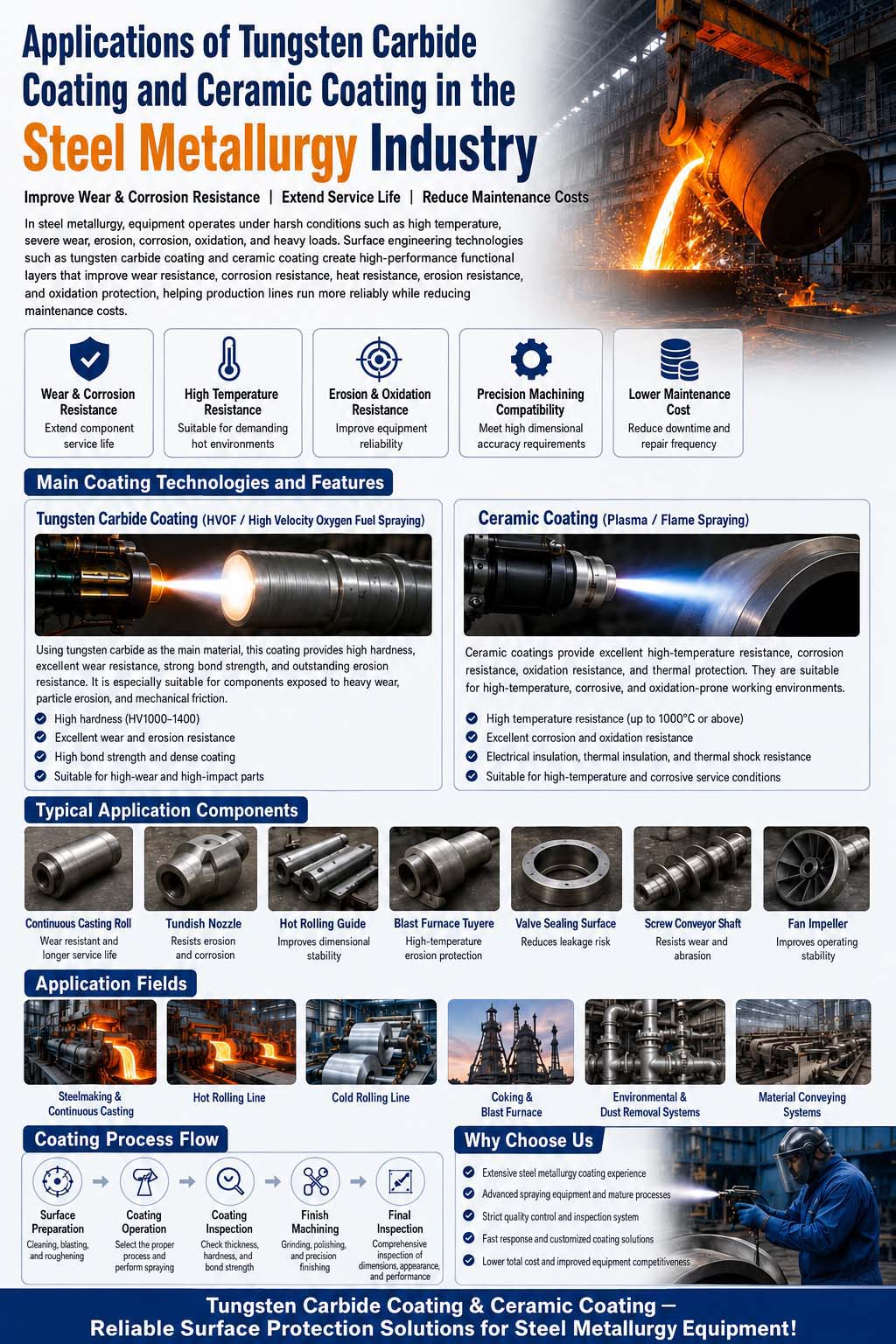
The steel metallurgy industry is a typical heavy industrial sector with long production processes, complex equipment systems, and extremely demanding operating conditions. Production lines cover sintering, coking, ironmaking, steelmaking, continuous casting, hot rolling, cold rolling, pickling, galvanizing, annealing, finishing, environmental protection and material transportation.
During these processes, many critical components operate under harsh conditions involving high temperature, heavy loads, mechanical impact, oxidation, corrosion, dust erosion, cooling water corrosion, and continuous friction. As a result, equipment surfaces are often affected by wear, corrosion, oxidation, sticking, scratches, dimensional changes, and sealing failures.
For steel manufacturers, stable equipment operation directly affects production efficiency, product quality, and maintenance costs. Components such as continuous casting rolls, furnace rolls, guide rolls, pinch rolls, conveyor rollers, fan impellers, pump sleeves, valve sealing surfaces, hot rolling guides, submerged rolls, stabilizer rolls, screw conveyors, and dust removal equipment parts are typical wear-prone components.
Once these key components fail, production lines may experience unexpected downtime, reduced product quality, shorter maintenance cycles, and increased spare parts costs.
With the development of surface engineering technologies, tungsten carbide coating, ceramic coating, HVOF coating, plasma spraying, thermal spray processing, wear-resistant coatings, anti-corrosion coatings, high-temperature protective coatings, oxidation-resistant coatings, and erosion-resistant coatings are increasingly used in the steel metallurgy industry.
By applying high-performance functional coatings on component surfaces, manufacturers can significantly improve wear resistance, corrosion resistance, heat resistance, oxidation resistance, erosion resistance, and operational stability without changing the original structure of the parts. These technologies help extend equipment service life, reduce maintenance costs, and improve continuous production efficiency.
1. Why Does the Steel Industry Need Surface Coating Technology?
In many cases, failure of steel production equipment does not result from insufficient material strength, but from surface damage occurring first.
Steel manufacturing environments expose equipment surfaces to iron oxide scale, dust particles, slag, steel billets, steel strips, cooling water, acid solutions, high-temperature gases, and corrosive chemicals. Different production stages create different challenges for equipment surfaces.
During ironmaking and sintering, equipment is exposed to high-temperature dust, mineral powder, coke particles, and corrosive gases. Fan impellers, pipelines, conveyors, and dust removal systems are vulnerable to erosion and corrosion.
During steelmaking and continuous casting, casting rolls, guide rolls, segment rolls, and pinch rolls experience high-temperature billet radiation, cooling water impact, oxide scale abrasion, and repeated thermal stress. Roll surfaces may suffer from wear, thermal fatigue, corrosion, and peeling.
During hot rolling, guide equipment, pinch rolls, furnace rolls, and transport rollers continuously contact high-temperature steel materials, causing abrasion, sticking, oxidation, and dimensional changes.
During pickling, galvanizing, cold rolling, and finishing, equipment faces additional challenges from acidic solutions, zinc corrosion, cooling fluids, and strict surface quality requirements.
Traditional repair methods include replacement, welding repair, hardening treatment, electroplating, and machining. However, many steel plant components are large, expensive, and time-consuming to manufacture. Replacing entire parts due to surface damage creates significant costs.
Thermal spray technology provides a more efficient solution by strengthening only the damaged surface area. Tungsten carbide coatings, ceramic coatings, and composite coatings can provide targeted protection according to actual operating conditions.
2. Advantages of Tungsten Carbide Coating in Steel Metallurgy
Tungsten carbide coating is a high-performance wear-resistant surface treatment technology. It is commonly applied through High Velocity Oxygen Fuel (HVOF) spraying, where tungsten carbide powder is accelerated at high speed onto the substrate surface to form a dense coating with high hardness and strong bonding strength.
Tungsten carbide coatings offer excellent:
- Wear resistance
- Abrasion resistance
- Erosion resistance
- Scratch resistance
- Particle impact resistance
They are especially suitable for steel production components exposed to mechanical friction, oxide scale abrasion, dust erosion, and heavy contact loads.
Typical applications include:
- Continuous casting rolls
- Conveyor rollers
- Guide rolls
- Pinch rolls
- Hot rolling guides
- Pump shafts and sleeves
- Mechanical seals
- Valve sealing surfaces
- Fan impellers
- Screw conveyor shafts
- Wear plates and liners
For continuous casting systems, rolls operate under extremely demanding conditions involving high-temperature billets, cooling water, pressure loads, and oxide scale abrasion. Excessive roll wear can affect billet quality and equipment accuracy.
Applying tungsten carbide coating improves roll surface hardness, reduces wear, minimizes scratches, and extends service intervals.
In hot rolling and transportation systems, tungsten carbide coatings help protect guide parts, rollers, and contact surfaces from abrasion caused by steel materials and oxide scale.
For fans, dust removal systems, and material handling equipment, tungsten carbide coatings improve resistance against particle erosion, reducing maintenance frequency and downtime.
3. Advantages of Ceramic Coating in Steel Metallurgy
Ceramic coating uses thermal spray technologies such as plasma spraying and flame spraying to apply materials including:
- Aluminum oxide (Al₂O₃)
- Chromium oxide (Cr₂O₃)
- Zirconia (ZrO₂)
- Titanium oxide (TiO₂)
onto metal surfaces, creating functional coatings with excellent:
- High-temperature resistance
- Corrosion resistance
- Oxidation resistance
- Thermal insulation
- Electrical insulation
- Chemical stability
Compared with tungsten carbide coatings, ceramic coatings provide better performance in high-temperature and chemically aggressive environments.
Steel production includes many high-temperature processes, such as heating furnaces, annealing furnaces, heat treatment lines, sintering systems, and hot rolling equipment.
Metal surfaces exposed to high temperatures may experience oxidation, corrosion, sticking, and thermal degradation. Ceramic coatings create a protective barrier that reduces direct contact between the metal substrate and harsh environments.
Typical applications include:
- Furnace rolls
- Heat treatment fixtures
- High-temperature guide components
- Gas ducts
- Pickling equipment parts
- Galvanizing line components
- Submerged rolls
- Corrosion-resistant structures
For example, furnace rolls in annealing lines operate under high temperature while contacting steel strips. Surface oxidation and material adhesion can affect product quality. Ceramic coatings provide improved oxidation resistance and surface protection.
In pickling and environmental systems, ceramic coatings protect pumps, pipelines, valves, and structural components from chemical corrosion.
4. Choosing Between Tungsten Carbide Coating and Ceramic Coating
The choice between tungsten carbide coating and ceramic coating depends on the actual operating environment.
Tungsten Carbide Coating is suitable for:
- Mechanical wear
- Particle erosion
- Sliding friction
- Impact wear
- Oxide scale abrasion
Typical components:
- Continuous casting rolls
- Conveyor rollers
- Pinch rolls
- Guide rolls
- Pump sleeves
- Valve sealing surfaces
- Fan components
Ceramic Coating is suitable for:
- High-temperature environments
- Oxidation
- Chemical corrosion
- Acid and alkaline media
- Thermal insulation requirements
Typical components:
- Furnace rolls
- Heat treatment equipment
- High-temperature ducts
- Pickling equipment
- Galvanizing components
For combined conditions involving wear, corrosion, and high temperature, customized composite coating solutions are often required.
Professional thermal spray suppliers evaluate:
- Component material
- Operating temperature
- Load conditions
- Chemical environment
- Wear mechanism
- Surface accuracy requirements
before selecting coating materials, thickness, spraying processes, and finishing methods.
5. Typical Applications in Steel Metallurgy
1. Continuous Casting Rolls and Guide Rolls
Continuous casting rolls are exposed to high temperatures, cooling water, oxide scale, and mechanical pressure.
Surface wear, corrosion, and thermal fatigue can affect casting quality.
Tungsten carbide and ceramic coatings improve:
- Wear resistance
- Corrosion resistance
- Thermal fatigue performance
and extend roll service life.
2. Furnace Rolls and Heat Treatment Rolls
Furnace rolls operate under continuous high-temperature conditions.
Ceramic coatings provide:
- Oxidation protection
- High-temperature stability
- Reduced material adhesion
For components requiring both wear resistance and heat protection, composite coating solutions can be applied.
3. Hot Rolling Guides, Pinch Rolls and Conveyor Rollers
These components continuously contact hot steel materials and oxide scale.
Tungsten carbide coatings improve:
- Surface hardness
- Wear resistance
- Scratch resistance
- Dimensional stability
helping maintain stable production quality.
4. Pickling Lines, Galvanizing Lines and Cold Rolling Equipment
These systems are exposed to:
- Acid solutions
- Zinc corrosion
- Cooling fluids
- Moisture
Ceramic coatings provide excellent corrosion protection for:
- Pumps
- Valves
- Guide components
- Roll surfaces
- Pipeline interiors
5. Fans, Dust Removal Equipment and Gas Pipelines
Steel plants generate large amounts of dust and high-temperature gases.
Fan blades, elbows, ducts, and dust removal components suffer from erosion and corrosion.
Tungsten carbide coatings protect against particle erosion, while ceramic coatings provide high-temperature and chemical protection.
6. Pumps, Shafts, Sleeves and Valve Sealing Components
Steel plants use many pumps and valves for cooling water, acid solutions, lubrication systems, and hydraulic circuits.
Wear and corrosion may cause:
- Leakage
- Dimension loss
- Reduced sealing performance
Thermal spray coatings restore surfaces and improve service reliability.
6. Value of Thermal Spray Processing for Steel Companies
For steel manufacturers, thermal spray technology provides more than surface hardening. It helps reduce downtime, improve reliability, and lower total operating costs.
Longer Component Service Life
Protective coatings reduce wear, corrosion, and oxidation, extending the lifespan of expensive components.
Lower Maintenance Costs
Instead of replacing entire parts, thermal spraying can restore dimensions and improve performance through repair and remanufacturing.
Improved Equipment Stability
Coatings reduce vibration, leakage, dimensional changes, and unexpected failures.
Customized Solutions
Steel production equipment varies greatly in size and operating conditions. Thermal spray processes can be customized according to drawings, samples, and production requirements.
Better Production Efficiency
Longer maintenance cycles and fewer equipment failures improve production continuity.
7. How to Choose a Steel Industry Coating Supplier?
When selecting a tungsten carbide coating supplier, ceramic coating supplier, or thermal spray processing company, companies should consider:
Advanced Spray Technology
The supplier should have mature HVOF, plasma spraying, and thermal spray capabilities.
Industry Experience
Steel production involves complex conditions. Suppliers should understand different applications such as casting, rolling, pickling, galvanizing, and environmental systems.
Machining and Finishing Capability
Many coated parts require:
- Grinding
- Polishing
- Precision machining
- Dimensional restoration
- Quality inspection
Integrated coating and machining capabilities ensure better delivery quality.
Quality Control
Important inspection factors include:
- Coating thickness
- Bond strength
- Surface roughness
- Appearance quality
- Dimensional accuracy
Reliable quality control ensures long-term performance.
Conclusion: Enhancing Steel Equipment Performance Through Advanced Surface Coatings
Steel metallurgy equipment operates under extreme conditions involving high temperature, heavy wear, corrosion, and continuous loading. Surface degradation is one of the main causes affecting equipment reliability and production efficiency.
Tungsten carbide coatings provide excellent protection for high-wear applications such as casting rolls, conveyor rollers, guide rolls, pump components, valve sealing surfaces, and fan parts.
Ceramic coatings provide superior protection for high-temperature, corrosion-resistant, oxidation-resistant, and special-function applications such as furnace rolls, heat treatment equipment, pickling systems, galvanizing lines, and chemical-resistant components.
By selecting the right thermal spray solution, steel companies can extend equipment life, reduce downtime, lower maintenance costs, and improve production stability.
With the development of modern steel manufacturing toward higher efficiency, longer operating cycles, and intelligent maintenance, tungsten carbide coating, ceramic coating, wear-resistant coating, corrosion-resistant coating, and high-temperature protective coating technologies will continue to play an increasingly important role in steel equipment manufacturing, repair, and remanufacturing.
