

Coating Service Overview
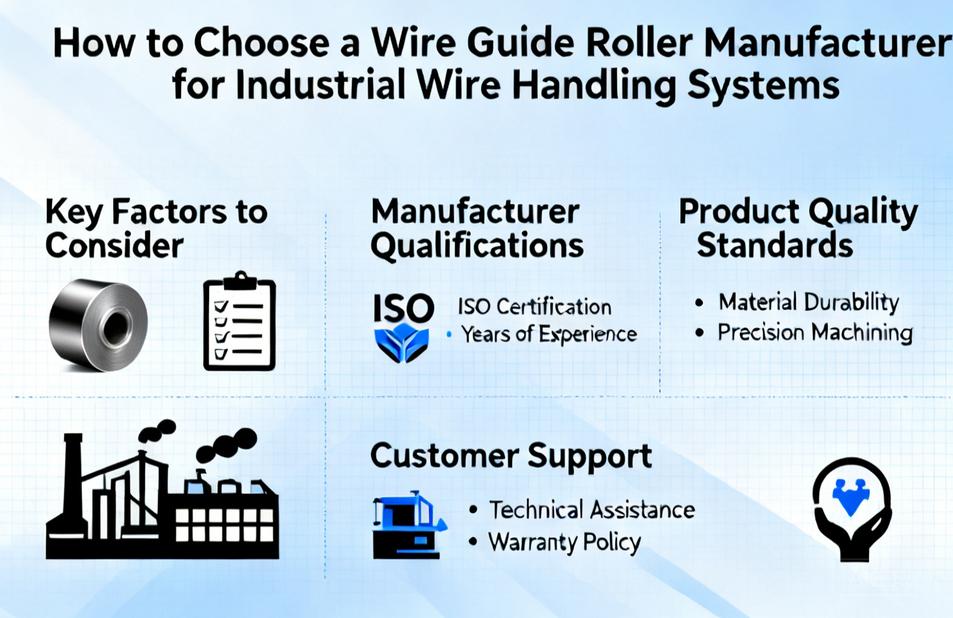
When specifying components for wire drawing, cabling, winding, or automated wire processing equipment, the wire guide roller often determines how smoothly and consistently the entire line performs. A wire guide roller is a rotating component that directs, tensions, or changes the path of wire, cable, or filament without causing abrasion, deformation, or unnecessary drag. Because these rollers are used in continuous production environments, buyers typically look for a wire guide roller manufacturer that understands material selection, surface finish, bearing integration, and application-specific customization rather than simply offering a catalog part.
What a Wire Guide Roller Does in a Production Line
In practical terms, a guide roller acts as a low-friction contact point between moving wire and the surrounding machine structure. It may be used in wire drawing machines, coil winding equipment, cable stranding lines, spring making machines, welding wire feed systems, textile machinery, and automated cutting or stripping stations. The roller keeps the wire aligned, prevents side-to-side wandering, reduces tension spikes, and protects the wire surface from scoring.
Depending on the machine layout, the roller can be a simple idler, a grooved pulley, a flanged roller, or a multi-groove assembly. Some applications require the roller to handle high linear speeds, while others prioritize precise positioning or resistance to chemicals and heat. For this reason, a reputable wire guide roller supplier will usually ask about wire diameter, line speed, load direction, environment, and mounting space before recommending a design.
Key Design and Material Considerations
Roller Body Materials
Common body materials include aluminum alloy, stainless steel, engineering plastics such as POM or PA, and specialized wear-resistant polymers. Aluminum is often chosen when low inertia and good machinability are important. Stainless steel is preferred in wet, corrosive, or high-temperature environments. Plastic or polymer rollers can be useful where the wire surface must not be scratched or where electrical insulation is required.
Surface Finish and Groove Geometry
The contact surface directly affects wire quality. A polished or mirror-finished surface reduces friction and wear. Groove profile, radius, and depth must match the wire or cable diameter to keep the product centered without pinching. For flat wire or ribbon, a cylindrical or slightly crowned surface may be more suitable than a deep V-groove.
Bearing and Mounting Options
Many guide rollers use sealed ball bearings for maintenance-free operation. Others are designed with plain bushings for high-temperature or high-load conditions. Mounting can be through a central shaft, a stud, or a custom bracket. The choice depends on available space, required radial and axial load capacity, and how often the roller needs to be replaced.
Typical Industrial Applications
- Wire drawing and annealing lines
- Cable stranding, taping, and rewinding equipment
- Welding wire feed and pay-off systems
- Spring coiling and wire forming machines
- Textile and fiber processing machinery
- Automated wire cutting, stripping, and crimping stations
- Coil winding and spooling systems for electrical components
Each application has its own priorities. A welding wire feeder may require a roller that minimizes wire deformation, while a cable stranding line may need rollers that withstand high tension and continuous rotation. Sharing these details with a wire guide roller factory helps ensure the final component matches the actual working conditions.
How to Choose the Right Manufacturer or Supplier
Selecting a supplier is not only about finding a low unit price. Procurement teams should evaluate technical communication, manufacturing capability, quality consistency, and responsiveness to customization requests. A reliable manufacturer should be able to review drawings or samples, suggest suitable materials and tolerances, and provide stable production for repeat orders.
Useful questions to ask include: Can the supplier produce rollers according to our drawing or sample? What machining and surface treatment processes are available in-house? How are bearing fits and runout controlled? What is the typical lead time for custom sizes? Can they support OEM branding or private labeling? The answers reveal whether the supplier is a trading company or a manufacturer with direct production control.
Customization and OEM Options
Many industrial buyers need non-standard sizes, specific groove profiles, or special mounting features. A capable wire guide roller manufacturer should offer custom fabrication based on drawings, including diameter, width, bore, groove shape, material, and surface finish. OEM service is also common in this category, where the roller is produced to the buyer’s specification and branded accordingly.
When requesting a custom quote, provide clear information: wire or cable type and diameter, operating speed, load direction, environmental conditions, mounting method, and expected service life. If a sample is available, sending it for reference can reduce misunderstanding. Prototyping or small-batch trial orders are often a practical way to verify fit and performance before committing to volume production.
Buying Considerations for Volume Procurement
For repeat purchasing, consistency matters as much as the initial sample. Buyers should confirm that the supplier has documented inspection steps, stable raw material sources, and the ability to maintain tolerances across batches. Packaging should protect the roller surface and bearing from damage during transport. It is also helpful to clarify whether spare bearings or replacement rollers are available separately.
Price should be evaluated together with material grade, machining accuracy, surface treatment, bearing quality, and after-sales support. A slightly higher unit cost can be justified if it reduces downtime, wire breakage, or premature replacement. For international buyers, communication speed and the ability to handle technical questions in English are practical factors that affect project timelines.
Frequently Asked Questions
What information is needed to quote a custom wire guide roller?
Provide the wire or cable diameter, roller dimensions, groove profile, material preference, mounting details, operating speed, load direction, and environmental conditions. A drawing or sample is very helpful for accurate quoting.
Can a manufacturer produce rollers for both metal wire and cable applications?
Yes. Many suppliers serve both metal wire and cable industries, but the material, surface finish, and groove design may differ. It is important to specify the exact application so the roller is optimized for friction, tension, and wear resistance.
How do I evaluate the quality of a wire guide roller supplier?
Review their manufacturing process, inspection capability, material traceability, sample consistency, and communication responsiveness. Ask for dimensional reports or trial samples when possible, and compare how carefully they address your technical questions.
Is OEM or private labeling available for guide rollers?
Many manufacturers offer OEM and custom branding for qualified projects. Availability depends on order volume, tooling requirements, and the supplier’s production setup. Discuss your branding and packaging needs early in the inquiry.
Conclusion
Choosing the right wire guide roller manufacturer comes down to matching the component to the application and working with a supplier that can support both standard and custom requirements. Focus on material selection, groove geometry, bearing configuration, surface finish, and the supplier’s ability to communicate technically. If you are sourcing guide rollers for wire drawing, cabling, welding, or automated wire handling, contact a manufacturer to discuss your specifications, application details, and OEM or customization needs.
