

Coating Service Overview
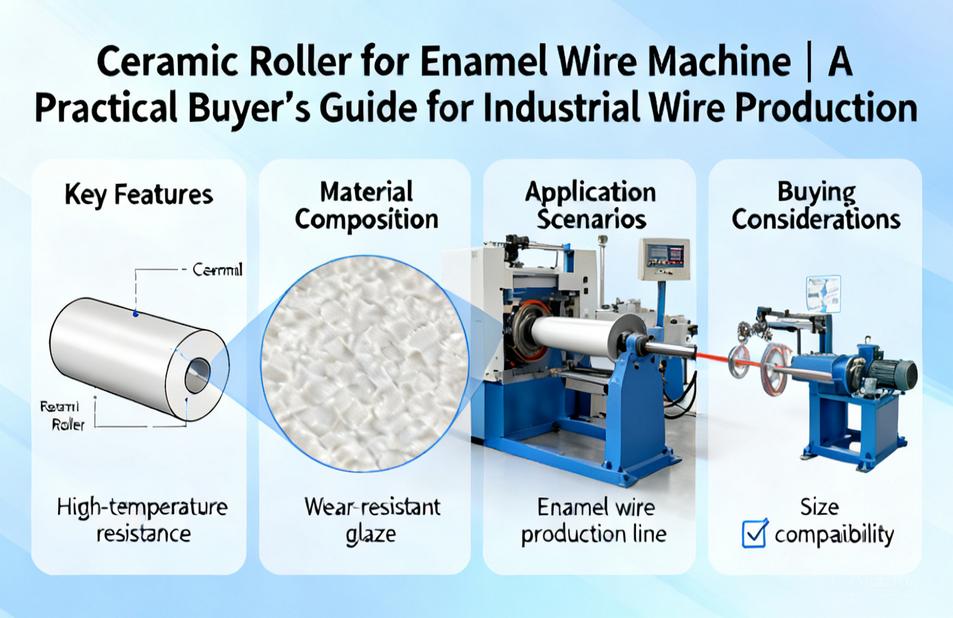
When setting up or upgrading a wire enamelling line, the ceramic roller for enamel wire machine plays a quiet but critical role in guiding the conductor through the coating and curing process. These rollers are used to support, tension, and guide bare or enamelled wire without scratching the insulation, deforming the conductor, or introducing contamination. For overseas buyers, understanding how these ceramic components work, where they are used, and how to specify them correctly can reduce downtime and improve finished wire quality. This guide explains the main selection factors that matter to purchasing teams, maintenance engineers, and OEM project managers.
What Is a Ceramic Roller for Enamel Wire Machine?
A ceramic roller for enamel wire machine is a rotating guide component made from technical ceramic material, typically used in wire drawing, annealing, enamelling, and take-up sections of a wire production line. Unlike metal rollers, ceramic rollers resist wear and reduce the risk of surface damage to fine copper or aluminium wire. The roller surface is usually polished to a low roughness so that the wire glides smoothly with minimal friction. Depending on the machine design, the roller may be a simple cylindrical guide, a grooved pulley, a flanged roller, or a custom-shaped ceramic part mounted on a metal shaft or bearing assembly.
In an enamel wire machine, these rollers help maintain stable wire tension and alignment as the conductor passes through enamel baths, dies, ovens, and cooling zones. Because the wire may travel at high speed and at elevated temperature, the roller material and mounting method must be matched to the machine environment. A poorly chosen roller can cause wire vibration, coating scratches, uneven enamel thickness, or frequent replacement downtime.
Key Functions in Wire Enamelling Lines
Ceramic rollers perform several functions that directly affect production efficiency and product quality. Their primary jobs include:
- Guiding the wire through multiple process stages without lateral drift
- Maintaining consistent tension between dancer rolls, capstans, and take-up spools
- Reducing friction and avoiding metal-to-metal contact that can damage soft conductors
- Resisting abrasion from continuous wire movement and occasional wire breaks
- Providing electrical insulation in certain sections where stray current must be avoided
Because the wire surface is delicate after enamelling, the roller contact area must be smooth and free from chips, pits, or embedded metal particles. This is why many manufacturers specify fine-grained ceramic materials with a high surface finish for critical guide positions.
Materials and Construction
Industrial ceramic rollers are commonly produced from alumina, zirconia, or other technical ceramic grades. Alumina offers good wear resistance and electrical insulation at a relatively economical cost, while zirconia provides higher toughness and is often chosen for high-impact or high-speed positions. The material choice depends on wire diameter, line speed, temperature, and the mechanical load on the roller.
The roller body may be manufactured by dry pressing, isostatic pressing, or injection moulding, followed by sintering and precision grinding. The inner bore, outer diameter, groove profile, and surface finish are usually machined to tight tolerances. Many rollers are supplied with stainless steel shafts, ceramic-coated bearings, or complete pulley assemblies for direct mounting. For custom projects, a ceramic roller manufacturer can produce non-standard dimensions, grooves, chamfers, and mounting features to match existing equipment.
Typical Industrial Applications
Ceramic rollers are used in a variety of wire and cable production environments, including:
- Enamelled copper wire lines for motors, transformers, and inductors
- Fine aluminium wire enamelling and annealing systems
- Wire drawing and intermediate guiding stations
- Magnet wire production with multiple coating passes
- Take-up and pay-off sections where wire must be gently redirected
- Textile, optical fibre, and other fine filament handling equipment
In each application, the roller must be compatible with the wire material, lubricant or enamel chemistry, and operating temperature. For example, a roller used near an enamelling oven may need to withstand radiant heat and thermal cycling, while a roller in a wet drawing section may need resistance to cooling fluids.
How to Choose the Right Ceramic Roller
Selecting a ceramic roller for enamel wire machine use involves more than matching a part number. Buyers should consider several practical factors.
Wire Diameter and Contact Geometry
Fine wire requires a very smooth, small-radius contact surface to avoid stress concentration. Larger conductors may call for a different groove profile or a flatter contact area. The roller diameter, groove width, and edge radius should match the wire path and the machine guide system.
Operating Speed and Load
High-speed lines generate more friction and heat at the contact point. The roller material, bearing type, and balance quality must be suitable for the intended speed range. Excessive vibration can transfer to the wire and affect enamel uniformity.
Temperature and Chemical Exposure
Ceramic rollers are often chosen for their thermal stability and chemical inertness, but not all ceramic grades behave the same way. Buyers should confirm compatibility with enamel solvents, lubricants, and cleaning agents used in the plant.
Surface Finish and Tolerance
A smooth, consistent surface reduces wire scratching and coating defects. Dimensional tolerance is also important for alignment, especially when multiple rollers work together in a guide train. Specifications should be agreed with the supplier before production.
Mounting and Replacement
Consider how the roller will be mounted, whether it uses a plain bore, a shaft, or an integrated bearing assembly. Easy replacement reduces maintenance time and helps keep the enamelling line running.
Customization and OEM Options
Many wire equipment builders and end users require custom ceramic rollers rather than standard catalogue parts. A capable supplier can offer OEM production based on drawings, samples, or machine model information. Customization may include outer diameter, inner bore, groove profile, flange shape, surface roughness, ceramic grade, and shaft assembly. For replacement projects, providing the original roller dimensions, wire diameter, and machine operating conditions helps the factory recommend a suitable design. Buyers should ask about tooling requirements, minimum order quantities, and sample availability before committing to volume production.
Buying Considerations for Overseas Purchasers
When sourcing ceramic rollers from an international supplier, purchasing teams should evaluate technical communication, quality consistency, and documentation. Useful checks include:
- Whether the supplier can review drawings and suggest material grades
- Whether dimensional reports or inspection records can be provided
- Whether samples can be tested on the actual enamelling line
- Whether packaging protects ceramic edges during transport
- Whether the supplier has experience with wire industry applications
It is also wise to discuss spare parts planning. Ceramic rollers are wear components, so maintaining a small inventory of critical sizes can prevent long downtime when a roller becomes chipped or worn.
Supplier Selection Tips
A reliable ceramic roller supplier should understand both ceramic manufacturing and wire enamelling processes. Look for a manufacturer or factory that can discuss guide angles, wire tension, surface finish, and assembly methods in practical terms. If the application is unusual, ask whether the supplier can produce a custom design rather than forcing a standard part into the machine. Clear communication about tolerances, material grade, and inspection criteria helps avoid costly mismatches. For OEM projects, confirm that the supplier can maintain consistency across repeat orders and support future spare parts demand.
Frequently Asked Questions
What is the main advantage of ceramic rollers over metal rollers in enamel wire machines?
Ceramic rollers are harder, smoother, and electrically insulating in many grades. They reduce the risk of scratching delicate enamel coatings and resist wear better than many metal surfaces, which helps maintain wire quality and reduce replacement frequency.
Can ceramic rollers be customized for my existing enamelling line?
Yes. Many manufacturers offer custom and OEM production based on drawings, samples, or machine specifications. Dimensions, groove profiles, ceramic grade, and mounting features can be adapted to match the equipment.
How do I choose the right ceramic material for my application?
The choice depends on wire diameter, line speed, temperature, and mechanical load. Alumina is common for general guide applications, while zirconia may be preferred where higher toughness is needed. The supplier should recommend a grade after reviewing the operating conditions.
What information should I provide when requesting a quotation?
Provide the roller dimensions, wire diameter, machine speed, operating temperature, contact position, and any drawing or sample. This helps the factory quote a suitable ceramic roller and identify whether a standard or custom design is required.
Conclusion
Choosing the right ceramic roller for enamel wire machine applications is a practical decision that affects wire quality, line uptime, and maintenance cost. Buyers should focus on material grade, surface finish, dimensional accuracy, mounting method, and supplier support rather than price alone. For custom or OEM requirements, working with a manufacturer that understands both ceramics and wire enamelling can simplify selection and reduce trial-and-error. If you are reviewing a new roller specification or need a replacement part, contact a qualified supplier with your drawings, wire details, and machine conditions to discuss suitable options.
