Aerospace
The aerospace industry represents one of the most demanding fields in …
The aerospace industry represents one of the most demanding fields in advanced manufacturing, requiring exceptional material performance, precision machining, and long-term operational reliability.
Aircraft engines, landing gear systems, hydraulic components, transmission parts, combustion chamber components, spacecraft structures, sealing systems, and high-temperature components often operate under extreme conditions, including high temperatures, high-speed movement, heavy loads, friction, oxidation, corrosion, thermal shock, and complex mechanical stress.
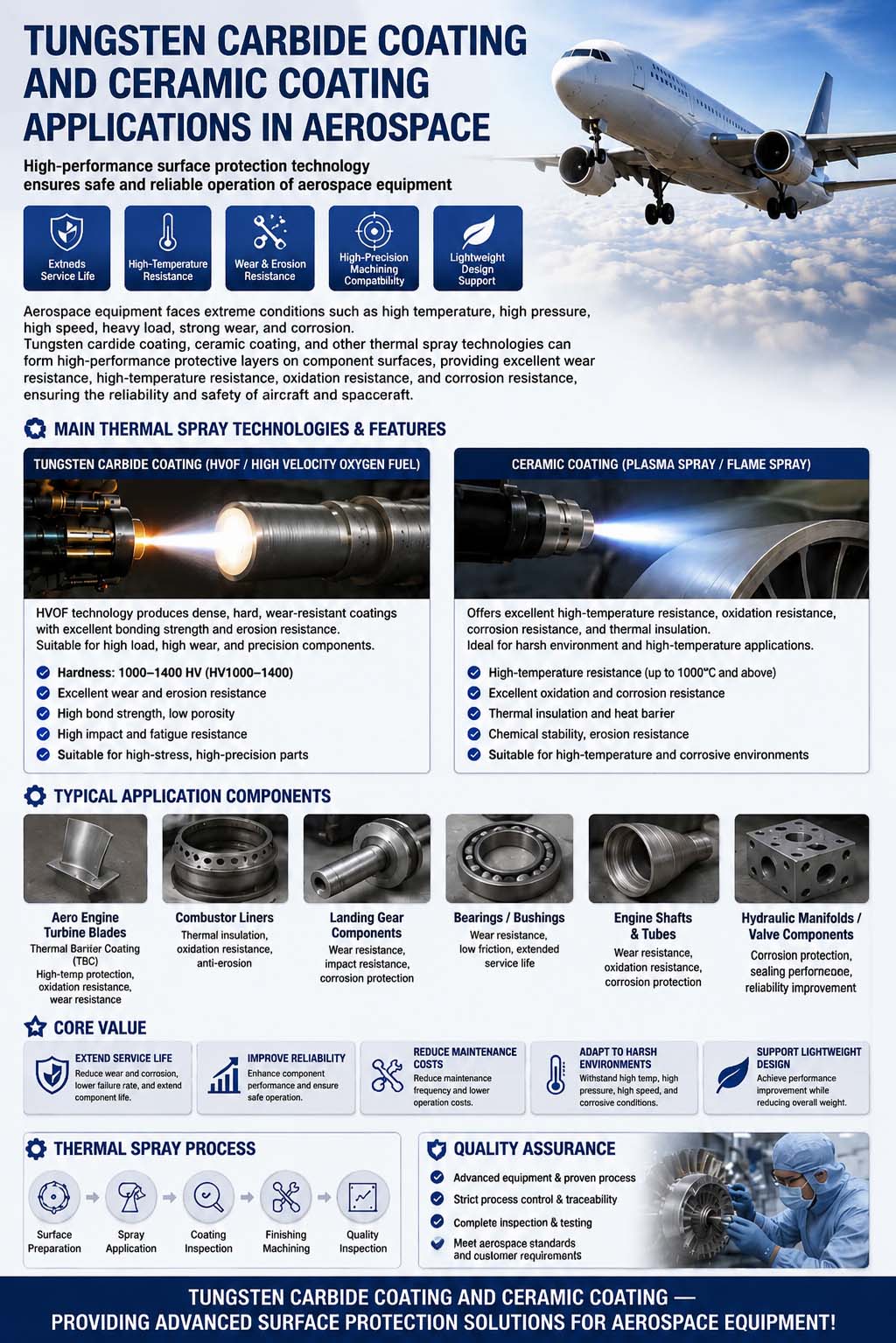
For these critical aerospace components, surface damage such as wear, corrosion, erosion, fatigue cracking, or dimensional failure can significantly affect equipment reliability, service life, and safety.
Advanced surface engineering technologies, including tungsten carbide coatings, ceramic coatings, HVOF coatings, plasma spraying, thermal spray processing, wear-resistant coatings, high-temperature coatings, corrosion-resistant coatings, and thermal barrier coatings, provide effective solutions for improving component performance.
By applying functional coatings to component surfaces, thermal spray technology enhances:
- Wear resistance
- High-temperature resistance
- Corrosion protection
- Oxidation resistance
- Erosion resistance
- Surface durability
without changing the basic structure of the substrate material.
Why Aerospace Components Need Thermal Spray Coatings
Aerospace components face much more demanding environments compared with conventional industrial equipment.
Aircraft and spacecraft parts must withstand:
- Extreme temperatures
- High-speed airflow
- Repeated mechanical loads
- Fuel and hydraulic fluids
- Salt spray corrosion
- Thermal cycling
- Vacuum environments
For example, aircraft engine hot-section components operate under high-temperature combustion gases and may suffer from thermal fatigue, oxidation, and particle erosion.
Landing gear systems, shafts, and transmission components experience friction, impact loads, and corrosion.
Hydraulic components such as piston rods, valve spools, and sealing surfaces require excellent hardness, dimensional accuracy, and wear resistance.
Traditional materials often cannot provide all required properties simultaneously. Thermal spray technology solves this challenge by separating structural and functional requirements:
- The substrate provides strength and lightweight structure.
- The coating provides wear resistance, thermal protection, corrosion resistance, or insulation performance.
This combination allows aerospace manufacturers to achieve higher performance and longer component life.
Tungsten Carbide Coatings for Aerospace Wear Protection
Tungsten carbide coating is one of the most widely used high-performance wear-resistant coating technologies in aerospace applications.
Usually applied through HVOF (High Velocity Oxygen Fuel) spraying, tungsten carbide particles are accelerated at extremely high speeds onto component surfaces, creating a dense coating with excellent bonding strength and hardness.
Key advantages include:
- Outstanding wear resistance
- Excellent scratch resistance
- Strong erosion resistance
- High surface hardness
- Good dimensional stability
- Long service life under friction conditions
Typical aerospace applications include:
- Aircraft landing gear components
- Hydraulic piston rods
- Shafts and rotating parts
- Bushings
- Valve spools and sleeves
- Bearing contact surfaces
- Sealing areas
- Transmission components
- Guide components
After coating application, precision grinding and polishing can further improve surface finish and dimensional accuracy.
Tungsten Carbide Coatings for Aerospace Repair and Remanufacturing
In aerospace maintenance and remanufacturing, tungsten carbide coatings provide an effective method for restoring worn components.
High-value parts such as shafts, sealing surfaces, and moving components may experience dimensional loss after long-term operation.
Through:
- Surface preparation
- Thermal spray coating
- Precision machining
- Final inspection
the original dimensions and surface performance can be restored.
Compared with replacing expensive aerospace components, thermal spray repair can significantly reduce maintenance costs and extend service life.
Ceramic Coatings for Aerospace High-Temperature Protection
Ceramic coatings are another important surface protection technology used in aerospace engineering.
Common ceramic coating materials include:
- Aluminum oxide (Al₂O₃)
- Chromium oxide (Cr₂O₃)
- Zirconium oxide (ZrO₂)
- Yttria-stabilized zirconia (YSZ)
Applied through processes such as plasma spraying, ceramic coatings provide excellent:
- High-temperature resistance
- Thermal insulation
- Oxidation resistance
- Corrosion protection
- Electrical insulation
- Thermal shock resistance
Ceramic Thermal Barrier Coatings for Aircraft Engines
One of the most important applications of ceramic coatings is thermal barrier coating (TBC) technology.
Aircraft engine turbine components and combustion chamber parts operate under extremely high temperatures.
Without protection, metal substrates may experience:
- Oxidation
- Thermal fatigue
- Material degradation
- Reduced mechanical strength
Ceramic thermal barrier coatings create a protective insulation layer that reduces heat transfer into the substrate.
Benefits include:
- Lower component temperature
- Improved engine efficiency
- Extended service life
- Enhanced operational reliability
Typical applications include:
- Turbine components
- Combustion chambers
- Guide vanes
- Fuel nozzles
- Heat shield structures
- Exhaust system components
Typical Aerospace Applications of Thermal Spray Coatings
1. Aircraft Engine Components
Aircraft engines require protection against:
- Extreme temperatures
- Thermal shock
- Oxidation
- Gas erosion
Ceramic coatings are mainly used for thermal barrier and high-temperature protection.
For components exposed to wear and erosion, tungsten carbide or metal-ceramic coatings may provide additional surface protection.
2. Landing Gear Systems
Landing gear components experience:
- Heavy impact loads
- Sliding friction
- Hydraulic movement
- Environmental corrosion
Tungsten carbide coatings improve:
- Surface hardness
- Wear resistance
- Scratch resistance
- Dimensional stability
They are widely used for shafts, sliding surfaces, bushings, and sealing areas.
3. Hydraulic Systems and Precision Components
Aerospace hydraulic systems require extremely high precision and reliability.
Thermal spray coatings are used on:
- Hydraulic piston rods
- Valve components
- Pump shafts
- Plungers
- Sealing surfaces
Tungsten carbide coatings reduce wear and maintain dimensional accuracy.
Ceramic coatings can provide additional corrosion resistance and insulation performance.
4. Shafts and Transmission Components
High-speed rotating components require excellent wear resistance and surface stability.
Tungsten carbide coatings help protect:
- Drive shafts
- Support shafts
- Bearing contact surfaces
- Guide sleeves
Ceramic coatings can also be used where thermal protection or insulation is required.
Choosing Between Tungsten Carbide and Ceramic Coatings
The correct coating selection depends on the operating environment and failure mechanism.
Tungsten Carbide Coatings Are Suitable For:
- Sliding wear
- Abrasion
- Impact wear
- Friction damage
- Dimensional restoration
Typical applications:
- Landing gear parts
- Hydraulic rods
- Shafts
- Valve components
- Wear surfaces
Ceramic Coatings Are Suitable For:
- High temperatures
- Oxidation
- Thermal shock
- Heat insulation
- Electrical insulation
Typical applications:
- Engine hot-section components
- Combustion chambers
- Heat shields
- High-temperature structures
For components exposed to multiple challenges, such as high temperature combined with wear and corrosion, multi-layer coating systems may be required.
Aerospace Thermal Spray Quality Control
Aerospace coating applications require strict quality control throughout the entire process.
Surface Preparation
Before spraying, components require:
- Cleaning
- Degreasing
- Abrasive blasting
- Surface protection
- Preheating when necessary
Proper preparation directly affects coating adhesion and service life.
Material Selection
Coating materials must match actual operating conditions.
Factors include:
- Temperature
- Load
- Wear mechanism
- Corrosion environment
- Surface requirements
Process Control
Important thermal spray parameters include:
- Spray distance
- Temperature
- Particle velocity
- Powder feeding rate
- Gas flow
- Coating thickness
These factors influence:
- Coating density
- Porosity
- Bond strength
- Surface quality
Inspection
Common inspection methods include:
- Coating thickness measurement
- Bond strength testing
- Hardness testing
- Microstructure analysis
- Surface roughness measurement
For critical aerospace components, strict testing and process verification are essential.
Selecting an Aerospace Thermal Spray Coating Supplier
A reliable aerospace coating manufacturer should have:
Advanced Equipment Capability
Including:
- HVOF coating systems
- Plasma spraying equipment
- Precision thermal spray technology
Precision Machining Capability
Aerospace parts often require:
- Grinding
- Polishing
- Precision finishing
- Dimensional inspection
Integrated coating and machining capability ensures better quality control.
Customized Engineering Solutions
Professional suppliers should provide coating solutions based on:
- Component drawings
- Materials
- Operating conditions
- Performance requirements
Strong Quality Management
A complete quality system ensures:
- Stable production
- Material traceability
- Consistent coating performance
- Reliable delivery
Conclusion
Tungsten carbide coatings and ceramic coatings play an essential role in aerospace manufacturing, maintenance, and remanufacturing.
Tungsten carbide coatings provide excellent wear resistance, erosion protection, and dimensional restoration for components such as:
- Landing gear systems
- Hydraulic rods
- Shafts
- Valve components
- Transmission parts
Ceramic coatings provide outstanding thermal protection, oxidation resistance, insulation, and high-temperature performance for:
- Aircraft engines
- Combustion chambers
- Thermal protection structures
- High-temperature aerospace components
By selecting the correct thermal spray solution, aerospace manufacturers can improve:
- Component service life
- Equipment reliability
- Maintenance efficiency
- Operating cost control
With the continuous development of aerospace technology toward higher performance, longer life, lighter structures, and improved reliability, advanced surface technologies such as HVOF coatings, tungsten carbide coatings, ceramic coatings, thermal barrier coatings, and wear-resistant coatings will continue to play a critical role in next-generation aerospace manufacturing.