Construction Materials & Power
In industries such as building materials, power generation, metallurgy…
In industries such as building materials, power generation, metallurgy, mining, chemical processing, and machinery manufacturing, equipment often operates under extremely harsh conditions, including heavy loads, severe wear, high temperatures, dust erosion, and corrosive environments.
Key components such as conveyor rollers, fan impellers, grinding equipment, boiler pipelines, valve sealing surfaces, pump sleeves, and flue gas treatment equipment are constantly exposed to abrasion, corrosion, oxidation, erosion, and fatigue damage. Once critical parts fail, companies may face production interruptions, unexpected maintenance, replacement costs, and reduced operational efficiency.
To solve these problems, advanced surface engineering technologies such as tungsten carbide coating, ceramic coating, HVOF coating, plasma spraying, thermal spray coating, wear resistant coating, corrosion resistant coating, and high temperature protective coating are increasingly used in industrial equipment protection.
By applying high-performance coatings onto metal surfaces, components can achieve improved wear resistance, corrosion resistance, oxidation resistance, high-temperature stability, and erosion protection, significantly extending service life and reducing maintenance requirements.
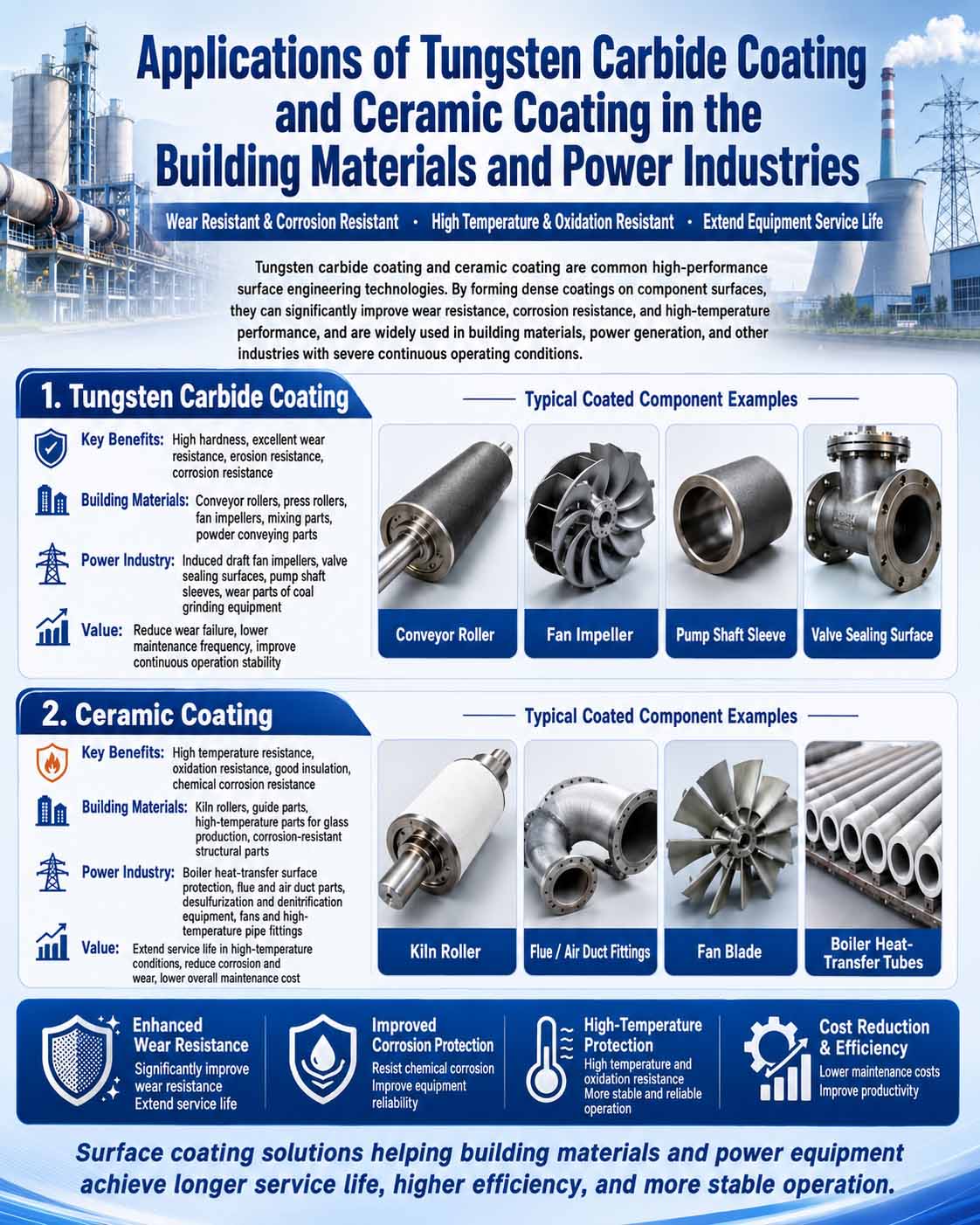
What Is Tungsten Carbide Coating?
Tungsten carbide coating is one of the most widely used surface treatment technologies for improving wear resistance. It is commonly applied through High Velocity Oxygen Fuel (HVOF) spraying, where tungsten carbide-based powders are accelerated at high speed onto the surface of components, forming a dense coating with excellent bonding strength and hardness.
Tungsten carbide coatings provide:
- Extremely high hardness
- Excellent wear resistance
- Strong erosion resistance
- Dense surface structure
- Stable friction performance
They are especially suitable for components exposed to abrasive wear, sliding wear, particle impact, and mechanical friction.
In the building materials industry, equipment used for cement, sand, ceramics, glass, gypsum, and mineral processing frequently suffers from severe wear caused by continuous contact with abrasive materials.
Typical applications include:
- Conveyor rollers
- Press rollers
- Guide wheels
- Support rollers
- Fan impellers
- Grinding components
- Mixing blades
- Screw conveyor parts
Applying tungsten carbide coating creates a protective wear-resistant layer on the component surface, allowing equipment to maintain stable performance under high-abrasion conditions.
In the power industry, tungsten carbide coatings are widely applied to:
- Fan impellers
- Valve sealing surfaces
- Pump shafts
- Shaft sleeves
- Guide components
- Sealing rings
- Wear-resistant parts
These coatings help reduce erosion, surface damage, leakage problems, and performance degradation caused by long-term operation.
What Is Ceramic Coating?
Ceramic coating is a thermal spray technology that applies ceramic materials such as aluminum oxide, chromium oxide, zirconia, and titanium oxide onto metal surfaces.
Compared with traditional metal coatings, ceramic coatings offer outstanding advantages in:
- High-temperature resistance
- Corrosion resistance
- Oxidation resistance
- Electrical insulation
- Chemical stability
- Anti-stick performance
Ceramic coatings are widely used in environments involving extreme temperatures, chemical corrosion, and special surface requirements.
In the building materials industry, ceramic coatings are commonly used for:
- Kiln rollers
- Heat-resistant components
- Glass production equipment
- Ceramic manufacturing equipment
- Thermal processing parts
- Guide components
- Molds
Many production environments involve not only wear but also high temperatures, dust, and chemical gases. Ceramic coatings provide a protective barrier that reduces oxidation, corrosion, and thermal fatigue.
In power plants, ceramic coatings are widely applied to:
- Boiler components
- Flue gas pipelines
- Desulfurization and denitrification equipment
- High-temperature ducts
- Corrosion-resistant pump and valve parts
Especially in environments containing sulfur, chlorine, dust, and high-temperature gases, ceramic coatings provide reliable long-term surface protection.
Why Do Building Material Industries Need Thermal Spray Coatings?
The building materials industry relies heavily on continuous production. Unexpected equipment failures can lead to significant economic losses.
Production lines for cement, aggregates, glass, ceramics, gypsum boards, and mineral powders often involve:
- High material hardness
- Large amounts of dust
- Strong particle impact
- Continuous friction
Traditional repair methods such as welding or replacing parts may involve long downtime, high costs, and limited durability.
Thermal spray technologies provide a more efficient solution by creating functional surface layers without changing the original structure of components.
For example:
- Tungsten carbide coatings are suitable for highly abrasive components such as rollers, pulleys, guide wheels, and fan blades.
- Ceramic coatings are suitable for high-temperature equipment such as kiln rollers and heat-resistant parts.
- Composite coatings can be designed for conditions involving combined wear, corrosion, and heat.
Commonly coated components include:
- Conveyor rollers
- Press rollers
- Support rollers
- Tower pulleys
- Guide wheels
- Fan impellers
- Mixing blades
- Screw conveyors
- Wear plates
- Sealing rings
- Molds
- Kiln accessories
Why Does the Power Industry Require Surface Coating Technology?
Power generation equipment often operates under demanding conditions involving:
- High temperature
- High-speed airflow
- Dust erosion
- Chemical corrosion
- Continuous operation
Critical equipment such as boilers, fans, pumps, valves, pipelines, and flue gas treatment systems must maintain high reliability.
Different components face different failure mechanisms:
- Fan blades suffer from particle erosion.
- Valve sealing surfaces experience wear and corrosion.
- Pump shafts and sleeves suffer from mechanical wear and chemical attack.
- Boiler components face oxidation and high-temperature corrosion.
Tungsten carbide coatings improve wear and erosion resistance for:
- Fan impellers
- Valve components
- Pump shafts
- Shaft sleeves
- Wear rings
Ceramic coatings provide protection for:
- Boiler parts
- Flue gas systems
- High-temperature pipelines
- Corrosion-resistant components
Together, these technologies improve equipment reliability and reduce maintenance costs.
Typical Applications of Tungsten Carbide Coating
1. Wear Protection for Rollers
Conveyor rollers, support rollers, and press rollers in cement and mineral processing plants often suffer from surface wear and dimensional changes.
Tungsten carbide coating improves:
- Surface hardness
- Wear resistance
- Running stability
- Service life
2. Anti-Erosion Coating for Fan Impellers
Industrial fans transporting dusty gases experience continuous particle impact.
Tungsten carbide coatings help prevent:
- Blade thinning
- Surface erosion
- Balance problems
- Efficiency loss
3. Valve Sealing Surface Protection
Industrial valves require reliable sealing performance.
Tungsten carbide coatings improve:
- Surface hardness
- Wear resistance
- Sealing reliability
- Operating life
4. Pump Shaft and Sleeve Repair
Pump components often fail due to wear and corrosion.
Thermal spray repair can restore dimensions while improving surface durability.
Typical Applications of Ceramic Coating
1. High Temperature Kiln Components
Ceramic coatings are widely used for:
- Kiln rollers
- Heat-resistant parts
- Thermal processing equipment
They improve oxidation resistance and high-temperature stability.
2. Corrosion Protection for Flue Gas Systems
Ceramic coatings protect:
- Flue gas pipelines
- Desulfurization equipment
- Chemical-resistant components
They reduce corrosion caused by aggressive gases.
3. Boiler High Temperature Protection
Ceramic coatings act as protective barriers against:
- Oxidation
- Thermal degradation
- High-temperature corrosion
How to Choose Between Tungsten Carbide Coating and Ceramic Coating?
The selection depends on actual operating conditions.
Choose tungsten carbide coating when components mainly experience:
- Abrasive wear
- Particle erosion
- Mechanical friction
- Sliding wear
Typical applications:
- Rollers
- Fan blades
- Valve sealing surfaces
- Shafts
- Guide wheels
Choose ceramic coating when components require:
- High-temperature resistance
- Corrosion protection
- Electrical insulation
- Chemical stability
Typical applications:
- Kiln equipment
- Boiler components
- Flue gas systems
- High-temperature pipelines
For complex environments involving wear, corrosion, and heat simultaneously, customized coating systems or multi-layer coatings may be required.
Professional thermal spray manufacturers can design solutions based on:
- Operating temperature
- Material type
- Load conditions
- Wear mechanism
- Corrosion environment
- Surface requirements
Benefits of Thermal Spray Coating Technology
For industrial companies, surface coating technology provides long-term economic value.
Extended Component Service Life
Instead of replacing expensive components, thermal spray coating can restore worn parts and improve performance.
Reduced Maintenance Costs
Wear-resistant and corrosion-resistant coatings reduce unexpected failures and downtime.
Improved Equipment Reliability
Protective coatings help maintain surface accuracy, sealing performance, and operational stability.
Customized Surface Solutions
Thermal spraying can be tailored for different materials, dimensions, and industrial applications.
Choosing a Professional Thermal Spray Coating Manufacturer
A reliable coating supplier should have:
Advanced Coating Technologies
Including:
- HVOF coating
- Plasma spraying
- Arc spraying
- Flame spraying
Engineering Capability
A professional manufacturer should provide solutions based on actual working conditions rather than simply recommending materials.
Complete Processing Ability
Important capabilities include:
- Surface preparation
- Coating application
- Grinding
- Polishing
- Dimensional restoration
- Quality inspection
Fast Response and Custom Service
For industries with continuous production requirements, fast repair and customized coating solutions are essential.
Conclusion
With increasing demands for longer equipment life, lower maintenance costs, and higher production efficiency, tungsten carbide coating, ceramic coating, HVOF coating, and thermal spray technologies are becoming essential solutions for industrial equipment protection.
In the building materials industry, wear-resistant coatings protect rollers, fan components, conveyors, and kiln equipment. In the power industry, protective coatings improve the reliability of fans, pumps, valves, boilers, and flue gas systems.
By selecting the right coating technology, companies can reduce downtime, improve equipment performance, extend component service life, and achieve more stable and efficient industrial operations.