

Oil & Gas
The oil and gas industry involves extremely demanding operating enviro…
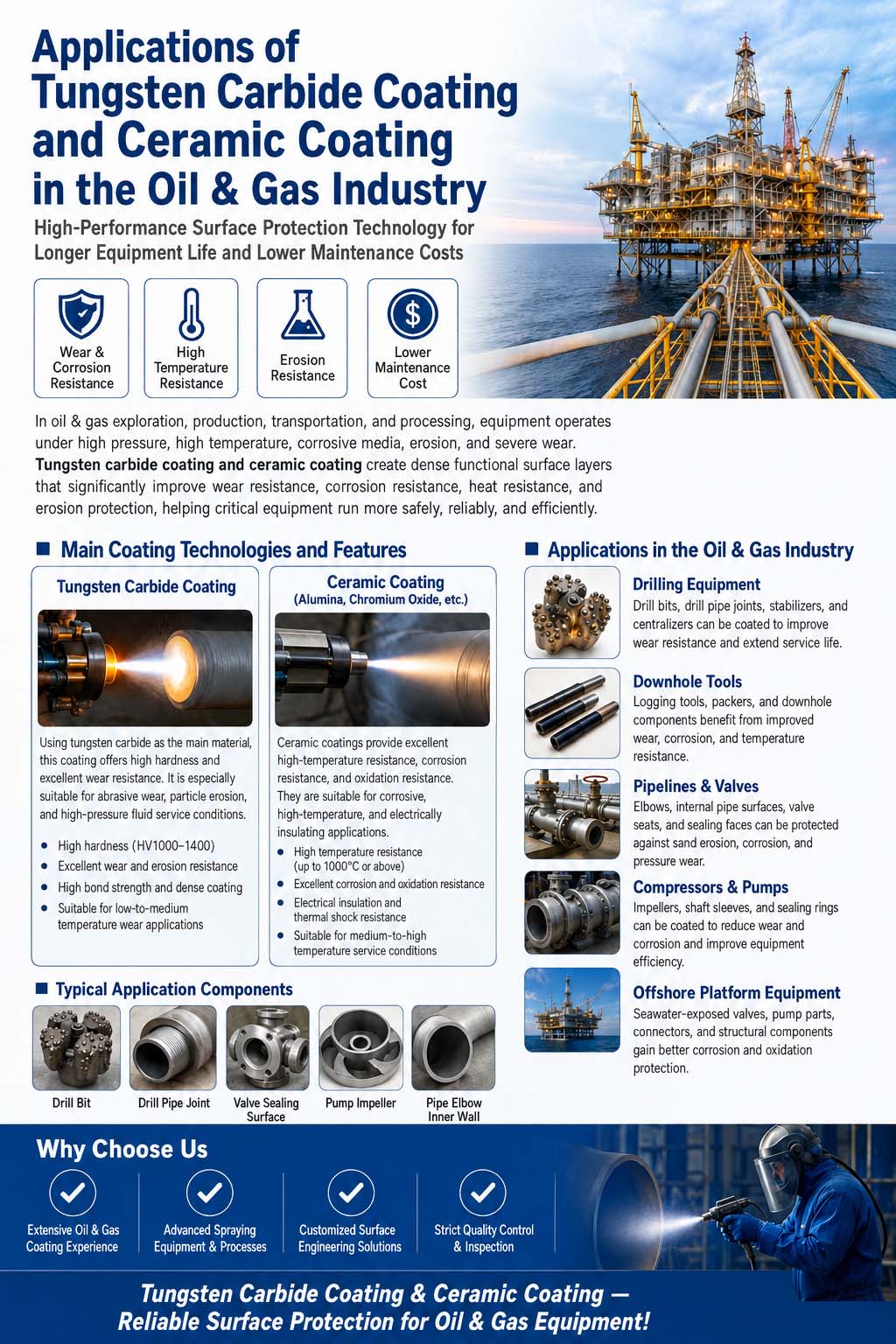
The oil and gas industry involves extremely demanding operating environments, from exploration and drilling to production, transportation, refining, offshore platforms, and natural gas processing. Equipment is often exposed to high pressure, high temperature, severe corrosion, erosion, abrasion, and continuous mechanical stress.
Critical components such as drilling tools, valves, pumps, compressors, pipelines, sealing parts, and offshore equipment frequently suffer from:
- Abrasive wear
- Corrosion damage
- Particle erosion
- High-temperature oxidation
- Seal failure
- Surface fatigue
These failures can increase maintenance frequency, cause unexpected downtime, reduce production efficiency, and even affect operational safety.
To improve equipment reliability, advanced surface engineering technologies such as tungsten carbide coating, ceramic coating, HVOF coating, plasma spraying, thermal spray coating, wear resistant coating, corrosion resistant coating, and high-temperature protective coating are increasingly applied in oil and gas equipment manufacturing, repair, and upgrading.
By applying high-performance coatings to component surfaces, companies can significantly improve:
- Wear resistance
- Corrosion resistance
- Erosion resistance
- Heat resistance
- Service life
without changing the original structure of expensive components.
Why Does the Oil & Gas Industry Need Surface Coating Technology?
In many oil and gas applications, equipment failure does not occur because the entire component loses strength. Instead, surface damage usually happens first.
During operation, equipment surfaces may directly contact:
- Drilling mud
- Sand particles
- Crude oil and gas media
- Salt water
- Acid gases
- Sulfur-containing environments
- High-temperature fluids
Long-term exposure can cause:
- Surface scratches
- Pitting corrosion
- Coating failure
- Dimensional loss
- Leakage
- Seal damage
For example:
During drilling operations, drill bits, stabilizers, drill pipe connections, and mud pump components experience continuous erosion from rock particles and drilling fluids.
During oil and gas production, valves, sealing surfaces, choke components, and downhole tools are exposed to high-pressure fluid flow and corrosive media.
During transportation, pipelines, elbows, pump components, impellers, and compressor parts suffer from erosion, particle impact, and chemical corrosion.
Offshore platforms face additional challenges, including seawater, salt spray, humidity, and harsh weather conditions.
Traditional solutions such as replacing expensive alloy components can increase costs and downtime. Thermal spray technology provides a more efficient alternative by strengthening only the damaged or high-risk surface area.
The main benefits include:
- Improving wear resistance
- Reducing corrosion damage
- Protecting against high-speed fluid erosion
- Extending component service life
- Reducing maintenance and replacement costs
Advantages of Tungsten Carbide Coating in Oil & Gas Applications
Tungsten carbide coating is one of the most effective wear-resistant surface treatment technologies used in oil and gas equipment.
It is commonly applied through High Velocity Oxygen Fuel (HVOF) spraying, where tungsten carbide powder is accelerated at extremely high speed onto the metal substrate, forming a dense coating with:
- High hardness
- Strong bonding strength
- Excellent wear resistance
- Superior erosion resistance
- Low porosity
Tungsten carbide coatings are particularly suitable for components exposed to:
- Sand erosion
- Drilling mud abrasion
- Sliding wear
- Particle impact
- High-pressure fluid erosion
Typical Applications of Tungsten Carbide Coating
1. Drilling Equipment and Downhole Tools
Drilling tools operate under extremely harsh conditions. Components such as:
- Drill bits
- Drill pipe connections
- Stabilizers
- Centralizers
- Mud pump plungers
- Valve seats
are continuously exposed to abrasive particles and high-pressure fluids.
Tungsten carbide coating improves surface hardness and wear resistance, reducing material loss and extending service intervals.
2. Valves and Sealing Components
Valves are critical control components in oil and gas systems, including:
- Wellhead equipment
- Pipeline systems
- Natural gas processing plants
- Offshore platforms
- Refining facilities
Valve sealing surfaces often suffer from erosion and corrosion, causing leakage and operational instability.
Tungsten carbide coating can be applied to:
- Ball valves
- Valve seats
- Valve stems
- Gate valves
- Choke valves
- Sealing rings
The coating improves resistance to abrasion, erosion, and mechanical damage, increasing valve reliability in high-pressure environments.
3. Pumps, Compressors and Rotating Equipment
Oil and gas pumps and compressors operate continuously at high speeds.
Components such as:
- Pump shafts
- Shaft sleeves
- Impellers
- Mechanical seals
- Compressor parts
- Rotors
are exposed to friction, erosion, and corrosion.
Tungsten carbide coatings help maintain dimensional stability, reduce wear, and improve equipment performance.
4. Pipeline and Internal Surface Protection
Oil and gas pipelines often experience erosion at:
- Elbows
- Valves
- Flow control areas
- High-speed fluid zones
When fluids contain sand, water, sulfur, or corrosive chemicals, erosion and corrosion can occur simultaneously.
Tungsten carbide coatings provide effective protection against abrasive flow and particle erosion.
Ceramic coatings can also be used where higher corrosion resistance and chemical stability are required.
Advantages of Ceramic Coating in Oil & Gas Applications
Ceramic coating uses thermal spray technologies such as plasma spraying and flame spraying to apply materials including:
- Aluminum oxide
- Chromium oxide
- Zirconia
- Titanium oxide
onto metal surfaces.
Compared with tungsten carbide coatings, ceramic coatings provide stronger advantages in:
- High-temperature resistance
- Corrosion protection
- Chemical stability
- Oxidation resistance
- Electrical insulation
Typical Ceramic Coating Applications
Ceramic coatings are widely used in:
- High-temperature pipelines
- Corrosion-resistant pump components
- Insulation parts
- Natural gas processing equipment
- Refining equipment
- Offshore platform components
- Chemical processing systems
In environments containing sulfur, chlorine, acidic gases, chemicals, or high-temperature fluids, ceramic coatings create a protective barrier that reduces direct contact between corrosive media and the metal substrate.
Ceramic coatings are also suitable for electrical insulation applications, where metal components require a stable insulating protective layer.
Tungsten Carbide Coating vs Ceramic Coating: How to Choose?
The correct coating solution depends on actual working conditions.
Choose Tungsten Carbide Coating When:
The component mainly experiences:
- Severe abrasion
- Sand erosion
- Mechanical friction
- Particle impact
- High-pressure fluid erosion
Typical applications:
- Drilling tools
- Valve sealing surfaces
- Pump shafts
- Shaft sleeves
- Mechanical seals
- Wear-resistant components
Choose Ceramic Coating When:
The component mainly requires:
- Corrosion resistance
- High-temperature protection
- Oxidation resistance
- Electrical insulation
- Chemical stability
Typical applications:
- High-temperature pipes
- Corrosive fluid equipment
- Gas processing systems
- Refining components
- Offshore equipment
Composite Coating Solutions
Many oil and gas applications involve multiple challenges, such as:
- Wear + corrosion
- High temperature + erosion
- Chemical attack + mechanical stress
In these cases, customized coating systems may combine different materials and technologies.
Professional thermal spray manufacturers evaluate:
- Component material
- Operating temperature
- Pressure conditions
- Fluid characteristics
- Wear mechanism
- Required surface finish
before selecting the appropriate coating solution.
Key Value of Thermal Spray Technology in Oil & Gas
For oil and gas companies, thermal spray coating provides much more than surface protection.
1. Extend Component Service Life
High-performance coatings reduce wear and corrosion, allowing expensive components to operate longer.
2. Reduce Downtime and Maintenance Costs
Protective coatings reduce unexpected failures and decrease replacement frequency.
3. Improve Equipment Reliability
Stable surface performance helps reduce:
- Leakage
- Vibration
- Clearance changes
- Efficiency loss
4. Support Repair and Remanufacturing
Many oil and gas components suffer only surface damage.
Thermal spray repair can:
- Restore dimensions
- Improve surface properties
- Extend component life
- Reduce replacement costs
5. Enable Customized Solutions
Oil and gas equipment includes many non-standard components.
Thermal spray processing can be customized according to:
- Engineering drawings
- Samples
- Material requirements
- Operating conditions
Common Coating Materials and Technologies
Typical coating materials used in oil and gas applications include:
- Tungsten carbide-based powders
- Aluminum oxide ceramics
- Chromium oxide ceramics
- Zirconia ceramics
- Nickel-based alloys
- Metal-ceramic composite powders
HVOF Spraying
HVOF coating is widely used for tungsten carbide coatings because it provides:
- High coating density
- Strong bonding strength
- Low porosity
- Excellent wear resistance
Plasma Spraying
Plasma spraying is commonly used for ceramic coatings such as:
- Aluminum oxide
- Chromium oxide
- Zirconia
providing excellent heat resistance and corrosion protection.
How to Choose a Professional Oil & Gas Coating Manufacturer?
When selecting a tungsten carbide coating supplier, ceramic coating manufacturer, or thermal spray service provider, companies should focus on:
Advanced Equipment and Process Capability
A qualified supplier should have stable spraying equipment and mature process control to ensure:
- Uniform coating thickness
- Strong bonding
- Accurate surface finish
Engineering Experience
Professional manufacturers should analyze:
- Wear conditions
- Corrosion environment
- Temperature
- Pressure
- Material compatibility
before recommending a coating solution.
Machining and Inspection Capability
A complete service provider should offer:
- Surface preparation
- Thermal spraying
- Grinding
- Polishing
- Precision machining
- Quality inspection
Fast Response and Technical Support
Oil and gas operations often have strict maintenance schedules. Suppliers with fast delivery, customization capability, and technical support provide greater long-term value.
Conclusion: Improving Oil & Gas Equipment Reliability Through Advanced Surface Coatings
Oil and gas equipment operates under some of the most challenging industrial conditions. Surface wear, corrosion, and erosion are major factors affecting equipment reliability and operating costs.
Tungsten carbide coating provides excellent protection against abrasion, erosion, and mechanical wear, making it ideal for drilling tools, valves, pumps, shafts, seals, and high-wear components.
Ceramic coating offers outstanding corrosion resistance, high-temperature protection, oxidation resistance, and insulation performance, making it suitable for pipelines, processing equipment, offshore systems, and high-temperature applications.
By selecting the right thermal spray coating solution, oil and gas companies can:
- Extend equipment service life
- Reduce maintenance costs
- Improve operational safety
- Increase production efficiency
With the continuous development of oil and gas equipment toward higher efficiency, longer service life, and lower maintenance requirements, technologies such as HVOF coating, tungsten carbide coating, ceramic coating, wear resistant coating, and corrosion resistant coating will continue to play an important role in equipment manufacturing, repair, and performance enhancement.
