

Coating Service Overview
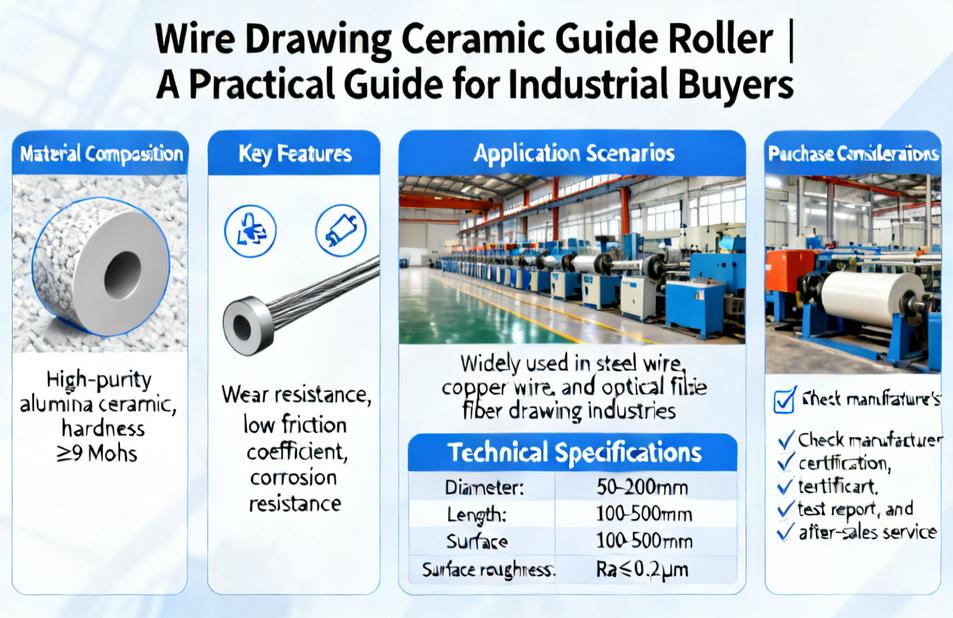
A wire drawing ceramic guide roller is a precision ceramic component used to guide, support, and align wire as it travels through drawing machines, annealing lines, coating equipment, and related wire processing systems. Unlike steel or plastic rollers, ceramic guide rollers are chosen for their ability to resist abrasion, reduce friction, and maintain a smooth surface over long production runs. For manufacturers and procurement teams sourcing wire drawing accessories, understanding how these rollers work, where they are used, and what to evaluate before ordering is essential for reducing downtime and maintaining consistent wire quality.
What Does a Wire Drawing Ceramic Guide Roller Do?
In wire drawing, metal wire is pulled through a series of dies to reduce its diameter. Between and around these dies, guide rollers control the wire path, prevent lateral movement, and minimize contact damage. A ceramic guide roller typically consists of a ceramic ring or disc mounted on a metal core, bearing, or shaft. The ceramic surface contacts the wire directly, while the core provides structural support and mounting compatibility.
Because wire drawing involves continuous motion and tension, the guide roller must handle constant contact without scratching the wire surface. Ceramic materials such as alumina (Al2O3) and zirconia (ZrO2) are common choices because they offer high hardness and wear resistance. This makes them suitable for drawing copper, aluminum, steel, stainless steel, and alloy wires.
Key Features Buyers Look For
When evaluating ceramic guide rollers for wire drawing equipment, several performance features matter to production and maintenance teams.
- Wear resistance: Ceramic surfaces resist grooving and flattening better than many metal alternatives, which helps maintain a consistent wire path.
- Low friction: A smooth ceramic contact surface reduces drag on the wire, which can help lower tension fluctuations.
- Chemical stability: Ceramic rollers are often used in environments where lubricants, coolants, or cleaning agents are present.
- Surface finish: A polished contact surface helps prevent marks, scratches, or micro-damage on drawn wire.
- Dimensional consistency: Consistent bore, outer diameter, and groove geometry support reliable replacement and alignment.
Materials and Construction
Most wire drawing ceramic guide rollers use one of two ceramic families: alumina and zirconia. Alumina rollers are widely used for general wire guiding because of their hardness and cost-effectiveness. Zirconia rollers offer higher toughness and are often selected for applications where impact resistance or thermal shock resistance is a concern. Some suppliers also offer silicon nitride or other advanced ceramics for specialized conditions.
The ceramic ring is usually assembled onto a metal core, which may be made from steel, stainless steel, or aluminum. The core can include a bearing, a plain bore, or a custom mounting configuration. The bonding method between ceramic and core also affects performance. Common approaches include shrink fitting, adhesive bonding, and mechanical locking. Each method has trade-offs in terms of temperature resistance, concentricity, and service life.
Industrial Applications
Wire drawing ceramic guide rollers appear in many wire and cable processing environments. Typical industrial applications include:
- Wire drawing machines for copper, aluminum, and steel wire
- Annealing and tinning lines
- Cable stranding and bunching equipment
- Wire coating and enameling systems
- Textile and fiber production where fine thread guidance is required
- Welding wire production and spooling
In each case, the roller must match the wire diameter, line speed, tension, and environmental conditions. A roller that works well for fine copper wire may not be suitable for larger steel wire or high-temperature annealing lines.
How to Choose the Right Ceramic Guide Roller
Selecting a wire drawing ceramic guide roller involves more than matching a part number. Buyers should consider the following factors:
Wire Material and Diameter
The wire material affects friction, wear, and the risk of surface damage. Harder wires may require tougher ceramic grades, while softer wires benefit from a very smooth contact surface. Wire diameter influences groove size and roller dimensions.
Machine Compatibility
Mounting style, bore size, outer diameter, width, and bearing type must match the drawing machine or guide system. In many cases, the original equipment manufacturer (OEM) drawing or sample is needed to ensure proper fit.
Operating Conditions
Line speed, tension, temperature, and the presence of lubricants or coolants all affect roller performance. High-speed lines may require dynamically balanced rollers, while high-temperature processes may require ceramic-to-core assembly methods that tolerate thermal expansion.
Surface Finish and Groove Geometry
The contact surface should be free of chips, cracks, or rough spots. Groove profile, radius, and depth should match the wire and guiding requirements. Custom groove profiles are often available from specialized suppliers.
Customization and OEM Options
Many wire drawing ceramic guide roller manufacturers and suppliers offer OEM and custom production. Customization can include specific outer diameters, bore sizes, groove profiles, ceramic materials, core materials, and mounting configurations. Buyers may also request special surface finishes, edge radii, or marking.
When requesting a custom roller, provide drawings, samples, or detailed specifications. This helps the factory confirm feasibility, tolerances, and production method. For replacement parts, sharing the original roller dimensions and application details can shorten the quoting process.
Buying Considerations
Before placing an order, procurement teams should clarify several points with the supplier:
- Ceramic material grade and relevant properties
- Core material and assembly method
- Dimensional tolerances and concentricity requirements
- Surface finish and inspection criteria
- Packaging method to prevent damage during transport
- Order quantity and whether custom or OEM production is available
It is also practical to request samples for trial runs when the application is critical. A trial can reveal whether the roller reduces wire damage, maintains alignment, and performs well under actual line conditions.
Supplier Selection Tips
Choosing a reliable supplier is as important as choosing the right roller. Look for a manufacturer or factory with experience in ceramic components for wire and cable equipment. A supplier that understands drawing machines, wire materials, and guide systems can often recommend suitable ceramic grades and geometries.
Ask about production capabilities, quality control measures, and communication processes. A supplier that responds clearly to technical questions and provides consistent documentation is usually easier to work with over the long term. For buyers sourcing from overseas, confirming packaging standards and shipping methods can help avoid breakage and delays.
Frequently Asked Questions
What is the difference between an alumina and zirconia guide roller?
Alumina rollers generally offer high hardness and wear resistance at a lower cost, while zirconia rollers provide higher toughness and better resistance to impact and thermal shock. The right choice depends on wire material, line speed, and operating temperature.
Can ceramic guide rollers be customized for my drawing machine?
Yes. Many suppliers offer custom and OEM production based on drawings, samples, or specific dimensions. Custom options can include material, groove profile, bore size, core type, and mounting configuration.
How do I know if a ceramic guide roller is suitable for my wire?
Consider wire material, diameter, tension, and line speed. A smooth, properly sized groove helps prevent scratching and misalignment. When possible, test a sample under actual production conditions before committing to a large order.
What information should I provide when requesting a quote?
Provide roller dimensions, wire type and diameter, machine details, operating conditions, and any drawings or samples. This helps the manufacturer recommend a suitable ceramic grade and configuration.
Conclusion
Selecting the right wire drawing ceramic guide roller comes down to matching material, dimensions, and surface quality to your wire and machine conditions. Buyers should evaluate wear resistance, friction, mounting compatibility, and customization options before ordering. Working with an experienced manufacturer or supplier that supports OEM and custom production can simplify sourcing and help maintain consistent wire quality. If you have specific dimensions, application details, or customization requirements, contact a qualified ceramic roller supplier to discuss your needs.
