

Coating Service Overview
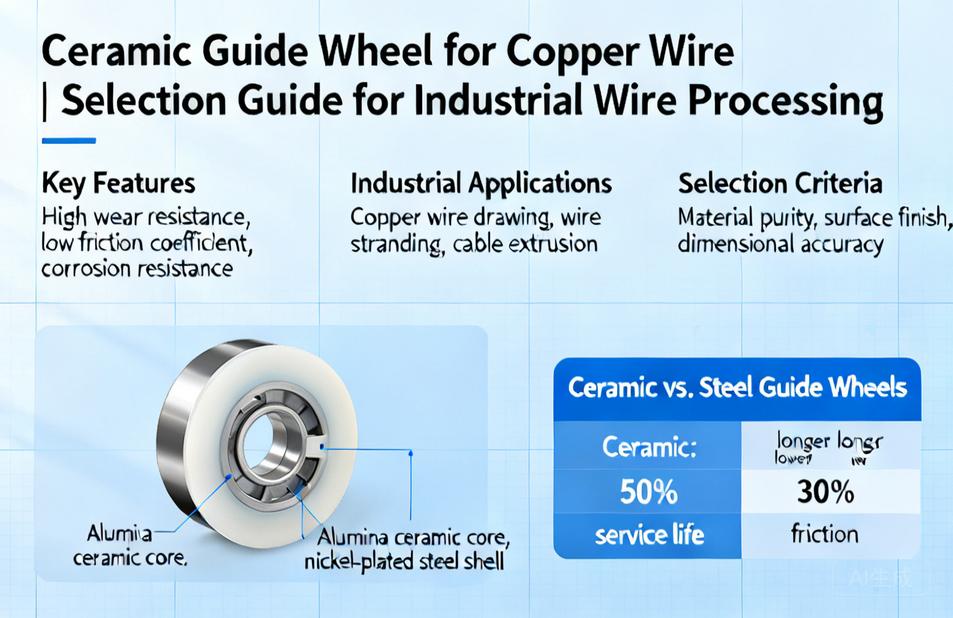
A ceramic guide wheel for copper wire is a precision wire contact component used to guide, tension, and redirect copper conductors through drawing, annealing, stranding, winding, and coating equipment. Unlike metal pulleys that can scratch soft copper or wear quickly under continuous sliding contact, ceramic guide wheels provide a hard, smooth, and electrically insulating surface that helps maintain wire surface quality and stable wire path geometry in high-speed production lines. For overseas buyers sourcing wire processing accessories, understanding the material options, groove design, mounting configuration, and customization possibilities is essential before requesting quotations from a manufacturer or supplier.
What Is a Ceramic Guide Wheel for Copper Wire?
In copper wire production, the wire travels at high speed across many contact points. Each contact point can introduce friction, heat, and surface damage. A ceramic guide wheel is a rotating or fixed pulley made with an engineered ceramic working surface, often mounted on a metal hub or bearing assembly. Its primary function is to keep the copper wire aligned while minimizing wear on both the wire and the guide itself. Because ceramics are non-conductive, these wheels are also used in applications where electrical isolation between the wire and machine frame is required, such as in certain annealing or plating lines.
The term ceramic guide wheel for copper wire covers several configurations, including grooved pulleys, flanged idler wheels, V-groove guides, U-groove rollers, and ceramic-coated metal wheels. The right choice depends on wire diameter, line speed, tension level, and the specific machine station where the wheel is installed.
Why Ceramic Is Preferred Over Metal or Plastic
Copper is a soft metal. When it rubs against hardened steel or aluminum guides, fine copper particles can transfer to the guide surface, creating a buildup that eventually damages the wire. Ceramic materials resist this adhesion and retain a polished surface much longer. Compared with plastic guides, ceramics offer better dimensional stability at elevated temperatures and greater resistance to wear from continuous wire contact.
Key performance characteristics of ceramic guide wheels include:
- High surface hardness that resists grooving and flattening
- Low friction coefficient to reduce drag and wire tension fluctuation
- Electrical insulation for isolated wire paths
- Chemical stability against many lubricants, coolants, and cleaning agents
- Thermal resistance suitable for hot wire processes
These properties make ceramic wheels a practical choice in fine wire drawing, enameling, and multi-wire stranding where surface defects are costly.
Common Ceramic Materials and Construction
Industrial ceramic guide wheels are typically produced from alumina (Al2O3), zirconia (ZrO2), or silicon nitride (Si3N4). Alumina offers good wear resistance and cost efficiency for general wire guiding. Zirconia provides higher toughness and a smoother surface, which can be beneficial for very fine copper wire. Silicon nitride is selected for demanding high-speed or high-load conditions where thermal shock resistance matters.
Construction usually combines a ceramic ring or ceramic insert with a metal core, shaft, or bearing. Some designs use a full ceramic body for maximum insulation and chemical resistance. The groove profile is precision ground and polished to a specific radius and surface finish. A poorly finished groove can abrade the copper surface, so buyers should ask the supplier about groove geometry, surface roughness, and concentricity tolerances rather than focusing only on the ceramic material grade.
Typical Industrial Applications
Ceramic guide wheels for copper wire appear in many stages of wire and cable manufacturing:
- Wire drawing machines, where the wire passes through multiple dies and capstans
- Annealing systems, where electrical insulation and heat resistance are useful
- Bunching and stranding equipment, where multiple wires must be guided without cross-contact damage
- Enameling and coating lines, where smooth guidance protects the insulation layer
- Coil winding and spooling machines, where consistent tension supports uniform package formation
- Wire cutting and stripping stations, where precise wire positioning affects cut quality
Other applications include magnet wire production, automotive wire harness manufacturing, and specialty cable assembly. In each case, the guide wheel is a small but critical part of the wire path.
How to Choose the Right Guide Wheel
Selecting a ceramic guide wheel for copper wire requires matching the component to the machine and process. Buyers should gather the following information before contacting a factory or supplier:
Wire diameter and range
The groove size must accommodate the wire diameter without pinching or allowing excessive lateral movement. If the machine runs multiple wire sizes, a wheel with a compatible groove profile and sufficient clearance may be needed.
Line speed and tension
Higher speeds and tensions increase friction and heat. The wheel’s bearing type, balance quality, and ceramic surface finish become more important under these conditions.
Mounting and space limits
Check shaft diameter, bore size, overall width, flange dimensions, and available clearance. A replacement wheel that does not fit the existing bracket can stop production.
Environmental factors
Consider temperature, lubricant exposure, cleaning methods, and whether electrical isolation is required. These factors influence material choice and sealing options.
Wear and maintenance expectations
Ask how the supplier defines wear limits and whether the wheel can be reworked or must be replaced. This affects long-term operating cost.
Customization and OEM Options
Many wire processing machines use non-standard guide wheels, so customization is common in this product category. A qualified manufacturer can produce custom groove profiles, outer diameters, bore sizes, flange shapes, and mounting features based on drawings or samples. OEM production may include private labeling, custom packaging, and batch-specific dimensional control.
When requesting a custom ceramic guide wheel, provide detailed drawings or physical samples, specify the copper wire diameter and machine model, and clarify the required surface finish and tolerance. If the application involves high speed or fine wire, mention this early so the supplier can recommend an appropriate ceramic grade and bearing arrangement.
Buying Considerations for Overseas Purchasers
Price should not be the only factor when sourcing ceramic guide wheels. Evaluate the supplier’s ability to control groove concentricity, surface roughness, and material consistency. Request dimensional reports or inspection records if available. Confirm packaging suitable for international shipping to prevent chipping or cracking. For repeat orders, discuss batch traceability and lead time planning.
It is also useful to compare total cost of ownership. A lower-priced wheel that wears quickly or damages copper wire can create scrap and downtime costs that far exceed the initial savings. Buyers should ask about expected wear life under their specific operating conditions, while recognizing that actual life depends on many variables.
How to Evaluate a Ceramic Guide Wheel Supplier
Look for a supplier with experience in wire industry components rather than a general ceramic parts trader. Ask about their production process, quality control steps, and ability to support custom and OEM projects. A responsive manufacturer should be able to review your drawing, ask relevant technical questions, and propose a suitable configuration. If possible, request references from similar wire processing applications, but verify them independently.
Communication matters. A supplier who understands wire drawing, stranding, and winding terminology can help avoid misalignment between the ordered part and the actual machine requirement. This is especially important for custom guide wheels where small dimensional differences affect performance.
Frequently Asked Questions
What is the difference between an alumina and zirconia guide wheel for copper wire?
Alumina is generally more economical and offers good wear resistance for many standard wire guiding applications. Zirconia has higher toughness and can provide a smoother surface, which may be preferred for fine copper wire or applications where surface finish is critical. The best choice depends on wire diameter, speed, and budget.
Can ceramic guide wheels be used on existing metal pulley brackets?
In many cases, yes, if the bore size, width, and mounting method match the bracket. However, ceramic wheels may have different weight and tolerances than the original metal pulley. Provide the bracket dimensions and shaft size to the supplier so they can confirm compatibility or recommend an adapter.
Are custom groove profiles available?
Yes. Many manufacturers offer custom groove profiles based on drawings or samples. Customization can include groove radius, V or U shape, flange height, and surface finish. Buyers should supply clear specifications and wire diameter information.
How do I know when a ceramic guide wheel needs replacement?
Inspect the groove for wear, flat spots, cracks, or surface roughness that could damage the copper wire. Increased wire tension fluctuation, surface scratches, or visible groove enlargement are common signs. Replacement intervals depend on line speed, tension, and wire type.
Conclusion
Choosing the right ceramic guide wheel for copper wire is a matter of matching material, groove geometry, mounting dimensions, and operating conditions to the specific wire processing machine. Buyers should prioritize dimensional accuracy, surface finish, and supplier experience over price alone. If you are working on a new line, replacing worn guides, or developing a custom wire path component, contact a qualified manufacturer or supplier with your drawings, wire specifications, and application details. They can help you select a standard model or discuss OEM and custom production options that fit your equipment and production goals.
