

Coating Service Overview
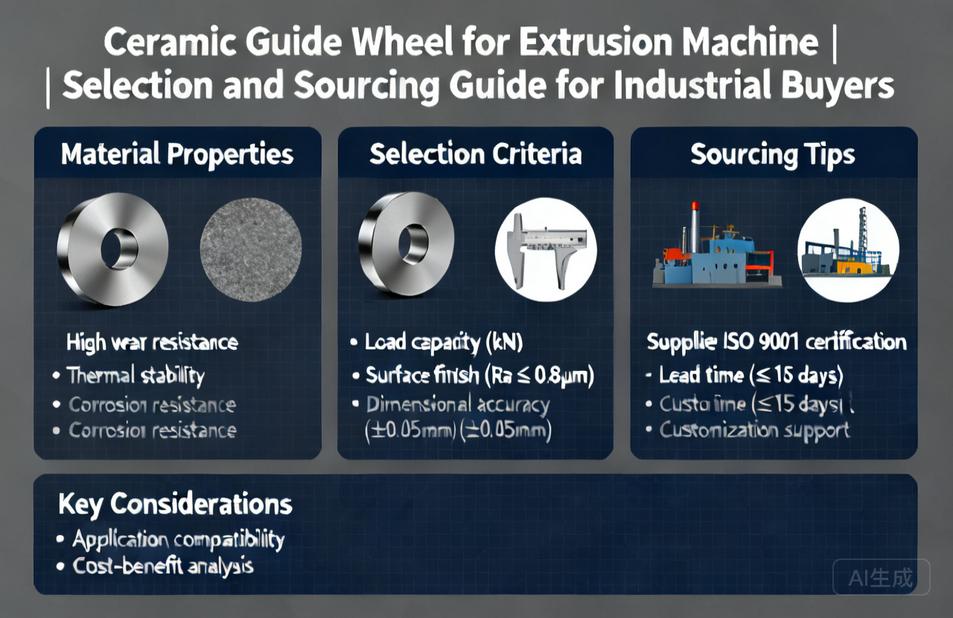
A ceramic guide wheel for extrusion machine is a precision wear part used to guide, support, or tension wire, cable, tube, profile, or filament as it exits the extrusion die and moves through cooling, haul-off, and winding stages. Unlike metal guide wheels, ceramic guide wheels are made from engineered ceramic materials that resist abrasion, reduce friction, and help maintain a stable product path without introducing scratches or metallic contamination. For overseas buyers sourcing components for wire and cable extrusion lines, plastic profile extrusion, or fiber production, understanding how these wheels work and how to specify them is essential for reducing downtime and improving product consistency.
What a Ceramic Guide Wheel Does in an Extrusion Line
In most extrusion processes, the freshly formed product is soft and dimensionally sensitive immediately after leaving the die. Any contact point must minimize friction and avoid marking the surface. A ceramic guide wheel provides a low-friction contact surface that helps keep the extrudate aligned with the next stage of the line. Common positions include:
- Between the die head and the cooling trough, where the wheel maintains a straight path
- At the entrance and exit of water or air cooling sections
- Before and after haul-off units, where tension control is critical
- On accumulators, dancers, and winding stations for wire, cable, and flexible profiles
Because the wheel does not conduct heat as readily as some metals and does not gall or cold-weld to soft polymers, it is often chosen for high-speed lines and for products with visible surfaces.
Key Features Buyers Look For
When evaluating a ceramic guide wheel for extrusion machine applications, purchasing teams and maintenance engineers typically focus on several practical features. These include the wheel geometry, the bearing or bushing arrangement, the surface finish of the groove, and the overall balance of the assembly. A well-made guide wheel should run smoothly at line speed, resist lateral loads, and maintain its groove profile over time.
Other important characteristics include low wear rate, resistance to many common lubricants and cooling water additives, and the ability to operate without generating particles that could contaminate the product. For clean-room or medical extrusion, non-marking and low-particle behavior can be especially important. Buyers should also consider whether the wheel will be used in a fixed guide position or in a tension-sensing application, since the mounting and bearing design differ.
Materials and Construction
Ceramic guide wheels are commonly produced from alumina, zirconia, or silicon-based ceramics, depending on the required combination of hardness, toughness, and wear resistance. The ceramic ring is usually mounted on a metal hub or bearing assembly. The groove may be V-shaped, U-shaped, or flat, and its dimensions must match the product diameter and the line layout.
Manufacturing quality depends on the ceramic forming and finishing process. Grinding and polishing of the groove affect friction and product contact. The concentricity between the ceramic ring and the bearing bore influences runout, which in turn affects guiding accuracy. A reliable factory should be able to control these tolerances and provide inspection information without disclosing confidential process details.
Typical Industrial Applications
The use of ceramic guide wheels extends beyond simple wire extrusion. Common industrial applications include:
- Wire and cable extrusion, including insulation and jacketing lines
- Plastic profile and pipe extrusion where surface quality matters
- Fiber and filament production, including textile and composite yarns
- Medical tubing extrusion, where contamination control is important
- 3D printing filament lines and specialty coating processes
In each case, the guide wheel helps maintain a consistent path and reduces the chance of surface damage or tension variation that could affect downstream dimensions.
How to Choose the Right Guide Wheel
Choosing a ceramic guide wheel for extrusion machine duty requires matching the wheel to the product and the machine, not simply selecting a catalog number. Buyers should start by defining the product type, diameter range, line speed, and the amount of tension or side load the wheel will see. The groove shape should support the product without pinching it or allowing it to ride up the sidewall.
Next, consider the bearing or bushing system. Sealed bearings can help exclude dust and water in wet cooling sections, while open or shielded designs may be suitable for dry environments. The mounting method, whether a simple shaft, a bracket, or a tension arm, determines the required hub configuration.
Finally, review the operating environment. Cooling water chemistry, cleaning agents, and ambient temperature can influence the choice of ceramic grade and bearing materials. If the line runs at high speed, dynamic balance and low runout become more important. Documenting these requirements before contacting a supplier reduces back-and-forth and helps ensure the delivered part fits the application.
Customization and OEM Options
Many extrusion lines use non-standard guide wheel sizes or groove profiles, so customization is often necessary. A ceramic guide wheel manufacturer or supplier may offer OEM production based on customer drawings, samples, or measured dimensions. Typical custom options include outer diameter, bore size, groove profile, ceramic material grade, bearing type, and hub material.
For buyers working with an existing machine, providing a sample or a detailed drawing is usually the most reliable path. If the original part is worn, it may still be possible to measure the groove and mounting features and produce a replacement. Custom packaging and labeling can also be discussed for distributors and OEM machine builders.
Buying Considerations and Supplier Selection
Price should not be the only factor when sourcing ceramic guide wheels. Because these parts affect product quality and line uptime, consistency and dimensional accuracy matter more than a small unit cost difference. Buyers should ask about the factory’s production process, quality control methods, and ability to handle repeat orders with the same specifications.
When evaluating a potential supplier, consider whether they understand extrusion equipment and can recommend a suitable groove profile or bearing arrangement. A supplier with experience in industrial ceramic parts may be better positioned to solve application problems than a general trading company. Requesting samples for trial runs is a practical way to verify performance before committing to volume orders.
It is also useful to clarify documentation expectations, such as dimensional reports or material descriptions, and to confirm whether the supplier can support ongoing supply as your extrusion line expands or changes product mix.
Frequently Asked Questions
How do I know which ceramic material is right for my extrusion line?
The choice depends on the product being extruded, line speed, and the operating environment. Alumina is often used for general wear resistance, while zirconia may be considered where higher toughness is needed. Discussing the application with a ceramic guide wheel supplier helps narrow the options without over-specifying.
Can ceramic guide wheels be customized to replace worn metal wheels?
Yes, many manufacturers offer custom and OEM production. A sample or accurate drawing of the existing wheel allows the supplier to match the groove, bore, and mounting features so the replacement fits the machine.
What should I check when receiving ceramic guide wheels?
Inspect dimensions, groove profile, surface condition, and runout. Verify that the bearing or bushing turns freely and that the mounting features match the drawing. If the wheels are for a critical line, a trial run before full production is recommended.
Are ceramic guide wheels suitable for wet cooling sections?
They can be used in wet environments when the bearing system is selected accordingly. Sealed or protected bearings help prevent water and debris ingress, but the specific cooling water chemistry and cleaning routine should be reviewed with the supplier.
Conclusion
Selecting the right ceramic guide wheel for an extrusion machine comes down to matching the wheel to the product, the line speed, and the operating environment. Buyers should focus on groove geometry, bearing design, material grade, and supplier consistency rather than unit price alone. Whether you need a standard replacement or a custom OEM part, working with a supplier who understands extrusion applications can reduce trial and error. To discuss specifications, samples, or customization for your extrusion line, contact a ceramic guide wheel manufacturer or supplier with your application details and drawings.
