

Coating Service Overview
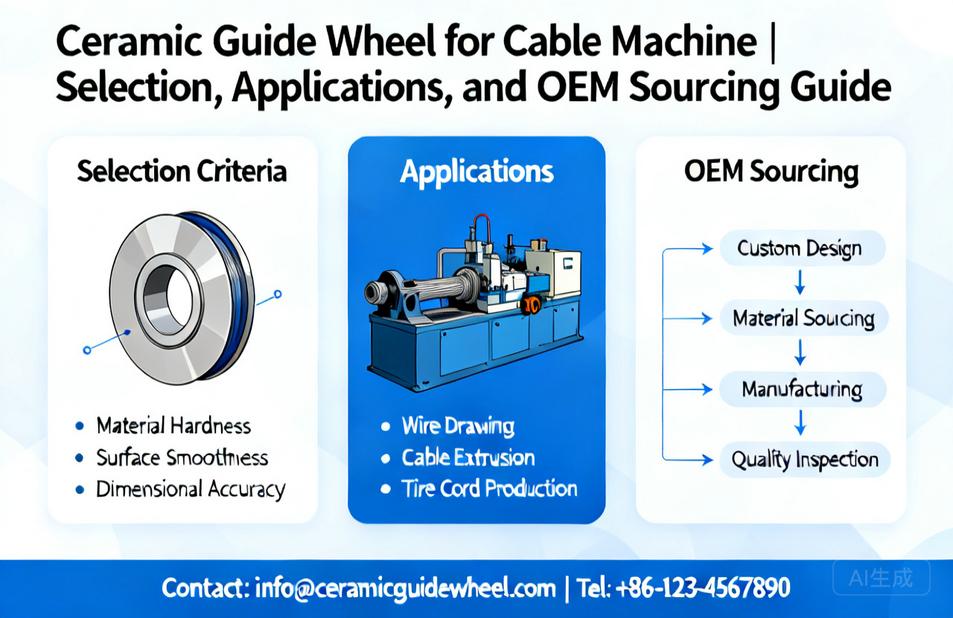
A ceramic guide wheel for cable machine is a precision-engineered component used to guide, tension, and protect cable, wire, and fiber during winding, stranding, extrusion, or take-up operations. Unlike metal pulleys that may wear, corrode, or scratch sensitive conductors, ceramic guide wheels offer a smooth, hard, and electrically insulating contact surface. Procurement teams searching for a reliable ceramic guide wheel for cable machine often need to balance wear life, cable surface protection, machine compatibility, and OEM customization. This guide explains how ceramic guide wheels work, where they are used, what to evaluate before purchasing, and how to work with a qualified manufacturer or supplier.
What Is a Ceramic Guide Wheel for Cable Machine?
A ceramic guide wheel is a rotating or fixed wheel with a ceramic contact surface, typically mounted on a shaft, bracket, or bearing assembly. In cable machinery, it redirects or supports moving cable without introducing damage. The ceramic element is usually an engineered oxide ceramic or similar hard, wear-resistant material selected for low friction and electrical insulation. Depending on the machine design, the wheel may be a full ceramic disc, a ceramic-coated metal wheel, or a ceramic insert ring pressed into a metal hub. The guide wheel may be grooved, flat, or flanged to match the cable diameter and travel path.
How a Ceramic Guide Wheel Works in Cable Equipment
Cable moves through a machine under tension. Every contact point influences surface quality, dimensional stability, and downstream electrical performance. A ceramic guide wheel provides a hard, polished surface that reduces friction and limits abrasion on insulation, shielding, or bare conductor. Because ceramics are electrically non-conductive, the wheel can also isolate the cable from stray currents in certain machine configurations. The wheel may rotate on a bearing to follow cable speed, or it may be fixed when the application requires a stationary guide surface. Proper alignment and smooth rotation are essential to avoid cable drift, edge wear, or tension fluctuation.
Key Features Buyers Look For
- High surface hardness for extended wear life in continuous production
- Low friction to reduce cable drag and motor load
- Electrical insulation properties for sensitive cable and wire processes
- Corrosion resistance in humid or chemically exposed plant environments
- Smooth surface finish to protect insulation, shielding, and conductor surfaces
- Custom groove profiles, diameters, and mounting configurations
Materials and Construction
The ceramic portion is commonly made from advanced technical ceramics chosen for hardness, chemical stability, and thermal resistance. The wheel body may be all-ceramic or a ceramic ring assembled into a metal hub. Bearing selection matters: sealed bearings suit dusty environments, while open or shielded bearings may be used where speed and low drag are priorities. Shaft material, tolerance, and balancing also affect performance. A manufacturer with ceramic machining capability can control roundness, surface roughness, and groove geometry, which directly influence cable tracking and wear.
Typical Industrial Applications
Ceramic guide wheels appear in many cable and wire handling processes, including:
- Wire drawing and annealing lines
- Cable stranding and bunching machines
- Extrusion and sheathing lines
- Coiling, spooling, and take-up equipment
- Optical fiber and data cable production
- Enamelled wire and fine conductor handling
- Robotic cable management and automated wire processing
In these applications, the guide wheel protects product quality and reduces downtime caused by worn or contaminated contact surfaces.
How to Choose the Right Guide Wheel
Selection starts with the cable or wire being processed. Consider conductor diameter, insulation type, line speed, tension range, and ambient temperature. The wheel groove should match the cable profile to provide stable tracking without pinching. Bearing type should suit speed and contamination levels. Mounting dimensions must match the machine bracket or shaft. If the cable is sensitive to surface marks, a fine surface finish and correct groove radius become more important. Buyers should also consider whether the wheel will be used in a stationary guide position or as a rotating pulley, because this changes bearing and balance requirements.
Customization and OEM Options
Many cable machine builders and end users require custom guide wheels rather than catalog items. A capable supplier can offer OEM and custom production based on drawings, samples, or application details. Customization may include outer diameter, bore size, groove shape, flange design, ceramic grade, bearing type, and mounting hardware. For OEM projects, early supplier involvement helps confirm tolerances and assembly method before production. When requesting a quote, provide cable type, speed, load, environment, and interface dimensions so the manufacturer can propose a suitable configuration.
Buying Considerations for Procurement Teams
Price alone is a poor indicator of total cost. A low-cost wheel that wears quickly or damages cable can increase scrap and downtime. Evaluate the supplier’s process control, ceramic quality, dimensional inspection, and ability to repeat orders consistently. Ask about packaging to prevent chipping during transport, since ceramic components can be damaged by impact. For international buyers, clarify documentation, labeling, and spare parts availability. If the application involves high speed or continuous operation, request samples for trial evaluation under real production conditions.
How to Select a Reliable Manufacturer or Supplier
Look for a factory with experience in ceramic machining and cable industry components. Review their technical communication, drawing review process, and quality control methods. A good supplier will ask about cable diameter, speed, tension, and machine interface rather than only quoting a size. Confirm whether they support OEM and custom orders, and whether they can provide material recommendations based on the application. Visit or audit the production site if volume justifies it, and start with a trial order to verify fit, finish, and wear performance.
Frequently Asked Questions
What cable types are suitable for ceramic guide wheels?
Ceramic guide wheels are used with many cable and wire types, including power cable, data cable, optical fiber, enamelled wire, and fine conductors. Suitability depends on cable diameter, insulation material, tension, and line speed. The groove profile and surface finish should be matched to the cable to avoid marking or flattening.
Can ceramic guide wheels be customized for existing machines?
Yes. Many manufacturers offer custom and OEM production based on drawings, samples, or measured dimensions. Custom options may include diameter, bore, groove shape, flange, ceramic grade, and bearing configuration. Providing machine interface details helps ensure correct fit.
How do I choose between a ceramic wheel and a metal pulley?
Ceramic wheels are often selected when wear resistance, low friction, electrical insulation, or cable surface protection are priorities. Metal pulleys may be adequate for less demanding applications. The decision should consider cable sensitivity, speed, environment, and maintenance expectations.
What information should I provide when requesting a quote?
Provide cable or wire type and diameter, line speed, tension range, operating temperature, environmental conditions, mounting dimensions, and whether the wheel rotates or remains fixed. If available, include a drawing or sample. These details allow the supplier to recommend a suitable ceramic guide wheel for cable machine use.
Conclusion
Choosing the right ceramic guide wheel for cable machine applications requires attention to cable type, machine interface, speed, environment, and wear life. A well-matched wheel protects product quality and reduces maintenance, while a poorly specified component can cause scrap and downtime. Buyers should work with a manufacturer or supplier that supports technical review, OEM and custom production, and consistent quality control. If you are evaluating options for a new line or replacing worn guides, contact a qualified supplier with your application details to discuss specifications, customization, and sample evaluation.
