

Coating Service Overview
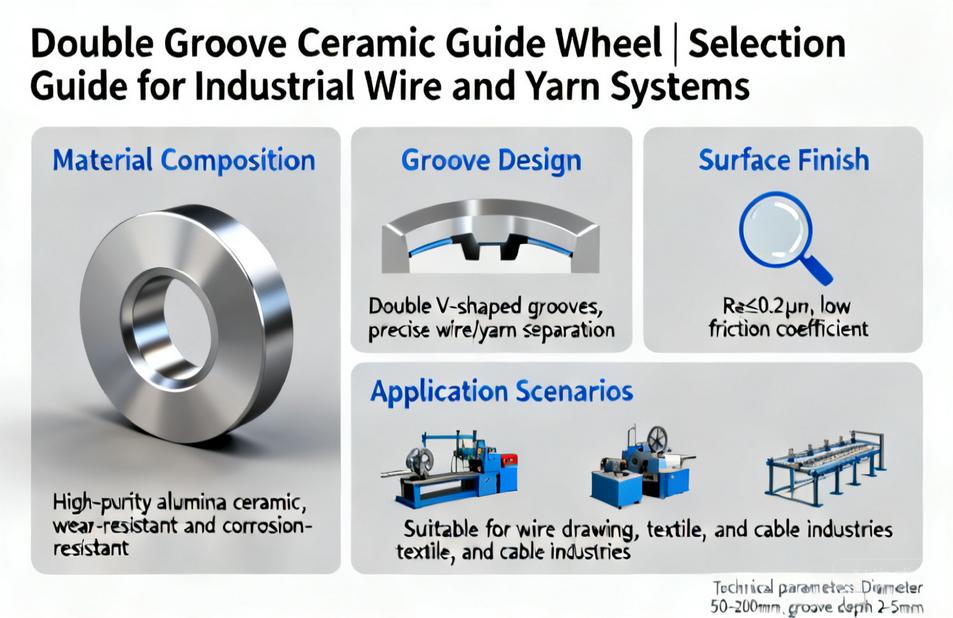
A double groove ceramic guide wheel is a precision ceramic component with two parallel grooves machined into its outer circumference, used to guide, tension, or redirect wire, yarn, fiber, or thread in industrial machinery. Unlike single groove designs, it allows one wheel to manage two separate lines or two passes of the same line, which reduces the number of guide points and simplifies machine layout. Buyers sourcing this component are typically working in wire drawing, textile machinery, cable manufacturing, optical fiber production, or automated winding equipment, where friction, wear, and wire contamination directly affect output quality.
Product Overview and Working Principle
The wheel is mounted on a shaft or bearing assembly, and the grooves act as tracks that keep moving material aligned. One groove may carry the incoming line while the second handles the outgoing line, or both grooves may run parallel strands. The ceramic surface provides a hard, smooth contact face that resists abrasion from fast-moving wire and reduces the risk of scratching or flattening soft metals. Because the material is non-conductive and chemically stable, the wheel also suits environments where metal guides would rust, spark, or react with lubricants.
A well-made double groove ceramic guide wheel maintains groove geometry over a long service life without the galling or grooving that affects metal pulleys. The two grooves must be concentric and consistent in radius so tension remains balanced across both lines. For procurement teams, the key question is not simply whether the wheel is ceramic, but whether the groove profile, surface finish, bore size, and mounting style match the machine and the material being processed.
Materials and Construction
Common Ceramic Grades
Most guide wheels in industrial service are made from alumina (Al2O3) or zirconia (ZrO2) ceramics. Alumina offers high hardness and wear resistance at a relatively economical cost, while zirconia provides higher toughness and is often chosen where impact or thermal shock is a concern. Both grades are electrically insulating and resistant to many oils and lubricants. The exact grade should be specified by the application rather than assumed, since hardness, density, and surface finish differ between suppliers.
Groove and Bore Design
Groove shape can be V-shaped, U-shaped, or radiused, depending on the wire or yarn profile. A double groove wheel may have two identical grooves or two different profiles if the machine handles two materials. The bore may be plain for a shaft, or configured for a bearing, bushing, or flanged hub. Surface finish inside the groove is especially important: a polished groove reduces friction and particle generation, which matters in clean processes such as optical fiber or fine wire.
Mounting Configurations
Wheels can be supplied with a central bore, a stepped bore, a metal insert, or a complete bearing assembly. Some designs include a metal hub bonded or shrink-fitted to the ceramic ring. Mounting style determines how the wheel fits existing brackets and tension arms, so buyers should share shaft diameter, retaining method, and available space when requesting a quote.
Typical Industrial Applications
- Wire drawing and annealing lines, where the wheel guides wire between dies and capstans
- Textile machinery, including spinning, twisting, and yarn winding equipment
- Cable and wire harness manufacturing, where two conductors or strands run side by side
- Optical fiber production and processing, where surface finish and cleanliness are critical
- Enameling and coating lines, where ceramic resists chemical exposure and wear
- Robotic and automated winding systems that require low-friction line routing
In each case, the double groove design is chosen to reduce guide count, control line spacing, or keep two process lines synchronized. A textile plant may use it to separate two yarn ends without adding another tensioning point, while a wire manufacturer may use it to route a strand through two passes of a single guide station.
How to Choose the Right Double Groove Ceramic Guide Wheel
Selection should start with the material being guided. Fine wire and filament require a smoother groove and tighter dimensional tolerance than heavier cable. Next, confirm the line speed and tension range, because these influence bearing choice and the risk of groove wear. Then match the wheel dimensions to the machine: outer diameter, groove pitch, groove depth, bore size, and overall width must fit existing mounting hardware. Finally, consider the environment. High humidity, coolant exposure, or elevated temperature may point toward a specific ceramic grade or a sealed bearing option.
Buyers should also ask about groove runout and concentricity, since poor tolerances cause line vibration and inconsistent tension. If the wheel is replacing an existing part, providing a sample or drawing is usually the fastest way to avoid fitment problems. For new equipment designs, sharing the machine layout and line path helps the supplier recommend a suitable groove profile and mounting method.
Customization and OEM Options
Many ceramic guide wheel manufacturers offer custom dimensions, groove profiles, and mounting features. Custom work may include non-standard outer diameters, special bore tolerances, matched groove pairs, laser marking, or assembly with bearings and shafts. OEM programs are common in this category, where the wheel is built to a machine builder’s drawing and supplied under the buyer’s part number. When discussing customization, provide a dimensioned drawing, the material being processed, operating speed, and any cleaning or sterilization requirements. This reduces back-and-forth and helps the factory propose a workable design.
Buying Considerations for Overseas Purchasers
Price should be evaluated together with dimensional consistency and groove finish, because a low-cost wheel with poor tolerance can increase downtime and scrap. Request a dimensional inspection report or sample evaluation before committing to volume. Confirm the packing method, since ceramic parts need protection against chipping during transport. Also clarify whether the supplier manufactures the ceramic in-house or sources it, as this affects lead time and the ability to control quality. For repeat orders, ask how batch consistency is maintained and whether the same grade and finish will be used.
Supplier Selection
A reliable supplier should be able to discuss ceramic grade selection, groove geometry, and mounting interfaces in technical terms. Look for a factory or manufacturer with experience in your industry, since application knowledge often matters more than a broad catalog. Ask for drawings, tolerance ranges, and available surface finish options. If you need OEM or custom production, confirm whether the supplier handles tooling, sample approval, and ongoing batch control. A supplier that asks detailed questions about your line speed, material, and machine interface is usually better positioned to deliver a usable part than one that only quotes a generic size.
Frequently Asked Questions
What is the difference between a single groove and a double groove ceramic guide wheel?
A single groove wheel guides one line, while a double groove wheel manages two lines or two passes. The double groove design can reduce the number of guide points and help keep two strands aligned or separated within the same station.
Which ceramic material is better for wire guiding, alumina or zirconia?
Alumina is often selected for wear resistance and cost efficiency, while zirconia offers higher toughness for applications with impact or thermal variation. The right choice depends on line speed, wire type, and the operating environment.
Can double groove ceramic guide wheels be customized for my machine?
Yes. Many manufacturers and factories offer custom outer diameters, groove profiles, bore sizes, and bearing assemblies. Providing a drawing or sample helps ensure the wheel fits your equipment correctly.
How do I evaluate a supplier before placing an order?
Review their technical response, ask for dimensional tolerances and surface finish data, request a sample if possible, and confirm their experience with your application. A supplier that communicates clearly about grade, groove design, and mounting is easier to work with over the long term.
Conclusion
Choosing a double groove ceramic guide wheel comes down to matching groove profile, ceramic grade, bore, and mounting style to your specific line and material. Buyers who share application details early usually receive more accurate recommendations and fewer fitment issues. If you are comparing suppliers or planning a custom or OEM guide wheel for a new machine, contact the manufacturer with your drawing, line conditions, and quantity requirements to discuss suitable specifications.
