

Coating Service Overview
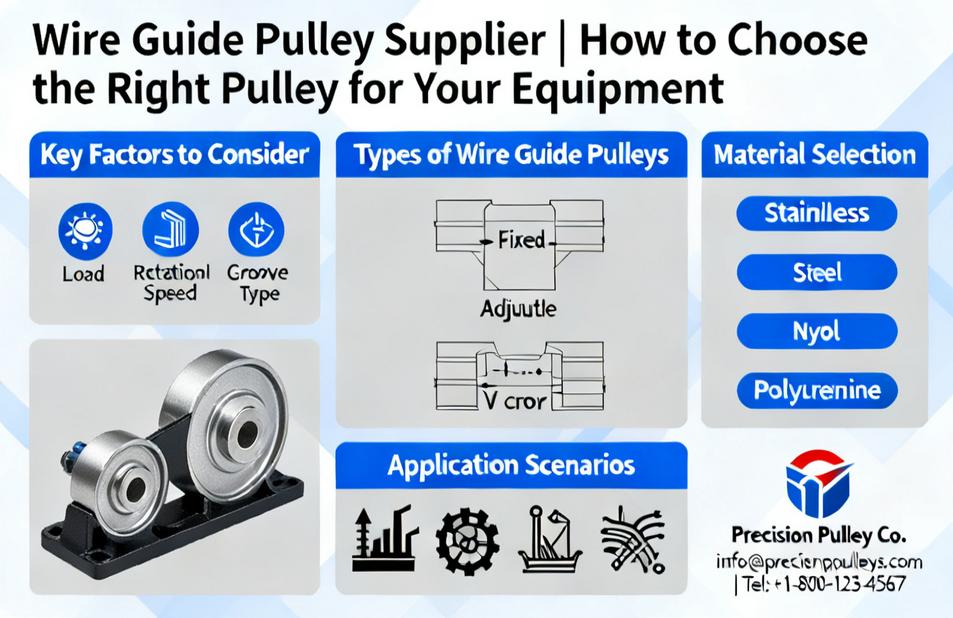
When you search for a wire guide pulley supplier, you are looking for a component that keeps wire, cable, or rope aligned and moving smoothly through industrial machinery. A wire guide pulley is a grooved wheel, usually mounted on a bracket or shaft, that changes the direction of a wire or cable while reducing friction and preventing wear. It is commonly used in wire drawing machines, cable handling systems, automated winding equipment, and general industrial tension control applications. Choosing the right supplier matters because the pulley must match your wire diameter, load, speed, and environmental conditions.
What a Wire Guide Pulley Does in Industrial Systems
In many production lines, wire or cable passes through multiple stages: feeding, straightening, tensioning, and winding. At each stage, a guide pulley directs the wire along the correct path. If the pulley is too small, the wire may bend too sharply and lose strength. If the groove is too wide or too narrow, the wire may jump out or rub against the side walls. A properly selected guide pulley protects both the wire and the surrounding equipment, and it helps maintain consistent tension, which is critical for product quality.
Guide pulleys are also used in automated material handling, packaging machinery, textile equipment, and wire rope systems. In some cases, they serve as part of a dancer or tensioner assembly, where the pulley moves on an arm to absorb changes in wire speed. This makes the pulley a small but important part of the overall machine performance.
Key Features Buyers Look For
When evaluating a wire guide pulley, overseas buyers often focus on groove profile, bearing type, mounting style, and material. The groove profile should match the wire or cable cross-section. For round wire, a U-shaped or V-shaped groove may be appropriate depending on the application. For flat cable, a different profile is needed. The groove surface should be smooth and free from burrs to avoid damaging the wire.
The bearing or bushing inside the pulley affects rotation smoothness and service life. Sealed bearings are common in dusty or wet environments, while open bearings may be used in clean, high-speed applications. Mounting options include shaft-mounted, bracket-mounted, and custom housings. Buyers should confirm the shaft diameter, mounting hole pattern, and available space before ordering.
Materials and Construction
Wire guide pulleys are made from a range of materials, and the choice depends on load, speed, corrosion exposure, and temperature. Common options include:
- Steel or stainless steel: suitable for heavy loads and high temperatures; stainless steel offers better corrosion resistance.
- Aluminum: lightweight and good for moderate loads where weight reduction matters.
- Engineering plastics such as nylon or POM: low friction, quiet operation, and resistance to many chemicals; often used in lighter-duty applications.
- Ceramic-coated or hard-anodized surfaces: used where wire abrasion is a concern, though buyers should verify compatibility with their specific wire type.
The pulley body may be machined, cast, or molded. Machined pulleys generally offer better dimensional consistency, while molded plastic pulleys can be cost-effective for high-volume OEM orders. A reliable manufacturer will confirm the material grade and surface treatment before production.
Typical Industrial Applications
Wire guide pulleys appear in many industries, including:
- Wire drawing and cable manufacturing
- Automated winding and spooling machines
- Robotic cable management systems
- Elevator and hoist rope guidance
- Textile yarn and thread handling
- Packaging and labeling equipment
- Welding wire feeders
- Fishing line and rope processing
Each application has different requirements. For example, a welding wire feeder may need a pulley that resists abrasion from metal wire, while a textile machine may require a low-noise plastic pulley. Sharing your application details with a supplier helps them recommend a suitable pulley.
How to Choose the Right Wire Guide Pulley
Start by defining the wire or cable specification: diameter, material, flexibility, and surface finish. Then consider the operating conditions: speed, load, temperature, humidity, and exposure to dust, oil, or chemicals. Next, check the available mounting space and shaft size. If the pulley is part of an existing machine, measure the old pulley or provide a drawing.
Other factors include:
- Groove dimensions and tolerance
- Bearing type and required rotation life
- Radial and axial load capacity
- Corrosion resistance and cleaning requirements
- Noise and vibration limits
- Compatibility with automated tension control
If you are unsure, ask the supplier for a technical review. A good supplier will ask about your wire type and machine layout before quoting.
Customization and OEM Options
Many buyers need custom wire guide pulleys rather than standard catalog parts. Customization can include specific groove profiles, non-standard diameters, special shaft bores, mounting flanges, and branded markings. OEM production is common in this category, especially for machine builders and distributors who need pulleys under their own part numbers.
When discussing custom options, provide detailed drawings or samples. A capable factory can produce prototypes or small batches before full production. It is also important to clarify tolerances, surface finish, and inspection criteria so both sides have the same expectations.
Buying Considerations for Overseas Buyers
Price is only one part of the decision. Buyers should also evaluate dimensional accuracy, material consistency, and packaging. Poorly made pulleys can cause wire damage, machine downtime, and expensive rework. Ask the supplier about their quality control process, from incoming material inspection to final dimensional checks.
Shipping and lead time also matter. For urgent replacements, a supplier with flexible production scheduling can be an advantage. For long-term supply, consider whether the supplier can hold inventory or provide stable batch-to-batch consistency. Always request a sample or pilot order before committing to large volumes.
Supplier Selection: What to Look For
When comparing wire guide pulley suppliers, look for experience in your industry, clear communication, and willingness to provide technical support. A manufacturer that understands wire handling can suggest improvements to groove design or bearing selection. A trading company may offer a wide range but less technical depth. Decide which model fits your needs.
Ask for references or examples of similar applications, but avoid relying only on general claims. Instead, request drawings, material certificates, and inspection reports where applicable. A professional supplier will welcome detailed questions and provide straightforward answers.
Frequently Asked Questions
How do I determine the correct pulley groove size for my wire?
Measure the wire diameter and consider its flexibility. The groove should support the wire without pinching or allowing excessive side movement. For critical applications, consult the pulley supplier with your wire specification and machine layout.
Can wire guide pulleys be used in wet or corrosive environments?
Yes, but material selection is important. Stainless steel, certain plastics, and coated surfaces can resist moisture and chemicals. Confirm the operating environment with the supplier so they can recommend a suitable material and bearing protection.
What is the typical lead time for custom pulleys?
Lead time depends on design complexity, material availability, and order quantity. It is best to ask the supplier directly after sharing your drawings and required quantity. Avoid assuming a fixed timeline without confirmation.
Do I need a manufacturer or a supplier for small orders?
Both can work, but a manufacturer may offer more control over customization and quality. For small orders, check whether the factory accepts low-volume production or has standard sizes in stock. A supplier with manufacturing experience can often provide better technical guidance.
Conclusion
Selecting the right wire guide pulley supplier involves more than comparing prices. Focus on groove design, material, bearing type, and the supplier’s ability to support your application. If you need custom dimensions, OEM branding, or technical advice, contact a manufacturer or supplier with experience in wire and cable handling. Share your specifications, and they can help you match the pulley to your equipment for reliable, long-term performance.
