

Coating Service Overview
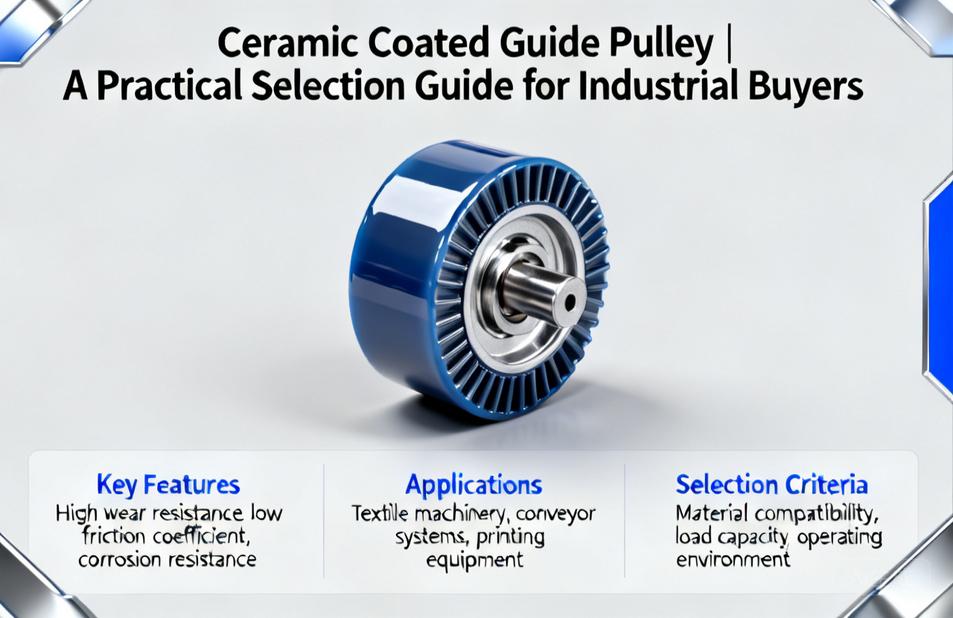
A ceramic coated guide pulley is a wire or cable routing component whose groove and often the flange surfaces are covered with a thin ceramic layer, typically applied over a metal body such as aluminum or steel. In industrial equipment, it is used to guide, redirect, and support moving wire, cable, rope, or fiber while reducing friction and protecting both the pulley and the moving line. Buyers searching for a ceramic coated guide pulley are usually dealing with wire drawing, textile machinery, cable manufacturing, wire winding, or similar continuous processes where wear and wire damage directly affect output quality and downtime.
This article explains how ceramic coated pulleys work, where they are used, what to check during selection, and how to evaluate a manufacturer or supplier for OEM and custom requirements.
What a Ceramic Coated Guide Pulley Does
A guide pulley does more than change the direction of a running line. In high-speed or high-tension applications, the contact surface determines how much friction, heat, and mechanical abrasion the wire experiences. A hard ceramic coating creates a smooth, wear-resistant contact surface that can tolerate continuous sliding contact better than many bare metal surfaces.
The coating is usually applied to the groove, where the wire or cable sits during operation. Some designs also coat the side flanges or the entire outer face. The result is a pulley that keeps its groove profile for a longer working period, which helps maintain consistent line tension and reduces the risk of wire marking, flattening, or surface scratching.
Key Features Industrial Buyers Look For
When reviewing a ceramic coated guide pulley for a production line, purchasing teams and maintenance engineers typically compare several functional characteristics.
- Low friction surface to reduce drag on the running wire or cable.
- High surface hardness to resist abrasion from continuous contact.
- Smooth groove finish to avoid scratching or marking sensitive materials.
- Chemical and corrosion resistance in environments where moisture or process fluids are present.
- Balanced rotation for stable guidance at higher line speeds.
- Dimensions matched to the existing shaft, bracket, or machine frame.
These features matter most in processes where wire breakage, surface defects, or frequent pulley replacement create measurable production losses.
Materials and Construction
The performance of a ceramic coated pulley depends on both the base material and the coating process. Aluminum is often selected for lower weight and easier machining, while steel may be preferred where higher mechanical strength or rigidity is required. The ceramic layer is applied through a thermal spray or similar coating method, then finished to the required surface roughness and groove profile.
Because coating quality affects bonding strength and surface uniformity, buyers should ask the supplier how the ceramic layer is applied and how the groove profile is controlled after coating. A well-prepared substrate, proper surface treatment, and consistent finishing are important for long service life. For custom projects, the pulley body can be machined to match existing bore diameters, keyways, mounting holes, and flange dimensions.
Typical Industrial Applications
Ceramic coated guide pulleys appear in many wire and cable handling processes. Common industrial applications include wire drawing machines, cable stranding and bunching equipment, textile yarn guides, wire winding and spooling systems, welding wire feed paths, and optical fiber or specialty cable production lines. They are also used in packaging machinery, rope guiding systems, and other equipment where a moving line must be redirected with minimal friction.
In each case, the pulley is selected according to wire diameter, line speed, tension, ambient temperature, and the presence of lubricants or process fluids. A pulley that performs well in a slow-speed textile guide position may not be suitable for a high-tension cable stranding line, so application details should always be shared with the supplier before ordering.
How to Choose the Right Ceramic Coated Guide Pulley
Choosing the correct pulley starts with the moving line itself. Buyers should confirm the wire or cable diameter, the required groove profile, the expected line speed, and the operating tension. These factors influence the groove radius, pulley diameter, and coating thickness.
Next, examine the mechanical interface. The bore diameter, keyway size, shaft tolerance, mounting configuration, and available space all determine whether a standard pulley can be used or a custom design is needed. Weight can also matter in moving assemblies, which is one reason aluminum bodies are common in high-speed routing positions.
Finally, consider the operating environment. Dust, moisture, chemicals, and temperature variation affect both the base material and the ceramic layer. Sharing these conditions with a supplier helps narrow the material and coating options and reduces the risk of premature wear or corrosion.
OEM and Customization Options
Many industrial buyers need more than a catalog item. A ceramic coated guide pulley manufacturer or supplier can usually support OEM and custom requirements, including specific outer diameters, groove profiles, bore sizes, flange heights, mounting patterns, and surface finishes. Custom pulleys are often produced from drawings or samples, with the coating applied to the areas that experience the most contact wear.
For OEM projects, it is useful to discuss expected production volume, repeatability requirements, and inspection criteria early in the process. A factory that can document dimensional checks and coating appearance standards is generally easier to work with over multiple orders than one that only quotes a generic description.
Buying Considerations and Supplier Selection
When comparing suppliers, look beyond the unit price. Ask how the ceramic coating is applied, how groove dimensions are verified, and whether samples can be provided for trial evaluation. A reliable manufacturer should be able to explain the relationship between the base material, coating method, and intended application without making vague claims.
It is also helpful to review the supplier production scope. A factory focused on pulleys and guide components is more likely to understand groove geometry, runout, and balancing than a general trading company. For custom or OEM orders, confirm drawing review capability, packaging requirements, and the inspection information that will be provided with each shipment.
Buyers should avoid treating ceramic coated pulleys as interchangeable commodities. Small differences in groove profile and surface finish can change how a wire runs, how long the pulley lasts, and how often the line needs adjustment.
Frequently Asked Questions
What is the advantage of a ceramic coating on a guide pulley?
The main advantage is a hard, smooth contact surface that reduces friction and resists abrasion from continuous wire or cable movement. This can help protect the running line and extend pulley service life in demanding applications.
Can ceramic coated guide pulleys be customized?
Yes. Many manufacturers offer custom dimensions, groove profiles, bore sizes, and mounting features. Providing a drawing or sample helps the supplier match the pulley to the existing machine.
How do I select the correct groove size?
The groove should match the diameter and type of wire or cable being guided. Line speed, tension, and the required contact angle also influence the selection, so these details should be shared with the supplier.
What information should I provide when requesting a quote?
Useful details include wire or cable diameter, pulley dimensions, bore and keyway size, mounting arrangement, line speed, operating environment, and whether the item is for a standard application or an OEM project.
Conclusion
Selecting a ceramic coated guide pulley is mainly a matter of matching the contact surface, groove geometry, and mechanical interface to the actual wire or cable handling process. Buyers who confirm line data, environmental conditions, and mounting dimensions before ordering are better positioned to avoid premature wear and production interruptions. If you are evaluating options for a new line, replacement part, or OEM program, contacting a qualified supplier with your specifications and application details is a practical next step.
