

Coating Service Overview
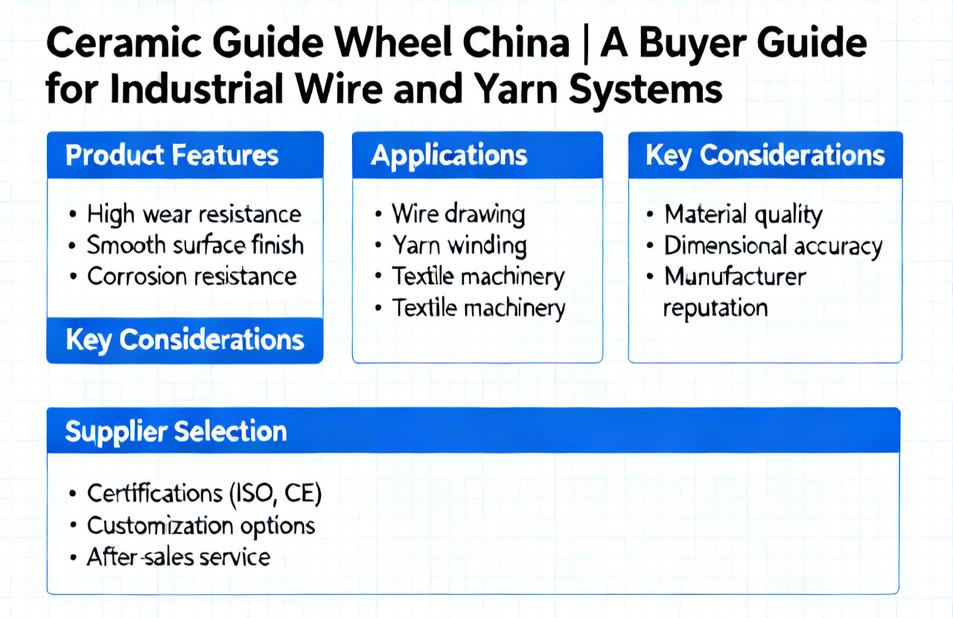
A ceramic guide wheel from China is a precision-engineered component used to guide, tension, and route wire, cable, yarn, thread, and optical fiber with minimal friction and wear. Overseas buyers often search for ceramic guide wheel China suppliers when they need smooth running surfaces, long service life, and consistent performance in textile machinery, wire drawing equipment, cable manufacturing, and automated winding systems. This guide explains what these wheels are, how they work, which applications suit them, and what to check before choosing a manufacturer or OEM partner.
What Is a Ceramic Guide Wheel?
A ceramic guide wheel is a rotating pulley or roller made with a ceramic contact surface, usually mounted on a metal bearing, shaft, or bushing. The ceramic surface provides a very smooth and hard running track that reduces friction and abrasion when a moving strand passes over it. Unlike metal guide wheels, ceramic versions resist wear from continuous contact with wire or yarn and help maintain stable tension. In many machines, these wheels are part of a guide system that includes ceramic eyelets, guide rollers, tension pulleys, and wire guides. The wheel itself may be a full ceramic disc, a ceramic-coated metal wheel, or a ceramic ring fitted into a metal hub. The choice depends on load, speed, strand diameter, and the working environment.
How Ceramic Guide Wheels Work in Industrial Equipment
The wheel rotates as the strand moves, so the contact point changes continuously instead of rubbing in one spot. This rolling action lowers friction and heat compared with a fixed guide. Because ceramic materials are hard and smooth, they help prevent scratching, flattening, or scraping of delicate wires and fibers. A well-matched bearing or bushing lets the wheel spin freely under light tension. In high-speed lines, the guide wheel must stay balanced and aligned with the strand path. Poor alignment can cause the strand to jump, twist, or wear the wheel edge. For this reason, buyers should consider the full guide assembly, not only the wheel.
Common Materials and Construction Options
Ceramic guide wheels may use different ceramic materials depending on the application. Alumina ceramic is common for general wear resistance and electrical insulation. Zirconia ceramic is chosen when higher toughness and a very smooth surface are useful. Silicon nitride and silicon carbide may be used in demanding wear or high-temperature settings. The wheel body can be made as a solid ceramic part, a ceramic ring mounted on a metal core, or a metal wheel with a ceramic coating. Bearings may be steel, stainless steel, or ceramic hybrid types. Housing materials can include stainless steel, aluminum, or engineering plastics. Each combination affects weight, corrosion resistance, temperature limits, and running noise. Since exact grades and dimensions vary by supplier, always confirm the material and tolerance requirements with the factory before ordering.
Key Features Buyers Look For
- Smooth ceramic surface that reduces friction and strand damage
- High hardness for extended wear life in continuous production
- Good electrical insulation for applications where current must not pass through the guide
- Corrosion and chemical resistance for wet or coated processes
- Low rotation resistance for light-tension wire and fine yarn
- Available in different bore sizes, outer diameters, groove shapes, and edge profiles
These features matter in high-speed machinery because a small change in friction can affect tension stability, product quality, and downtime. A guide wheel that runs smoothly and stays true to its axis helps the strand maintain a consistent path.
Typical Industrial Applications
Ceramic guide wheels are used in many fields where a moving strand must be guided with low friction. In textile machinery, they guide yarn, thread, and filament in spinning, twisting, winding, and knitting equipment. In wire and cable production, they route copper wire, steel wire, and cable conductors through drawing, annealing, plating, and coiling lines. Optical fiber manufacturing uses them to protect delicate glass fibers. They also appear in wire harness processing, coil winding machines, 3D printer filament guides, and automated wire cutting and stripping systems. Other applications include fishing line equipment, medical thread handling, and specialized automation where electrical insulation or wear resistance is important. Each application may require a different groove shape, wheel diameter, or bearing type.
How to Choose the Right Ceramic Guide Wheel
Start with the strand. Note its material, diameter, surface finish, and tension range. Then review the machine speed, direction changes, and available mounting space. Check the wheel outer diameter, bore size, groove profile, and width. Confirm whether the wheel needs a bearing or a plain bore. Consider the environment: dust, moisture, lubricants, coatings, or temperature can affect both the ceramic and the bearing. If the strand is electrically conductive and the guide must insulate, verify the ceramic grade and mounting design. If noise or vibration is a concern, look at bearing clearance and wheel balance. For replacement parts, match the original dimensions or request a sample for fit testing. A good supplier can help compare options based on the working conditions rather than only the catalog size.
Customization and OEM Options
Many China-based factories offer custom ceramic guide wheels for specific equipment. Customization may include outer diameter, inner bore, groove angle, groove depth, edge radius, and overall width. Buyers can also request specific ceramic materials, bearing types, shaft configurations, and mounting flanges. OEM production is common for machinery builders that need private-label parts or branded packaging. When requesting a custom quote, provide drawings, samples, or detailed specifications. Clarify tolerances, surface finish, and any balancing requirements. A capable manufacturer will discuss the production method, tooling needs, and inspection points before confirming the order. Avoid suppliers that cannot explain how they control dimensions or material consistency.
Buying Considerations for Overseas Purchasers
Price alone is not a reliable guide when buying ceramic guide wheels from China. Low-cost parts may use inconsistent ceramic grades, poor bearing fit, or rough surface finishing, which can lead to premature wear and production interruptions. Ask about the ceramic material, the manufacturing process, and the quality checks used for roundness, bore tolerance, and surface smoothness. Confirm packing methods for fragile ceramic parts and whether the supplier has experience with export shipping. For repeat orders, request batch consistency and lot traceability if available. It is also useful to compare samples under actual machine conditions. A guide wheel that performs well in one line may not suit another if speed, tension, or strand type changes.
How to Select a Reliable Ceramic Guide Wheel Supplier in China
Look for a manufacturer or supplier with experience in industrial ceramic parts and guide components. Review their product range, technical communication, and ability to answer application questions. A factory that understands textile, wire, or cable machinery can often suggest better groove profiles and bearing options. Check whether they support OEM and custom orders, and how they handle drawings and samples. Ask about production capacity, lead times, and packaging, but treat these as points to verify rather than fixed promises. If possible, request references or review their export history. The right partner will be transparent about what they can make and what they cannot, and will help match the guide wheel to the equipment rather than simply quoting a size.
Frequently Asked Questions
What is the difference between a ceramic guide wheel and a metal guide wheel?
Ceramic guide wheels generally offer a harder, smoother contact surface with better wear resistance and electrical insulation than metal wheels. Metal wheels may be suitable for heavier loads or where impact resistance is the main concern. The best choice depends on strand type, speed, tension, and environment.
Can ceramic guide wheels be customized for my machine?
Yes. Many China-based manufacturers provide custom sizes, groove profiles, bore dimensions, ceramic materials, and bearing options. To get an accurate quote, provide a drawing, sample, or detailed specification of the existing part.
How do I know which groove shape to choose?
The groove shape should match the strand diameter and contact angle. A rounded or V-shaped groove is common for wire and yarn, while flat or U-shaped profiles may suit other materials. The supplier can recommend a profile after reviewing the application.
Are ceramic guide wheels suitable for high-speed machinery?
They can be used in high-speed lines when the wheel is balanced, properly aligned, and fitted with a suitable bearing. Speed limits depend on the specific design, load, and operating conditions, so confirm these factors with the manufacturer.
Conclusion
Choosing the right ceramic guide wheel from China comes down to matching the wheel material, dimensions, bearing, and groove profile to the actual strand and machine conditions. Buyers should focus on consistent ceramic quality, accurate tolerances, and a supplier that can support samples, OEM orders, and custom specifications. If you are reviewing options for textile, wire, cable, or automation equipment, contact a qualified manufacturer or supplier with your drawings and application details so they can help you select a suitable guide wheel for your system.
