

Coating Service Overview
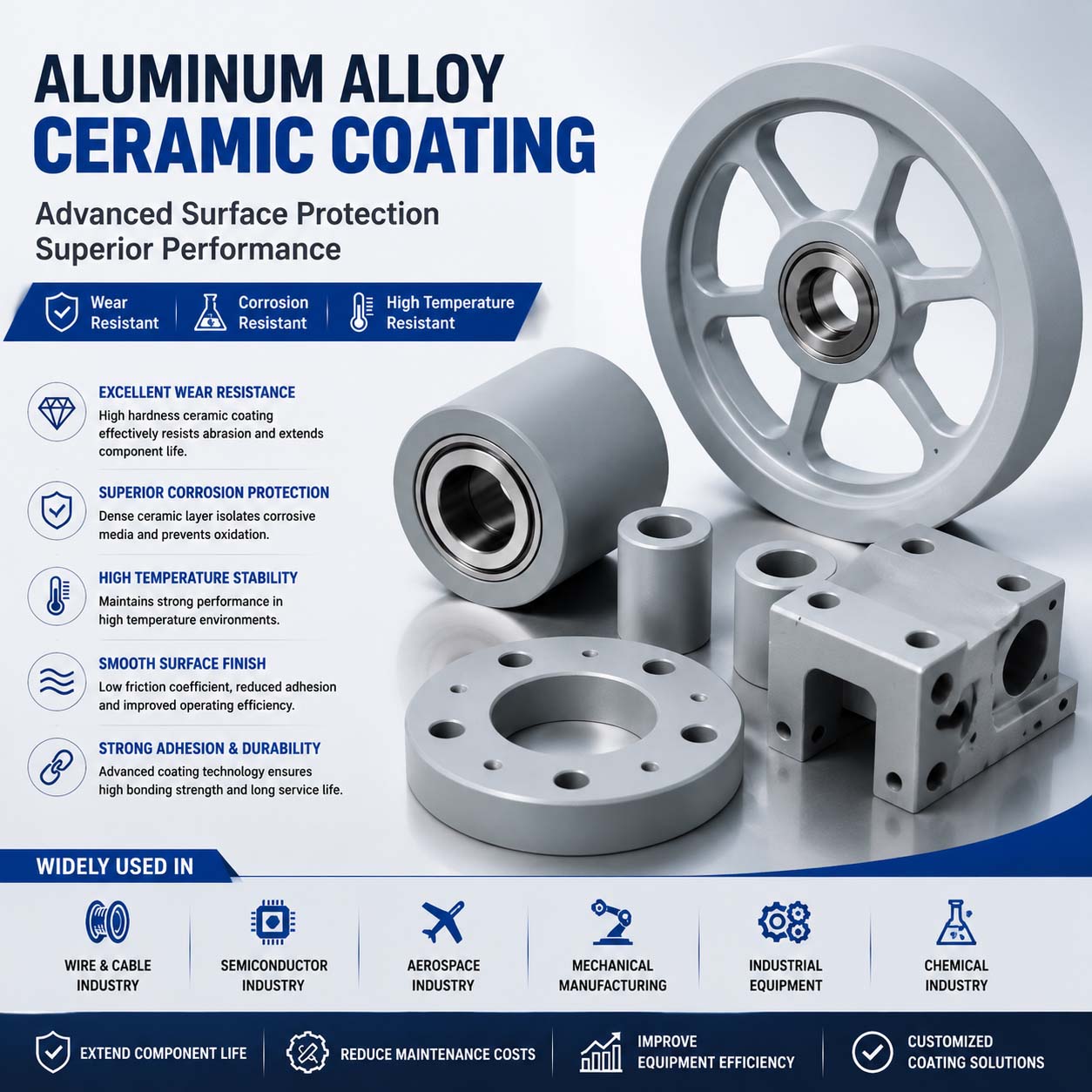
In modern industrial manufacturing, aluminum alloy parts are widely used due to their lightweight, high strength, and excellent processing performance. However, aluminum alloys also have limitations, such as low surface hardness, insufficient wear resistance, and poor corrosion resistance under harsh working conditions. When aluminum components operate in environments involving friction, impact, chemicals, or high temperatures, surface damage can significantly affect equipment performance and service life.
Aluminum Alloy Ceramic Coating is an advanced surface engineering technology designed to improve the performance of aluminum alloy components. By applying a high-performance ceramic coating onto the aluminum surface, manufacturers can achieve enhanced wear resistance, corrosion protection, thermal stability, and extended service life.
What Is Aluminum Alloy Ceramic Coating?
Aluminum Alloy Ceramic Coating refers to the process of depositing a ceramic protective layer onto aluminum alloy substrates through advanced coating technologies such as thermal spraying, plasma spraying, HVOF coating, and other surface treatment methods.
The ceramic coating forms a dense and hard protective layer that improves the surface properties of aluminum alloy parts while maintaining the lightweight advantages of the original material.
Common ceramic coating materials include:
- Aluminum oxide (Al₂O₃) ceramic coating
- Chromium oxide (Cr₂O₃) ceramic coating
- Zirconia ceramic coating
- Silicon carbide ceramic coating
- Composite ceramic coatings
Different ceramic materials can be selected according to the working environment and performance requirements.
Advantages of Aluminum Alloy Ceramic Coating
1. Excellent Wear Resistance
Aluminum alloys are relatively soft compared with steel and ceramic materials. In high-friction applications, untreated aluminum surfaces may suffer from scratches, deformation, and rapid wear.
Ceramic coatings provide extremely high surface hardness, significantly reducing abrasive wear and improving component durability. This makes aluminum alloy ceramic coating ideal for precision mechanical parts, rollers, pulleys, guide wheels, and industrial equipment components.
2. Superior Corrosion Protection
Industrial environments often expose aluminum components to moisture, chemicals, salt spray, and corrosive media. Ceramic coatings create a protective barrier that prevents direct contact between the aluminum substrate and external corrosive substances.
This improves corrosion resistance and helps maintain stable performance in demanding applications.
3. High Temperature Performance
Many industrial processes involve elevated temperatures. Ceramic materials have excellent thermal stability and can withstand high-temperature conditions while maintaining coating strength and structural integrity.
Aluminum alloy ceramic coating is widely used for components requiring heat resistance and thermal protection.
4. Improved Surface Performance
A precisely applied ceramic coating can provide:
- Low friction coefficient
- Smooth surface finish
- Reduced material adhesion
- Better dimensional stability
- Improved operating efficiency
For precision components, ceramic coatings help reduce maintenance frequency and improve production reliability.
Applications of Aluminum Alloy Ceramic Coating
Aluminum alloy ceramic coating is widely used across multiple industries, including:
Wire and Cable Industry
In wire drawing and cable manufacturing equipment, aluminum alloy guide wheels, pulleys, and rollers require excellent wear resistance and surface smoothness. Ceramic coating improves durability and protects wire surfaces from scratches.
Semiconductor and Electronics Industry
Precision aluminum parts used in semiconductor equipment require corrosion resistance, dimensional stability, and clean surface performance. Ceramic coatings help extend service life and improve equipment reliability.
Aerospace Industry
Aerospace components require lightweight structures combined with high-performance surfaces. Ceramic coatings provide additional protection against wear, oxidation, and extreme environments.
Mechanical Manufacturing
Industrial rollers, shafts, fixtures, and precision components benefit from ceramic coating technology to reduce wear and improve operational efficiency.
Aluminum Alloy Ceramic Coating Process
A professional ceramic coating process usually includes:
- Surface preparation
Cleaning, sandblasting, and surface activation improve coating adhesion. - Ceramic material selection
Select suitable ceramic materials according to wear, temperature, and corrosion requirements. - Coating application
Advanced spraying technologies are used to form a uniform and dense ceramic layer. - Precision finishing
Grinding and polishing processes ensure accurate dimensions and required surface roughness. - Quality inspection
Coating thickness, hardness, bonding strength, and surface quality are tested to ensure performance.
Why Choose Professional Aluminum Alloy Ceramic Coating Services?
The performance of ceramic coatings depends not only on coating materials but also on spraying technology, equipment accuracy, and process control. Professional coating manufacturers can provide customized solutions based on component structure, operating conditions, and customer requirements.
With advanced ceramic coating technology, aluminum alloy components can achieve longer service life, lower maintenance costs, and improved production efficiency.
Conclusion
Aluminum Alloy Ceramic Coating is an effective surface enhancement solution for improving the durability and performance of aluminum components. Through advanced ceramic coating technology, aluminum alloys can overcome their limitations in hardness, wear resistance, and corrosion protection.
For industries requiring lightweight components with high-performance surfaces, ceramic coating provides a reliable way to extend equipment lifespan, improve operational stability, and reduce long-term maintenance costs.
