

Coating Service Overview
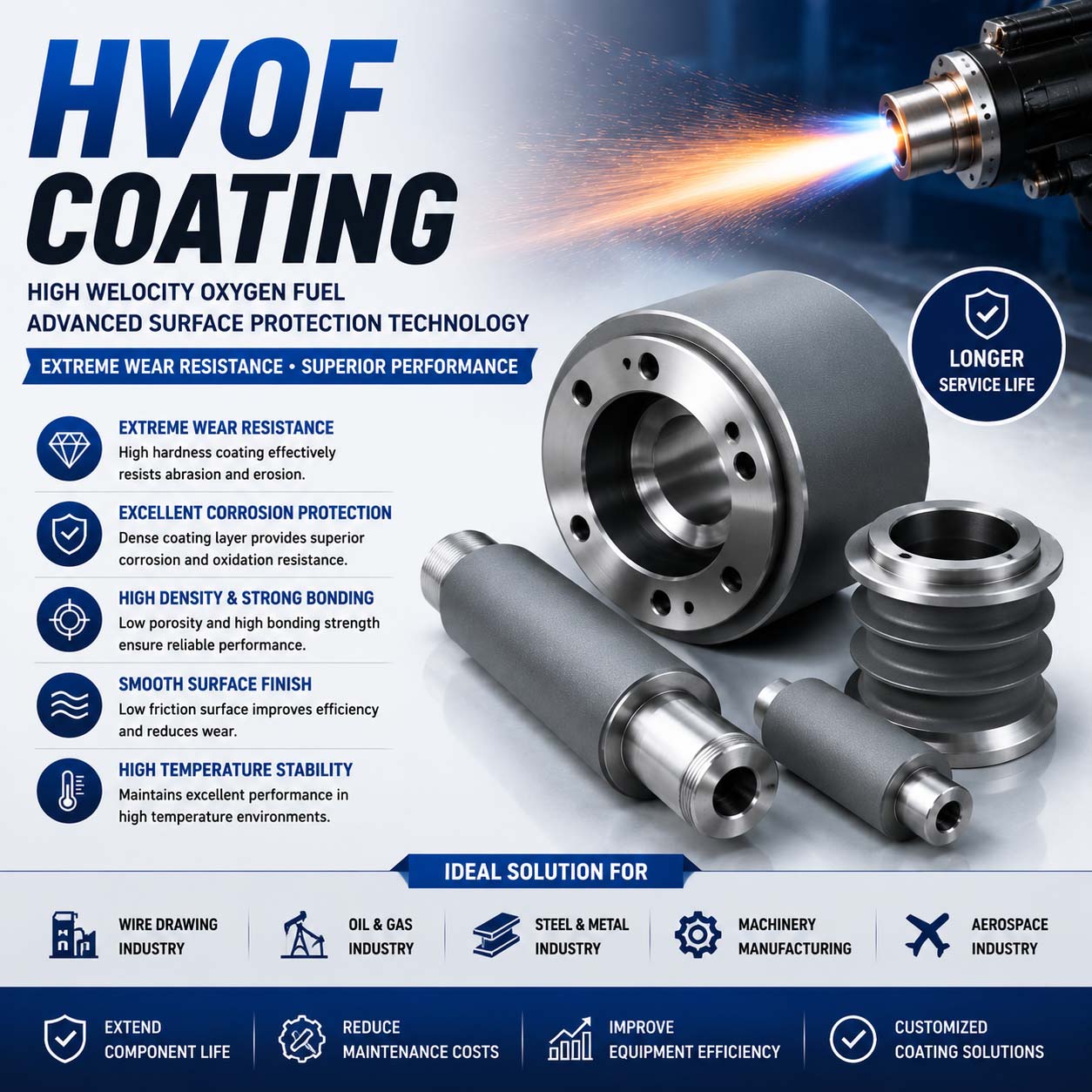
In modern industrial manufacturing, equipment components often operate under extreme conditions, including high friction, high temperature, corrosion, impact, and continuous wear. These harsh environments can significantly reduce component service life, increase maintenance costs, and affect production efficiency.
HVOF Coating (High Velocity Oxygen Fuel Coating) is an advanced thermal spray technology designed to solve these challenges. By creating a dense, high-strength protective coating on metal surfaces, HVOF coating improves wear resistance, corrosion protection, and component durability. It has become a widely used surface engineering solution in industries such as aerospace, oil and gas, steel manufacturing, wire drawing, and precision machinery.
What Is HVOF Coating?
HVOF Coating is a high-speed thermal spraying process that uses oxygen and fuel combustion to generate an extremely high-velocity flame. Powder materials are accelerated and sprayed onto the surface of a component at supersonic speeds, forming a dense and strongly bonded coating layer.
Unlike traditional coating methods, HVOF technology produces coatings with:
- Extremely low porosity
- High bonding strength
- Excellent hardness
- Superior wear resistance
- Outstanding surface quality
Common HVOF coating materials include:
- Tungsten carbide (WC-Co)
- Chromium carbide (Cr₃C₂-NiCr)
- Ceramic materials
- Nickel-based alloys
- Stainless steel alloys
Advantages of HVOF Coating
1. Outstanding Wear Resistance
Mechanical wear is one of the main causes of industrial component failure. Parts such as rollers, shafts, valves, and hydraulic components are often exposed to continuous friction and heavy loads.
HVOF coatings provide excellent resistance against:
- Abrasive wear
- Sliding wear
- Erosion wear
- Particle impact
For example, tungsten carbide HVOF coating can significantly extend the service life of wire drawing rollers, guide wheels, and industrial wear components.
2. High Coating Density and Strong Adhesion
A major advantage of HVOF technology is the ability to create extremely dense coatings with strong bonding strength.
The high-speed spraying process reduces coating porosity and improves resistance against:
- Mechanical impact
- Chemical penetration
- Surface cracking
This makes HVOF coating suitable for demanding industrial environments where reliability is critical.
3. Excellent Corrosion Protection
Many industries face corrosion problems caused by chemicals, moisture, salt environments, and aggressive working conditions.
HVOF coatings provide a protective barrier that helps prevent:
- Oxidation
- Chemical corrosion
- Surface degradation
- Premature component failure
This technology is widely used for pumps, valves, marine components, and oil & gas equipment.
4. Improved Surface Performance
After precision grinding and polishing, HVOF coated surfaces can achieve excellent surface finishes.
Benefits include:
- Reduced friction
- Improved dimensional accuracy
- Better product quality
- Lower energy consumption
For precision industries such as wire and cable manufacturing, a smooth coated surface helps protect wire quality and maintain stable production.
HVOF Coating Applications
Wire Drawing Industry
In wire drawing equipment, components such as:
- Tower pulleys
- Guide rollers
- Drawing wheels
- Pressure rollers
experience continuous high-speed friction.
HVOF tungsten carbide coatings improve:
- Wear resistance
- Groove stability
- Surface protection
- Equipment lifespan
Oil and Gas Industry
Oil and gas equipment requires reliable protection against wear and corrosion.
HVOF coatings are commonly applied to:
- Valves
- Pump components
- Drilling tools
- Hydraulic parts
They help maintain performance under high pressure and harsh environments.
Steel and Metal Processing
Steel manufacturing equipment operates under extreme temperatures and heavy mechanical loads.
HVOF coating is used for:
- Rollers
- Shafts
- Wear plates
- Mechanical components
to reduce downtime and improve production reliability.
Aerospace and Precision Machinery
Due to its excellent performance, HVOF coating is also used for:
- Aircraft components
- Landing gear parts
- Precision mechanical surfaces
where high reliability and long service life are required.
HVOF Coating Process
A professional HVOF coating process usually includes several steps:
Surface Preparation
The component surface is cleaned and roughened to improve coating adhesion.
Thermal Spraying
Coating powder is accelerated at high velocity onto the substrate surface, forming a dense protective layer.
Grinding and Polishing
The coated surface is precision machined to achieve the required size and surface roughness.
Quality Inspection
Coating thickness, hardness, bonding strength, and surface quality are tested to ensure performance.
Why Choose HVOF Coating?
Compared with traditional surface treatments, HVOF coating offers:
✔ Longer component service life
✔ Higher wear resistance
✔ Better corrosion protection
✔ Reduced maintenance costs
✔ Improved equipment reliability
✔ Customized coating solutions
It is an effective technology for companies seeking to improve equipment performance and reduce operating costs.
Conclusion
As industries continue to demand higher efficiency and longer equipment life, HVOF Coating has become an essential surface protection technology. With its high-density structure, excellent wear resistance, and strong bonding performance, HVOF coating provides reliable solutions for industrial components operating in harsh environments.
From wire drawing machines and manufacturing equipment to oil and gas systems and precision machinery, HVOF coating helps extend component lifespan, reduce downtime, and improve overall production efficiency.
Choosing an experienced HVOF coating manufacturer with advanced spraying equipment and precision finishing capabilities ensures the best protection solution for your industrial applications.
