

Coating Service Overview
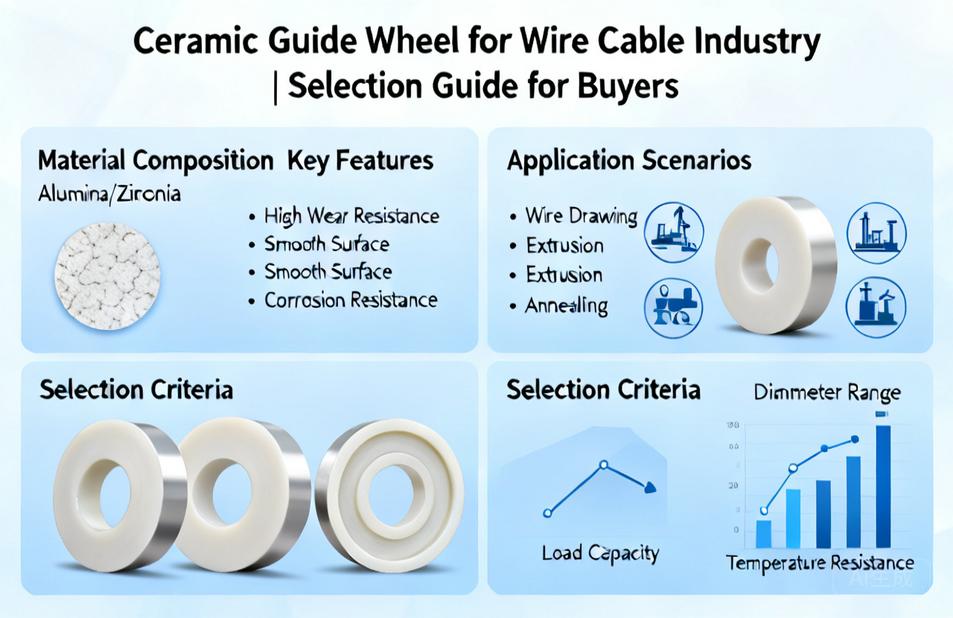
A ceramic guide wheel for wire cable industry is a precision wire contact component used to guide, position, and tension wire, cable, and conductor during drawing, stranding, bunching, cabling, and winding processes. Unlike metal pulleys that can wear quickly or damage soft conductors, ceramic guide wheels provide a smooth, low-friction contact surface that helps protect wire insulation and conductor surface quality. For cable manufacturers, wire machinery builders, and maintenance teams, choosing the right ceramic guide wheel often has a direct effect on line efficiency, wire surface quality, and replacement frequency.
What a Ceramic Guide Wheel Does in Wire and Cable Production
In a wire or cable line, the guide wheel sits at critical points where the product changes direction, enters a machine, exits a die, or passes through a tension control zone. The wheel keeps the wire centered, prevents side-to-side movement, and reduces rubbing that can cause scratches, flattening, or insulation damage. Because the wire is often moving at high speed and under tension, the guide wheel material and surface finish are important. A rough or worn guide surface can create defects that only appear later in the finished cable, so many manufacturers treat guide wheels as a quality-control component rather than a simple accessory.
Ceramic guide wheels are commonly used in copper and aluminum wire drawing, multi-strand bunching, cable stranding, taping, extrusion lines, rewinding, and coil winding. They are also found in wire processing equipment for automotive cable, communication cable, magnet wire, and specialty cable production. Depending on the machine design, the wheel may be a standalone pulley, a grooved roller, a guide with a ceramic insert, or a complete assembly with bearings and mounting hardware.
Key Features Buyers Look For
When purchasing ceramic guide wheels for wire and cable applications, buyers typically evaluate several practical features. The contact surface should be smooth and consistent, with no chips, pits, or sharp edges that could mark the wire. The ceramic material should resist abrasion from continuous wire contact and maintain its shape over a reasonable service life. Low friction is also important because it reduces tension variation and energy loss along the line. If the wheel includes a bearing, the bearing should rotate freely and match the speed and load requirements of the application.
Other considerations include chemical resistance, temperature resistance, and the ability to withstand cleaning or exposure to lubricants and coolant. In high-speed drawing or bunching operations, balance and concentricity matter because vibration can affect wire positioning and surface quality. For thin wire and soft conductors, a fine surface finish is often more important than extreme hardness. For abrasive or larger conductors, wear resistance and mechanical strength become more critical.
Materials and Construction
Ceramic guide wheels are usually made from technical ceramics such as alumina, zirconia, or silicon nitride, although the exact grade depends on the application. Alumina ceramic is often chosen for general wear resistance and electrical insulation. Zirconia ceramic can offer higher toughness and is sometimes used where impact or bending stress is a concern. Silicon nitride is another option for demanding wear and thermal conditions. The ceramic may be used as a full wheel, a ring, or an insert pressed or bonded into a metal hub.
Construction details affect installation and maintenance. Some wheels have a plain bore for mounting on a shaft, while others are supplied with bearings, flanges, or sleeves. The groove profile, if present, should match the wire or cable diameter and the angle of approach. A wheel that is too wide or too narrow for the wire can cause tracking problems. Buyers should confirm dimensions, bore size, groove shape, and mounting method before ordering, especially when replacing parts on existing machinery.
Industrial Applications and Matching to Equipment
Ceramic guide wheels are used in wire drawing machines, bunching machines, stranders, cablers, extrusion lines, taping machines, and winding equipment. In the wire cable industry, they are often found at pay-off and take-up stations, before and after dancers, at guide stands, and near dies and capstans. The correct wheel for a given machine depends on wire diameter, line speed, tension, ambient temperature, and the level of contamination in the process. For example, a fine magnet wire line may need a very smooth ceramic surface to avoid surface defects, while a heavy cable line may need a robust wheel with a deeper groove and stronger mounting.
When matching a guide wheel to equipment, it helps to review the original part number, mounting dimensions, and wear pattern of the previous wheel. If the old wheel failed early, the cause may be misalignment, excessive tension, or an incorrect groove profile rather than the ceramic material itself. In some cases, a custom guide wheel design can solve a recurring wire marking or tracking problem.
How to Choose the Right Ceramic Guide Wheel
Start by defining the wire or cable type, diameter range, and surface sensitivity. Then review the machine speed, tension range, and available mounting space. Check whether the wheel needs a groove, a flat surface, a flanged edge, or a specific radius. Confirm the bore diameter, overall dimensions, and whether a bearing or bushing is required. Consider the operating environment, including temperature, lubricants, dust, and cleaning methods. Finally, evaluate the supplier’s ability to provide consistent dimensions, suitable ceramic grade, and replacement support.
For buyers sourcing in volume, it is useful to request samples or small trial quantities before full production. A trial run on the actual line can reveal whether the wheel reduces wire marks, vibration, or wear compared with the current part. This approach is common among cable manufacturers and OEM machine builders who need reliable performance without disrupting production.
Customization and OEM Options
Many ceramic guide wheel suppliers offer custom sizes, groove profiles, bore dimensions, and mounting configurations. OEM production is common in this category because guide wheels are often designed around a specific machine or process. A custom guide wheel may include a particular ceramic grade, a metal hub, a bearing assembly, or a special surface finish. When discussing customization, provide drawings, samples, or detailed dimensions, along with the wire type and operating conditions. This helps the manufacturer recommend a practical design rather than simply copying a drawing that may not suit the application.
For machine builders, private-label packaging and consistent batch-to-batch dimensions are often important. For end users, the priority is usually fit, wire quality, and service life. A supplier that understands both sides can often suggest cost-effective alternatives without compromising the wire contact surface.
Buying Considerations and Supplier Selection
When comparing ceramic guide wheel manufacturers and suppliers, look at their experience with wire and cable applications, not just general ceramic parts. Ask how they control dimensional tolerance, surface finish, and material consistency. Check whether they can provide material information, dimensional drawings, and inspection reports relevant to the order. If you need OEM or custom production, confirm their ability to work from samples or technical drawings and to maintain repeatability over multiple orders.
Delivery reliability and communication also matter. A guide wheel may be a small part, but a missing or incorrect replacement can stop a production line. Choose a supplier that responds clearly to technical questions and can support ongoing replacement needs. If possible, visit the factory or request a video review of the production process for critical orders. This is especially useful when the guide wheel will be used in a high-speed or high-value cable application.
Frequently Asked Questions
What is a ceramic guide wheel used for in the wire cable industry?
It guides and positions wire or cable during drawing, stranding, bunching, cabling, and winding. The ceramic contact surface reduces friction and helps prevent surface damage compared with some metal guide surfaces.
How do I choose the right ceramic guide wheel for my machine?
Match the wheel to the wire diameter, line speed, tension, mounting dimensions, and groove profile. Review the old part and wear pattern, and confirm the bore size, bearing type, and available space before ordering.
Can ceramic guide wheels be customized or OEM manufactured?
Yes. Many suppliers offer custom dimensions, groove profiles, ceramic grades, and bearing assemblies. Provide drawings, samples, and operating details so the manufacturer can recommend a suitable design.
What should I check when selecting a supplier?
Look for experience with wire and cable applications, consistent tolerances, surface quality, material documentation, and the ability to support custom or repeat orders. Clear technical communication is also important for replacement parts.
Conclusion
Choosing a ceramic guide wheel for wire cable industry applications comes down to matching the wheel to the wire, the machine, and the operating conditions. Focus on surface finish, groove profile, mounting dimensions, ceramic material, and supplier consistency. If you need a standard replacement or a custom OEM guide wheel, share your specifications, application details, and drawings with a qualified manufacturer or supplier. They can help you review suitable options and support your wire and cable production requirements.
