

Coating Service Overview
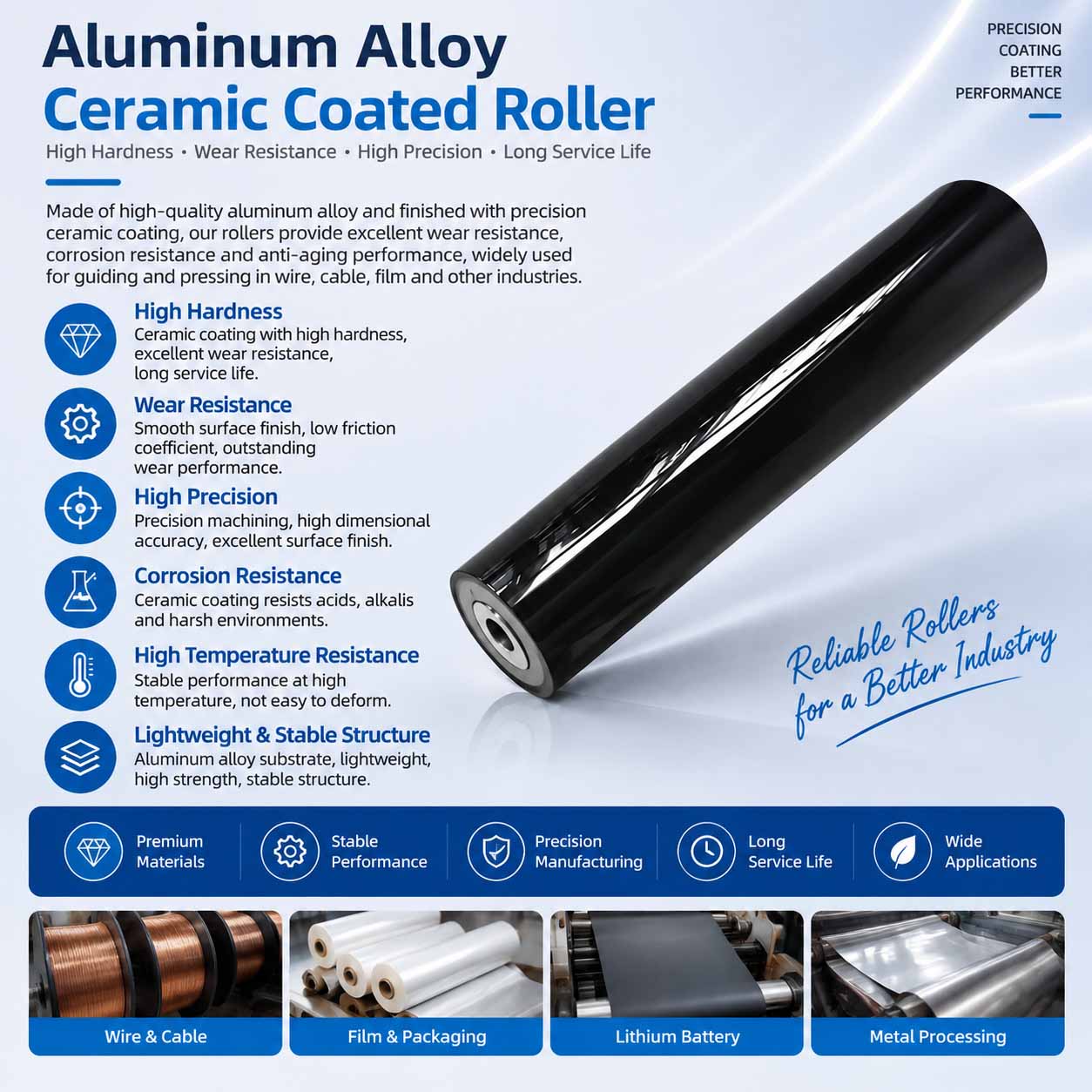
In metal processing, wire and cable annealing, lithium battery electrode manufacturing, and other continuous production industries, the wear resistance and surface quality of rollers directly affect production efficiency and product consistency.
Aluminum alloy ceramic coated pressure rollers combine the advantages of lightweight aluminum alloy substrates with advanced ceramic or tungsten carbide coatings. Although aluminum alloy offers excellent thermal conductivity and low weight, its surface hardness is relatively limited. By applying thermal spray coatings, roller surfaces can achieve significantly improved wear resistance, corrosion resistance, and anti-stick performance while maintaining lightweight characteristics.
Ceramic and Tungsten Carbide Coating Technologies
Thermal spray coating technology is widely used to enhance the performance of rollers and pressure wheels. For aluminum alloy substrates, the most common coatings include ceramic coatings and tungsten carbide coatings.
Ceramic Coating
Ceramic coatings, such as chromium oxide (Cr₂O₃) and alumina (Al₂O₃), provide:
- Excellent electrical insulation
- High temperature resistance
- Low friction coefficient
- Superior corrosion resistance
- Anti-stick performance
They are ideal for applications requiring clean surfaces, heat resistance, and chemical stability, such as heating rollers and annealing equipment components.
Tungsten Carbide Coating
Tungsten carbide coatings offer extremely high hardness (HV 1000–1300) and excellent resistance to abrasive and sliding wear.
They are suitable for high-load and high-speed applications, including:
- Metal slitting pressure rollers
- Lithium battery electrode rollers
- Tension rollers
- Heavy-duty industrial rollers
Before spraying, the aluminum alloy surface requires professional preparation, including cleaning and grit blasting, to ensure strong coating adhesion. The coating thickness is usually controlled between 0.1–0.3 mm to avoid excessive stress and potential coating failure.
Typical Applications
Annealing Equipment Components
In wire drawing and cable annealing machines, aluminum alloy ceramic coated rollers guide materials through high-temperature zones. Ceramic coatings provide heat resistance and anti-stick properties, reducing wire scratches and material buildup while extending roller service life.
Slitting Machines and Electrode Rollers
Metal slitting rollers and lithium battery electrode rollers require excellent surface finish and wear resistance. Tungsten carbide coatings can withstand high shear forces, maintain stable operation, and reduce surface damage. Ceramic coatings are preferred for applications requiring corrosion protection and clean processing environments.
Heating Rollers and Wear-Resistant Rollers
For heating and cooling processes, ceramic coated aluminum alloy rollers provide excellent thermal performance combined with anti-stick properties. Compared with steel rollers, aluminum alloy rollers are lighter, making them suitable for high-speed rotating applications with reduced energy consumption.
Selection Guide and Maintenance
When selecting an aluminum alloy ceramic coated pressure roller, consider the following factors:
Load and Speed
- High load and high-speed applications: tungsten carbide coating is recommended.
- Low load, high temperature, or insulation requirements: ceramic coating is preferred.
Working Environment
- Corrosive environments: ceramic coatings provide better chemical resistance.
- Severe mechanical wear conditions: tungsten carbide coatings offer superior durability.
Substrate Compatibility
Aluminum alloy has a higher thermal expansion coefficient than steel. Coating design must consider thermal stress to prevent cracking during rapid heating or cooling cycles.
Maintenance Recommendations
To maximize roller service life:
- Avoid impact damage to the coating surface during installation.
- Clean with soft cloths and neutral cleaning agents.
- Regularly inspect for cracks, peeling, or surface damage.
- Repair coating defects promptly to prevent substrate corrosion.
- Store rollers in a dry environment and avoid mechanical impact.
Frequently Asked Questions
How long is the service life of an aluminum alloy ceramic coated roller?
Service life depends on operating conditions, including load, speed, temperature, and working environment. Under proper maintenance, the coating can provide thousands of hours of stable operation.
Can damaged coatings be repaired?
Yes. The damaged coating can be removed, the surface can be re-prepared, and a new coating can be applied to restore performance. The substrate condition should be evaluated before repair.
Can ceramic and tungsten carbide coatings be combined?
Generally, a single coating system is preferred because different materials have different thermal expansion characteristics. A special transition layer may be used for specific applications.
Is aluminum alloy suitable for all thermal spray processes?
Because aluminum alloy has a relatively low melting point, heat input must be carefully controlled. Plasma spraying and HVOF spraying are commonly used coating methods.
How is coating quality inspected?
Quality evaluation includes visual inspection, coating thickness measurement, bonding strength testing, hardness testing, and surface roughness analysis.
Aluminum Alloy Roller vs Steel Roller
Aluminum alloy rollers are lightweight and suitable for high-speed applications with lower energy consumption. Steel rollers provide higher mechanical strength for extremely heavy loads. For applications where weight reduction and stable performance are important, aluminum alloy ceramic coated rollers are an excellent choice.
Advanced Surface Coating Solution for Industrial Rollers
With professional thermal spray technology and precision machining, Aluminum Alloy Ceramic Coated Pressure Rollers provide lightweight, wear-resistant, and corrosion-resistant solutions for wire, cable, lithium battery, metal processing, and industrial manufacturing applications. They help improve production efficiency, reduce maintenance frequency, and extend equipment service life.
