

Coating Service Overview
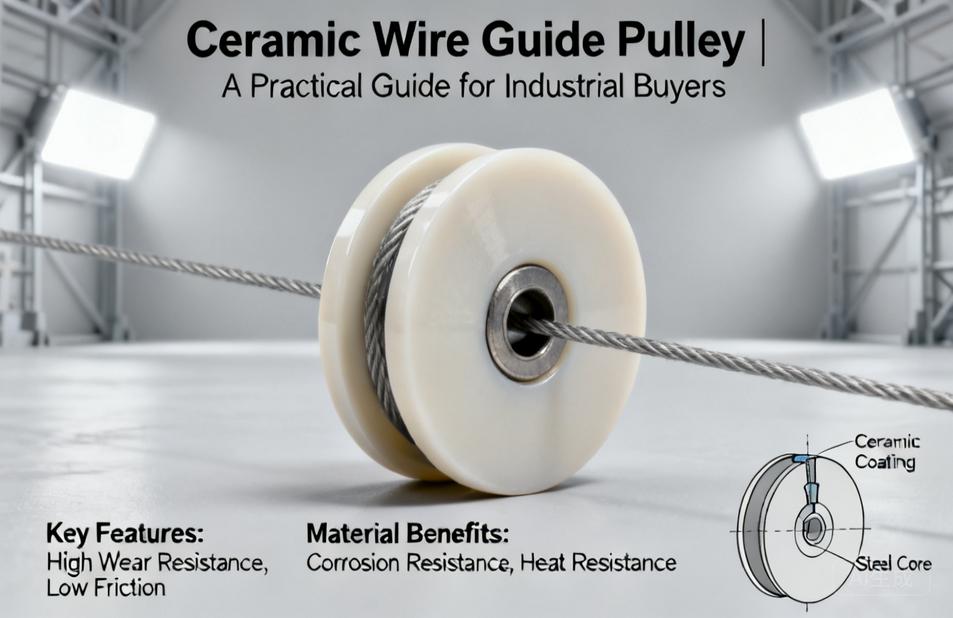
A ceramic wire guide pulley is a precision routing component used to guide, tension, and redirect wire, cable, or fiber without damaging the moving material. In industrial machinery, these pulleys are commonly found in wire drawing lines, coil winding equipment, cable manufacturing, textile machines, and automated wire processing systems. Because the wire runs continuously over the pulley surface, the choice of material and groove geometry directly affects wire quality, machine uptime, and maintenance frequency.
For procurement teams and engineers sourcing wire guide components, understanding how ceramic pulleys work, where they are used, and how to match them to specific equipment is essential. This guide covers product construction, application scenarios, selection criteria, customization options, and supplier evaluation factors for overseas buyers.
What Is a Ceramic Wire Guide Pulley?
A ceramic wire guide pulley consists of a ceramic insert or ceramic-coated ring mounted on a metal or plastic body, often supported by a bearing or bushing. The ceramic surface forms the contact area where the wire runs. Depending on the design, the pulley may have a V-groove, U-groove, flat profile, or custom radius to match the wire diameter and routing angle.
Unlike metal pulleys, ceramic contact surfaces resist abrasion from continuous wire movement. This makes them suitable for fine wire, enameled wire, stainless steel wire, and optical fiber applications where surface damage or contamination can cause defects. The pulley body provides structural support, while the ceramic ring protects the wire and extends service life.
Key Features Buyers Look For
When evaluating ceramic wire guide pulleys, buyers typically focus on features that influence wire quality and production efficiency:
- Low friction surface: Reduces drag on the wire, which helps maintain consistent tension.
- Abrasion resistance: Ceramic materials withstand continuous contact better than many metal surfaces.
- Smooth groove finish: Minimizes scratching or marking on delicate wire and cable.
- Chemical stability: Suitable for environments where lubricants or cleaning agents are present.
- Bearing options: Available with sealed bearings, open bearings, or ceramic bushings depending on speed and load.
Materials and Construction
Most ceramic wire guide pulleys use alumina ceramic (Al2O3) or zirconia ceramic for the contact ring. Alumina offers good wear resistance and is widely used in general wire guiding. Zirconia provides higher toughness and is sometimes selected for applications with vibration or shock loading. Some designs use ceramic-coated metal instead of a solid ceramic ring.
The pulley body is often made from aluminum alloy, stainless steel, or engineering plastic. The choice depends on the mounting method, the required mechanical strength, and the operating environment. Bearings can be steel, stainless steel, or ceramic, and the selection affects speed limits, noise, and maintenance intervals.
Typical Industrial Applications
Ceramic wire guide pulleys are used across many industries where wire or cable routing is part of the production process:
Wire and Cable Manufacturing
In wire drawing, stranding, and cabling lines, these pulleys guide wire through tension devices, capstans, and take-up systems. The ceramic surface helps prevent scratches that can affect conductivity or insulation.
Coil Winding and Transformer Production
During coil winding, enameled wire is routed under controlled tension. A smooth ceramic pulley reduces the risk of enamel damage, which can lead to electrical faults.
Textile and Fiber Processing
Textile machinery uses guide pulleys for yarn and synthetic fiber routing. Ceramic surfaces resist wear from continuous fiber movement and help maintain consistent yarn tension.
Welding Wire and Automation
In automated welding cells, ceramic pulleys guide filler wire from spools to welding torches. They are also found in robotic wire feeding systems and 3D printing filament guides.
How to Choose the Right Ceramic Wire Guide Pulley
Selecting a pulley requires matching several parameters to the actual operating conditions. Buyers should consider:
- Wire or cable diameter: The groove size must match the wire diameter to avoid pinching or excessive movement.
- Line speed: Higher speeds require bearings rated for the corresponding RPM and low vibration.
- Load and tension: The pulley body and bearing must handle the maximum tension in the system.
- Environment: Temperature, humidity, dust, and chemical exposure influence material selection.
- Mounting method: Shaft mount, bracket mount, or custom housing designs affect compatibility.
- Maintenance access: Easy replacement or re-lubrication can reduce downtime.
It is also important to review the wire path. The number of pulleys, wrap angle, and direction changes determine the cumulative friction and tension loss. In some cases, a combination of different pulley sizes is needed to maintain stable wire transport.
Customization and OEM Options
Many ceramic wire guide pulley manufacturers offer customization for specific machinery or production lines. Common custom options include:
- Non-standard groove profiles for specialty wire or fiber
- Specific shaft diameters, bore sizes, or mounting flanges
- Material combinations such as alumina ceramic with stainless steel body
- Bearing type and sealing level
- Surface finish requirements for sensitive wire
- Private labeling or OEM packaging for distributors
When requesting a custom pulley, buyers should provide drawings or samples, wire type and diameter, operating speed, tension range, and environmental conditions. A supplier with in-house machining and ceramic processing capabilities can usually respond more efficiently to custom requirements.
Buying Considerations for Overseas Procurement
Price is only one factor in total cost of ownership. A low-cost pulley that wears quickly can cause wire defects, downtime, and replacement labor. Buyers should evaluate:
- Dimensional consistency: Batch-to-batch variation affects installation and wire path alignment.
- Surface quality: Cracks, chips, or rough spots can damage wire.
- Bearing performance: Smooth rotation and appropriate clearance affect noise and life.
- Packaging: Ceramic components need protection during shipping to prevent breakage.
- Documentation: Material certificates, dimensional reports, or inspection records may be required for quality systems.
For repeat orders, establishing a clear specification and sampling process helps maintain consistency. It is also useful to discuss failure modes with the supplier so that material and design choices match the actual application.
Choosing a Reliable Supplier
When sourcing ceramic wire guide pulleys, look for a manufacturer or supplier with experience in ceramic components and wire handling applications. A factory that controls ceramic forming, sintering, and precision grinding can maintain tighter tolerances. Ask about their quality control process, typical lead times for standard and custom items, and whether they support OEM or private label programs.
Communication matters as well. A supplier who asks about wire type, speed, and environment is more likely to recommend a suitable pulley than one who only quotes a generic part number. For buyers developing new equipment, involving the supplier early can reduce integration issues.
Frequently Asked Questions
What is the difference between alumina and zirconia ceramic pulleys?
Alumina ceramic is widely used for general wire guiding and offers good wear resistance at a lower cost. Zirconia ceramic has higher toughness and may be preferred in applications with vibration or impact. The best choice depends on wire material, speed, and operating conditions.
Can ceramic wire guide pulleys be used with enameled wire?
Yes, they are often used with enameled wire because a smooth ceramic surface helps reduce the risk of enamel damage. However, the groove finish and wire tension should be controlled to avoid mechanical stress on the insulation.
How do I determine the correct pulley size?
Start with the wire or cable diameter to select the groove size. Then consider line speed, tension, and mounting space. If possible, provide a drawing or sample of the existing pulley so the supplier can match dimensions and profile.
Do suppliers offer custom or OEM ceramic pulleys?
Many manufacturers offer custom groove profiles, shaft sizes, materials, and branding options. Buyers should provide application details and required quantities so the supplier can confirm feasibility and production requirements.
Conclusion
Choosing the right ceramic wire guide pulley involves balancing wire protection, wear life, bearing performance, and dimensional fit. Buyers should define the application conditions first, then evaluate material and design options that match those conditions. Customization and OEM support can be valuable when standard pulleys do not fit the equipment or when a specific wire path needs optimization.
If you are sourcing ceramic wire guide pulleys for a new line or replacing worn components, sharing your wire type, speed, tension, and mounting details with a qualified supplier can help you identify a practical solution. Discussing specifications, customization options, and OEM requirements early in the process supports smoother procurement and more reliable production.
