

Coating Service Overview
When engineers and procurement teams search for a ceramic guide wheel factory, they are usually looking for a partner who can supply precision ceramic wheels that guide, tension, or support wire, thread, tape, film, and other flexible materials without introducing wear, friction damage, or contamination. Ceramic guide wheels are small but critical components in wire drawing machines, textile equipment, cable manufacturing lines, optical fiber processing, and automated winding systems. Because the wheel surface contacts the moving material directly, its material, finish, bore tolerance, and mounting style influence product quality and machine uptime. This guide explains what these wheels do, how they are made, what to evaluate, and how to work with a ceramic guide wheel manufacturer or supplier on standard and custom requirements.
What a Ceramic Guide Wheel Does in Industrial Equipment
A ceramic guide wheel is a rotating or fixed wheel made from technical ceramic, often used to route, tension, or change the direction of wire, fiber, thread, or strip material. Unlike metal pulleys, ceramic guide wheels resist abrasion and can maintain a smooth contact surface over long production runs. In many machines, the wheel works together with ceramic eyelets, guide rollers, and tension assemblies to keep the material aligned and prevent surface scratches.
Typical industrial applications include wire drawing and enameling, cable and wire harness production, textile spinning and twisting, optical fiber processing, capacitor winding, and film slitting lines. In each case, the wheel must match the line speed, material tension, and ambient conditions of the equipment.
Key Features Buyers Look For
Purchasing teams and machine builders generally evaluate ceramic guide wheels on several practical points. The contact surface should be smooth and consistent to reduce friction and avoid marking delicate materials. The bore and outer diameter need to hold tolerance so the wheel runs true on its shaft or bearing. Edge geometry matters when the material must be guided without slipping off. Low wear rate and chemical stability are also important in environments where lubricants, solvents, or elevated temperatures are present.
Another consideration is weight and inertia. A lighter wheel can respond faster in high-speed winding and tension control systems, while a heavier wheel may suit low-speed, high-load guiding. The mounting method, whether the wheel runs on a bearing, a ceramic bushing, or a fixed shaft, also affects maintenance and replacement time.
Materials and Construction
Alumina and zirconia are common technical ceramic materials for guide wheels. Alumina offers good wear resistance and electrical insulation at a relatively economical cost, while zirconia provides higher toughness and can be suitable for applications where impact or edge loading is a concern. The choice depends on the material being guided, the line speed, and the mechanical load.
Manufacturing usually involves pressing or forming the ceramic body, machining or grinding to size, and then firing. After firing, the wheel may be diamond-ground to achieve the required surface finish and dimensional tolerance. Some designs include a metal hub or bearing insert, which requires careful assembly to avoid stress concentrations. A capable ceramic guide wheel factory should control the full process, from material preparation to final inspection, and should be able to explain how each step affects the finished wheel.
Matching the Wheel to Your Machine and Process
Selecting the right guide wheel starts with the material being processed. Fine wire and optical fiber demand a very smooth surface and tight runout to avoid surface defects. Textile threads may require a specific groove profile to keep the yarn centered. Flat tape and film often need a crowned or flat face to maintain web tracking.
Machine interface details are equally important. The bore diameter, width, and mounting configuration must match the existing shaft or bearing housing. Shaft speed and radial load determine whether a plain bore, bushing, or bearing version is appropriate. Environmental factors such as temperature, humidity, and chemical exposure should also be reviewed, because they can influence material selection and long-term performance.
For OEM projects, sharing the machine drawing, sample wheel, or application details helps the supplier recommend a suitable ceramic grade, surface finish, and tolerance class. In many cases, a small change in groove radius or edge chamfer can solve a persistent guiding problem.
Customization and OEM Options
Many ceramic guide wheel manufacturers offer custom sizes, groove profiles, bore configurations, and material grades. Custom work may include special outer diameters, V-grooves, U-grooves, flanged edges, or stepped bores. OEM buyers often need private labeling, custom packaging, or kitting with related ceramic parts such as eyelets and guide pins.
When requesting a custom quote, provide as much technical detail as possible: material to be guided, wheel dimensions, tolerance requirements, surface finish, load and speed conditions, and the quantity needed for initial samples and mass production. A factory that asks detailed questions is usually better prepared to deliver a working solution than one that quotes immediately without reviewing the application.
How to Choose a Reliable Supplier
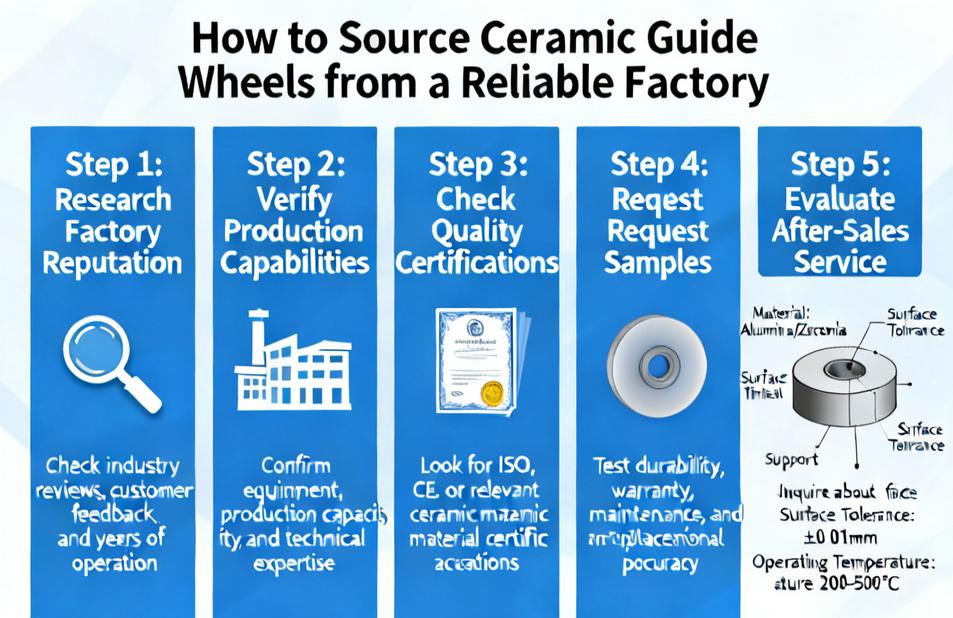
Supplier selection should go beyond price per piece. Check whether the factory has in-house ceramic forming, grinding, and inspection capabilities, because outsourcing critical steps can affect consistency. Ask about dimensional inspection methods and how they document critical dimensions. Review their experience with similar industrial applications, such as wire, cable, textile, or optical fiber equipment.
Communication matters too. A supplier who can provide clear technical feedback, recommend alternative designs, and respond to tolerance questions is more valuable than one who only confirms a part number. For long-term supply, discuss packaging protection, batch traceability, and how they handle replacement or nonconforming parts. If the project involves OEM production, clarify tooling ownership, sample approval steps, and production lead times without assuming specific numbers.
Buying Considerations for Volume and Quality
Ceramic guide wheels are often purchased in batches for machine assembly or aftermarket replacement. Buyers should confirm that the supplier can maintain the same material grade and dimensions across repeat orders. Incoming inspection should focus on bore diameter, outer diameter, runout, surface finish, and visible defects such as chips or cracks at the edges. Proper packaging is essential because ceramic parts can chip if they rub against each other during shipping.
For critical applications, request samples for trial runs before committing to volume. Document the approved sample and use it as a reference for future shipments. This simple practice reduces the risk of receiving wheels that meet the drawing but do not perform as expected on the machine.
Frequently Asked Questions
What information do I need to provide to get an accurate quote?
Provide the material being guided, wheel dimensions, bore size, groove profile, required tolerance, surface finish, operating speed and load, environmental conditions, and estimated annual quantity. Photos or samples of the current wheel are also helpful.
Can ceramic guide wheels be customized for my machine?
Yes. Many factories offer custom dimensions, groove shapes, bore configurations, and ceramic material grades. OEM and private label options are also common for machine builders and distributors.
How do I compare ceramic guide wheel suppliers?
Compare their in-house manufacturing capability, inspection process, experience in your application, technical communication, and ability to maintain consistency across repeat orders. Price should be evaluated together with these factors.
What causes a ceramic guide wheel to fail?
Common causes include edge chipping from handling or misalignment, improper bore fit, excessive radial load, and surface wear from abrasive materials. Correct selection and proper installation reduce these risks.
Conclusion
Working with the right ceramic guide wheel factory means balancing material selection, dimensional precision, application fit, and long-term supply reliability. Buyers should define the application first, then evaluate a supplier’s technical capability and customization options. If you need help matching a guide wheel to your equipment or want to discuss OEM or custom production, contact the supplier with your specifications and application details to request a suitable recommendation.
