

Coating Service Overview
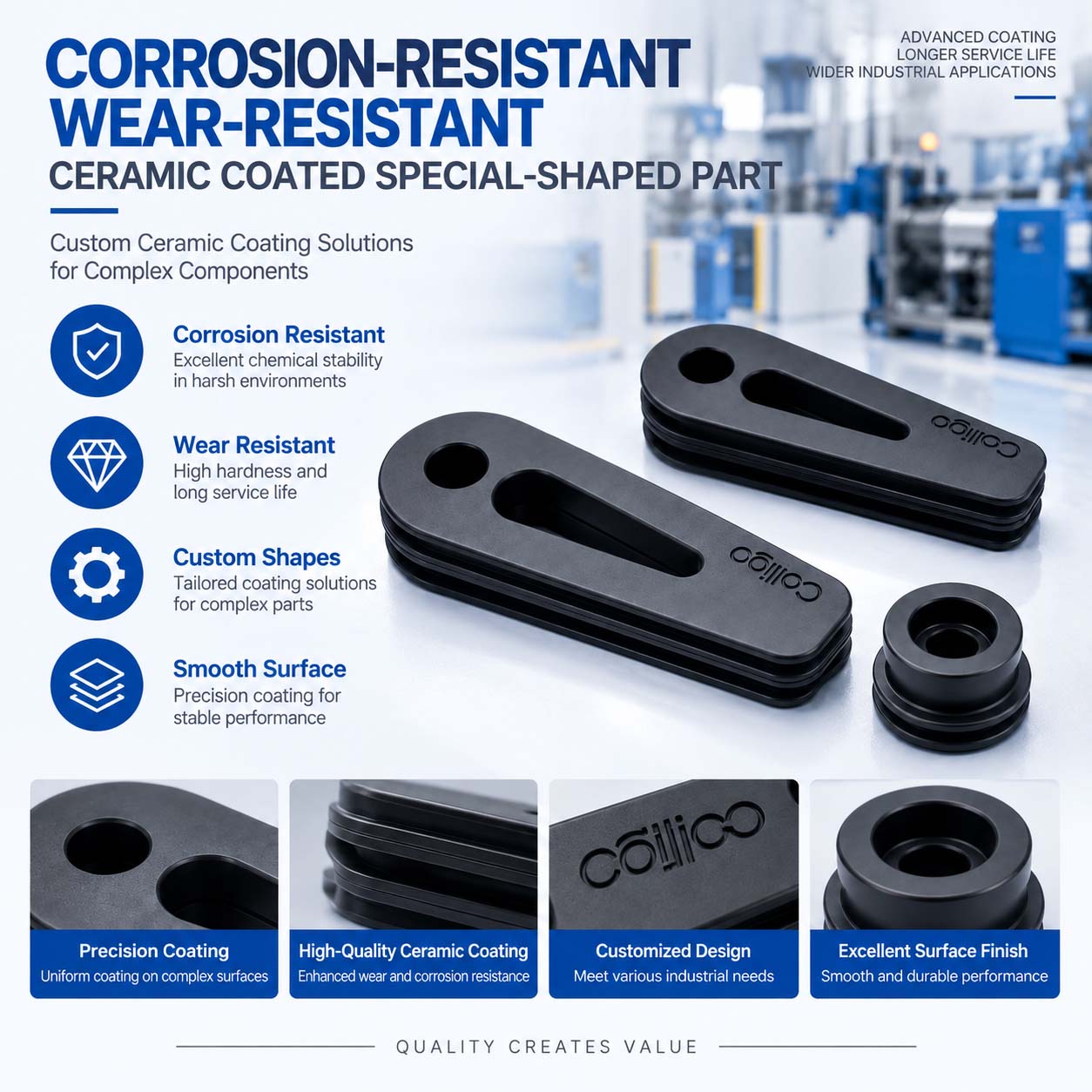
In industries such as wire drawing, textile manufacturing, and chemical processing, many critical components have complex shapes and are continuously exposed to wear and corrosion. Conventional coating processes often struggle to achieve uniform coverage on irregular surfaces, resulting in premature local failure.
To solve these challenges, we provide custom ceramic coated wear-resistant components using advanced thermal spray technology. High-performance ceramic coatings are applied to component surfaces to significantly improve wear resistance, corrosion protection, and service life.
This article introduces suitable coating materials, processing methods, applications, and maintenance recommendations.
Ceramic Coating Materials and Systems
Different ceramic coatings can be selected according to specific working conditions:
- Zirconia (ZrO₂) Coating:
Excellent high-temperature resistance, thermal shock resistance, and thermal insulation properties. Suitable for high-temperature wear environments, such as wire drawing machine components. - Silicon Carbide (SiC) Coating:
Provides extremely high hardness, excellent abrasive wear resistance, and strong corrosion resistance. Suitable for severe wear and chemical environments. - Alumina (Al₂O₃) Coating:
Offers electrical insulation, wear resistance, and cost-effective performance. Widely used for general industrial applications. - Tungsten Carbide (WC) Coating:
Provides outstanding wear resistance for heavy-duty applications. However, its temperature resistance is generally lower than ceramic coatings.
Common substrate materials include stainless steel, aluminum alloy, and carbon steel. The coating is firmly bonded to the substrate through mechanical and metallurgical bonding. Bond strength can exceed 70 MPa depending on coating material and processing conditions.
Processing Procedure and Quality Control
Complex-shaped components require precise coating processes:
1. Surface Preparation
The component surface is cleaned, degreased, and grit blasted to increase surface roughness and improve coating adhesion.
2. Thermal Spray Process
Advanced processes such as plasma spraying and High Velocity Oxygen Fuel (HVOF) spraying are selected according to application requirements.
For irregular surfaces, customized spray paths are designed to ensure uniform coating thickness. Extended spray guns and rotary fixtures can be used for deep holes and internal surfaces.
3. Post Processing
After spraying, the coating can be precision ground or polished to achieve required dimensions and surface finish. Sealing treatment may also be applied to further improve corrosion resistance.
4. Inspection
Quality inspection includes:
- Coating thickness measurement
- Bond strength testing
- Hardness testing
- Surface inspection for cracks or peeling
With multi-axis robotic systems and positioning equipment, we can process complex components ranging from small parts to large industrial components. Maximum workpiece capacity can be customized according to requirements.
Typical Applications
Ceramic coated custom components are widely used in:
Wire Drawing Industry
Components such as capstans, guide wheels, and take-up pulleys experience continuous high-speed wire friction. Ceramic coatings improve wear resistance, reduce wire damage, and extend service intervals.
Textile Machinery
Guide rollers, yarn guides, and other components require smooth, wear-resistant surfaces. Ceramic coatings help reduce fiber damage and improve equipment stability.
Chemical Pumps and Valves
Impellers, valve cores, and other special-shaped components benefit from excellent corrosion resistance, extending maintenance cycles in aggressive chemical environments.
Paper Manufacturing Equipment
Rollers, doctor blades, and other parts require resistance against pulp abrasion and chemical corrosion.
Coating Selection and Maintenance
How to Select the Right Coating Material
Selection should be based on the main failure mode:
- Severe wear conditions: Silicon carbide or tungsten carbide coatings
- High-temperature environments: Zirconia coatings
- Electrical insulation requirements: Alumina coatings
- Combined wear and corrosion conditions: Composite or gradient coatings
Providing operating conditions such as temperature, medium, load, and speed helps determine the most suitable coating solution.
Usage and Maintenance Recommendations
- Avoid impact on coating edges during installation and use suitable soft tools.
- Regularly inspect coating surfaces for cracks, peeling, or damage.
- Use neutral cleaning agents and avoid prolonged exposure to strong acids or alkalis unless the coating is specifically designed for such environments.
- Store components in dry conditions to prevent substrate corrosion.
Frequently Asked Questions
Can Complex Internal Holes Be Coated?
Yes. Internal surfaces with larger diameters can usually be coated using specialized spray guns. Smaller internal holes require technical evaluation because accessibility may limit thermal spraying applications.
What Is the Typical Coating Thickness?
Typical coating thickness ranges from 0.1–0.5 mm. Thicker coatings can be designed according to wear requirements, but excessive thickness may reduce bonding strength.
Will the Coating Change Component Dimensions?
Yes. The spraying process increases component dimensions, so machining allowance must be reserved. After grinding, dimensional accuracy can typically be controlled within approximately ±0.05 mm depending on requirements.
What Temperature Can Ceramic Coatings Withstand?
Zirconia coatings can generally operate at high temperatures up to around 800°C in suitable conditions. Silicon carbide coatings can withstand higher temperatures in non-oxidizing environments. Actual performance also depends on substrate material.
What Is the Production Lead Time?
Lead time depends on component complexity and quantity. Typical samples require about 5–10 working days, while batch production usually requires 15–25 working days.
How Can I Request a Quote?
Please provide drawings or samples together with substrate material, quantity, coating requirements, and operating conditions. We will evaluate the requirements and provide a suitable coating solution.
