

Coating Service Overview
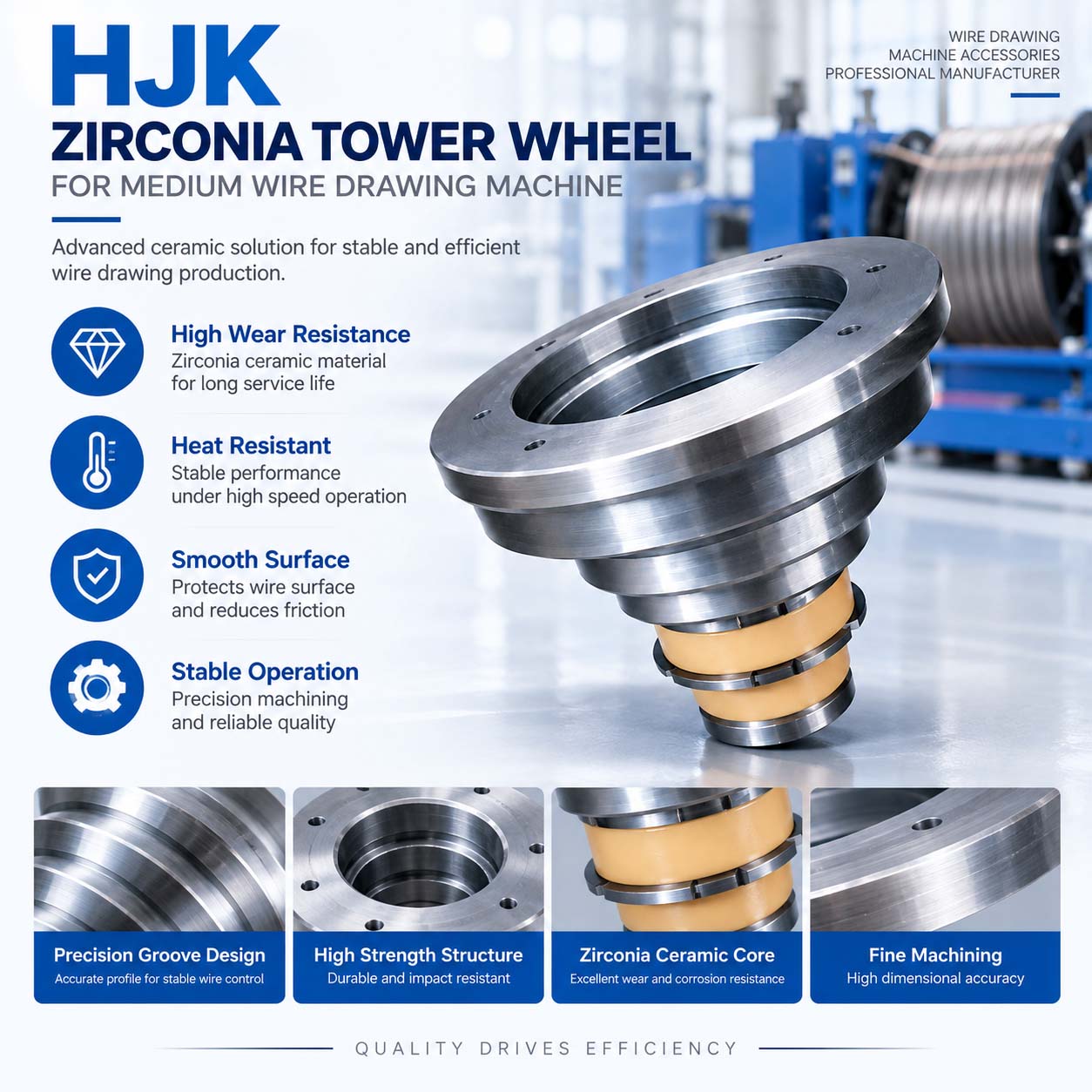
In metal wire drawing processes, medium wire drawing operations require capstans with excellent wear resistance, surface finish, and dimensional stability. The HJK Zirconia Capstan for Medium Wire Drawing Machine is specially designed to meet these demanding requirements.
The working area of this capstan uses advanced zirconia ceramic material. Compared with traditional metal or carbide capstans, it provides superior wear resistance, corrosion resistance, and wire surface protection, helping extend maintenance intervals and reduce overall operating costs.
Product Features and Material Advantages
The performance of HJK Zirconia Capstan mainly comes from the excellent properties of zirconia ceramic:
- High Hardness and Wear Resistance:
Zirconia ceramic has outstanding hardness and wear resistance, effectively resisting friction from high-speed wire movement while maintaining accurate groove profiles. - Low Friction Coefficient:
The smooth ceramic surface reduces drawing resistance, lowers energy consumption, and minimizes scratches, burrs, and surface damage on the wire. - Excellent Impact Toughness:
Through transformation toughening technology, zirconia ceramic provides better impact resistance compared with many other ceramics. It can withstand frequent start-stop operations and tension fluctuations during medium wire drawing. - Chemical Stability:
Zirconia is highly resistant to drawing lubricants, cleaning agents, and environmental corrosion. It does not rust or react with wire materials.
Typical Applications
HJK Zirconia Capstans are widely used in medium wire drawing processes for various metal wires, including:
- Copper wire and copper alloy wire
- Aluminum wire and aluminum alloy wire
- Stainless steel wire and galvanized steel wire
- Other non-ferrous metal and alloy wires
They are commonly used in industries such as:
- Electrical wire and cable manufacturing
- Welding wire production
- Spring wire processing
- Network cable production
The capstan can be adapted to various domestic and international medium wire drawing machines. Installation dimensions should be confirmed according to specific equipment requirements.
Selection and Installation Guide
Proper selection and installation are essential for achieving the best performance and service life.
Groove Design
Select suitable groove diameter, groove shape, and pitch circle diameter according to wire diameter and drawing passes. Proper groove matching helps prevent uneven wear and ensures stable wire contact.
Installation Accuracy
Ensure accurate alignment between the capstan and shaft. Use proper installation tools and avoid excessive tightening or vibration during operation.
Dynamic Balance
For high-speed wire drawing applications, the capstan should be dynamically balanced to reduce vibration and improve drawing stability.
Supporting Components
Check compatibility of bearings, spacers, locking nuts, and other related components. Replace worn supporting parts when necessary.
Maintenance and Care
Proper maintenance can significantly extend the service life of zirconia capstans.
- Regular Groove Inspection:
Check groove wear regularly. Replace the capstan if deep grooves, cracks, or ceramic chipping appear. - Cleaning and Lubrication:
Keep the capstan surface clean and remove lubricant residue, metal particles, and contaminants. Ensure proper bearing lubrication to prevent overheating or seizure. - Storage Conditions:
Store spare capstans in a dry environment without corrosive gases. Avoid impact and protect ceramic surfaces from hard objects. - Abnormal Condition Inspection:
If wire breakage increases suddenly, wire diameter fluctuates, or abnormal noise appears, stop the machine and check capstan wear, alignment, and installation conditions.
Frequently Asked Questions
What Is the Difference Between Zirconia and Silicon Carbide Capstans?
Zirconia capstans provide better toughness and impact resistance, making them suitable for medium wire drawing conditions with certain mechanical impacts. Silicon carbide offers higher hardness and wear resistance but has higher brittleness, making it more suitable for fine and micro wire drawing applications. Selection should be based on wire material, drawing speed, and equipment conditions.
Can a Worn Zirconia Capstan Be Repaired?
Minor wear may be corrected through precision grinding if groove accuracy and surface finish can be maintained. For severe wear, cracks, or ceramic chipping, replacement is recommended to ensure wire quality and equipment safety.
How Can Proper Installation Be Verified?
After installation, manually rotate the capstan to confirm smooth movement without resistance. Use a dial indicator to check radial and axial runout according to equipment requirements. Perform low-speed testing to confirm there is no abnormal vibration or noise.
What Lubricants Are Compatible with Zirconia Capstans?
Zirconia ceramic is chemically stable and compatible with most water-based and oil-based wire drawing lubricants. Avoid lubricants containing strong acids, strong alkalis, or abrasive particles that may damage the surface.
How Long Is the Service Life?
Service life depends on wire material, drawing speed, tension, lubrication conditions, and maintenance quality. There is no fixed service period. Regular inspection and wear records are recommended to determine the optimal replacement cycle.
Can Non-Standard Sizes Be Customized?
Yes. Customized zirconia capstans can be manufactured according to customer drawings, samples, and specific equipment requirements after technical evaluation.
