

Coating Service Overview
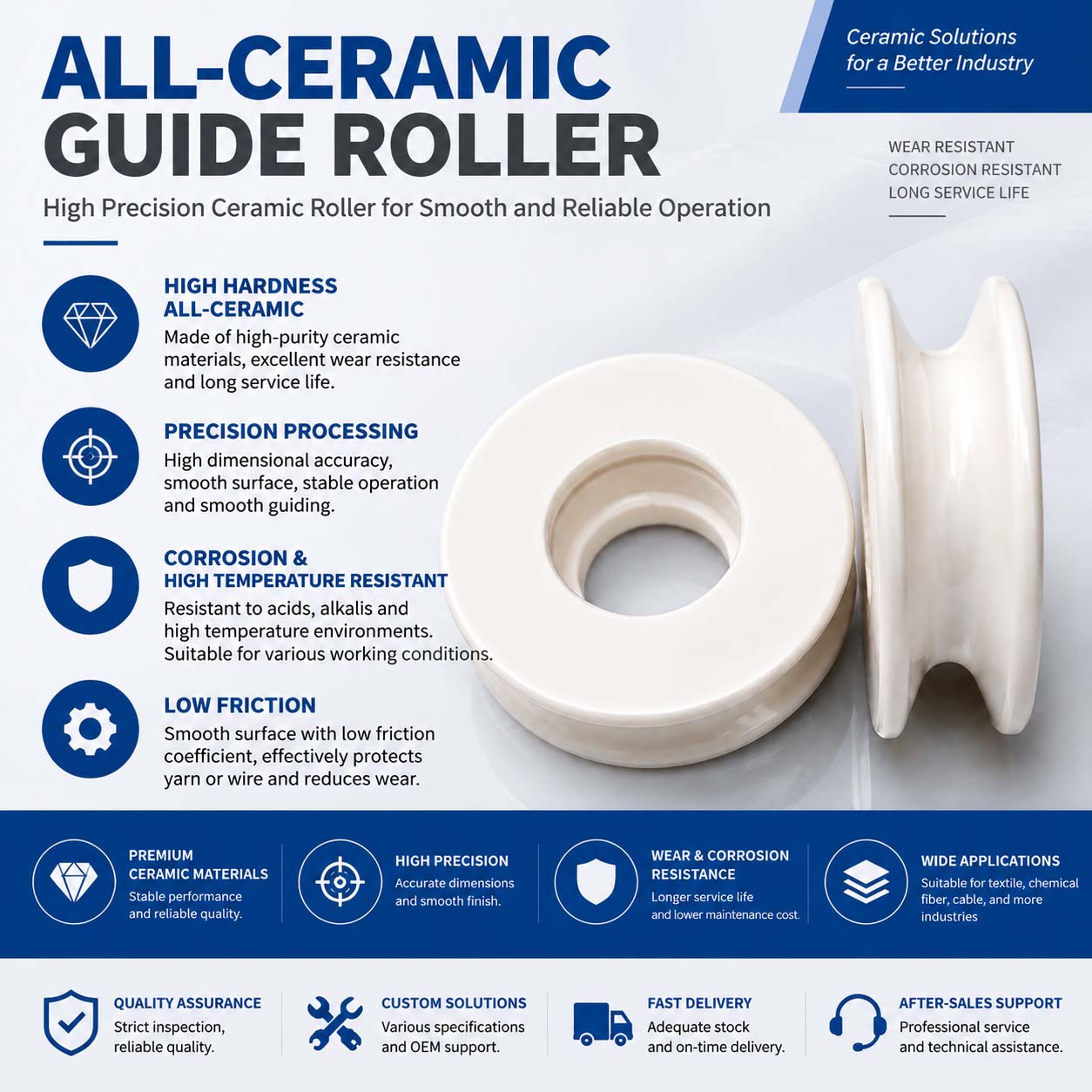
In textile, chemical fiber, and machinery industries, guide rollers, yarn guides, and wire-guiding components are continuously exposed to high-speed friction and chemical environments. Conventional metal or plastic parts often cannot meet demanding operating conditions.
All-ceramic guide rollers and hard alloy coating technologies provide long-term protection for critical components through high hardness, low friction, and excellent corrosion resistance.
We specialize in thermal spray processing, including HVOF (High Velocity Oxygen Fuel) spraying, plasma spraying, and other surface treatment technologies, providing complete solutions from new component coating to worn part refurbishment.
Features and Applications of All-Ceramic Guide Rollers
All-ceramic guide rollers are manufactured from high-purity ceramic materials such as alumina (Al₂O₃) or zirconia (ZrO₂) through high-temperature sintering.
Main Advantages
- Excellent hardness and wear resistance: Significantly extends roller service life.
- Smooth surface finish: Reduces friction and minimizes damage to yarn and wire.
- Excellent chemical stability: Resistant to acids, alkalis, and organic solvents.
- Electrical insulation and non-magnetic properties: Suitable for special industrial environments.
Typical applications include:
- Textile yarn guide rollers
- Chemical fiber spinning equipment guide components
- Cable industry wire guide rollers
All-ceramic guide rollers help reduce yarn breakage, fiber damage, and production interruptions while improving product quality.
Hard Alloy Coating Technologies
Hard alloy coatings mainly include tungsten carbide (WC) and chromium carbide (CrC) coatings. These materials are applied onto metal substrates through thermal spray processes, creating high-hardness and wear-resistant protective layers.
HVOF Thermal Spray
HVOF uses high-speed combustion flame to accelerate coating particles onto the substrate surface, forming dense coatings with excellent bonding strength.
Typical tungsten carbide coating properties:
- Hardness: approximately 1100–1300 HV
- Low porosity structure
- Excellent wear resistance
HVOF coatings are widely used for severely worn components such as rollers, plungers, valves, and mechanical transmission parts.
Plasma Spraying
Plasma spraying provides extremely high temperatures and is suitable for high-melting-point materials.
It is commonly used for:
- Ceramic coatings
- Heat-resistant coatings
- Thermal barrier coatings
- Electrical insulation coatings
Compared with HVOF, plasma spraying generally produces slightly higher porosity but offers greater material flexibility.
Arc Spraying
Arc spraying provides high efficiency and lower cost, making it suitable for large-area coating applications.
Common materials include:
- Zinc
- Aluminum
- Stainless steel alloys
It is widely used for corrosion protection and dimensional restoration of large components.
Tungsten Carbide Coating Services
“Tungsten steel” commonly refers to tungsten-containing hard materials, and industrial spraying applications mainly use tungsten carbide powder.
We provide complete tungsten carbide coating services, including:
- Surface preparation
- Thermal spraying
- Precision grinding and polishing
After finishing, coating surfaces can achieve roughness below Ra 0.2 μm, meeting precision assembly requirements.
Typical applications include:
- Paper machine rollers and doctor blades
- Oil drilling components
- Molds and cutting tools
- Wear-resistant industrial parts
Thermal Spray Repair for Used Components
For worn or corroded components, thermal spray repair provides an economical alternative to replacement.
The repair process includes:
- Cleaning and surface preparation
- Sandblasting treatment
- Application of wear-resistant or corrosion-resistant coatings
- Precision machining to restore dimensions
Refurbished components can achieve performance comparable to or better than new parts.
Repairable components include:
- Shafts
- Bearing seats
- Sealing surfaces
- Impellers
- Mechanical wear parts
Coating Selection and Maintenance
When selecting a coating system, consider:
Wear Conditions
Different wear mechanisms require different materials:
- Abrasive wear
- Erosion wear
- Sliding wear
Operating Temperature
High-temperature environments require heat-resistant coatings such as ceramic coatings.
Corrosion Environment
Acidic and alkaline conditions require corrosion-resistant ceramic or alloy coatings.
Substrate Compatibility
The coating and substrate thermal expansion characteristics must be compatible to prevent cracking or peeling.
Maintenance Recommendations
- Regularly inspect coating surfaces for cracks or peeling.
- Avoid impact damage during operation and installation.
- Clean with soft materials or neutral detergents.
- Prevent contamination and surface scratches.
Frequently Asked Questions
Can all-ceramic guide rollers break?
Ceramic materials are relatively brittle and may crack under severe impact or overload. Under proper installation and normal operation, their service life is significantly longer than metal rollers.
How thick can hard alloy coatings be?
Typical coating thickness ranges from 0.1–0.5 mm. Special applications may require coatings over 1 mm, but thickness must be designed according to bonding strength requirements.
Can coated parts be machined after spraying?
Yes. Grinding and polishing can achieve required dimensions and surface finish. Diamond grinding tools are usually required due to the high coating hardness.
How long can repaired components last?
Service life depends on coating material, process parameters, and operating conditions. Properly repaired components can often achieve or exceed the performance of new parts.
How should the thermal spray process be selected?
HVOF is preferred for high wear resistance, plasma spraying for high-temperature and insulation applications, and arc spraying for large-area corrosion protection.
What is the delivery time?
Processing time depends on component size and complexity. Sample orders usually require 3–5 working days, while batch orders are confirmed according to specific requirements.
