

Coating Service Overview
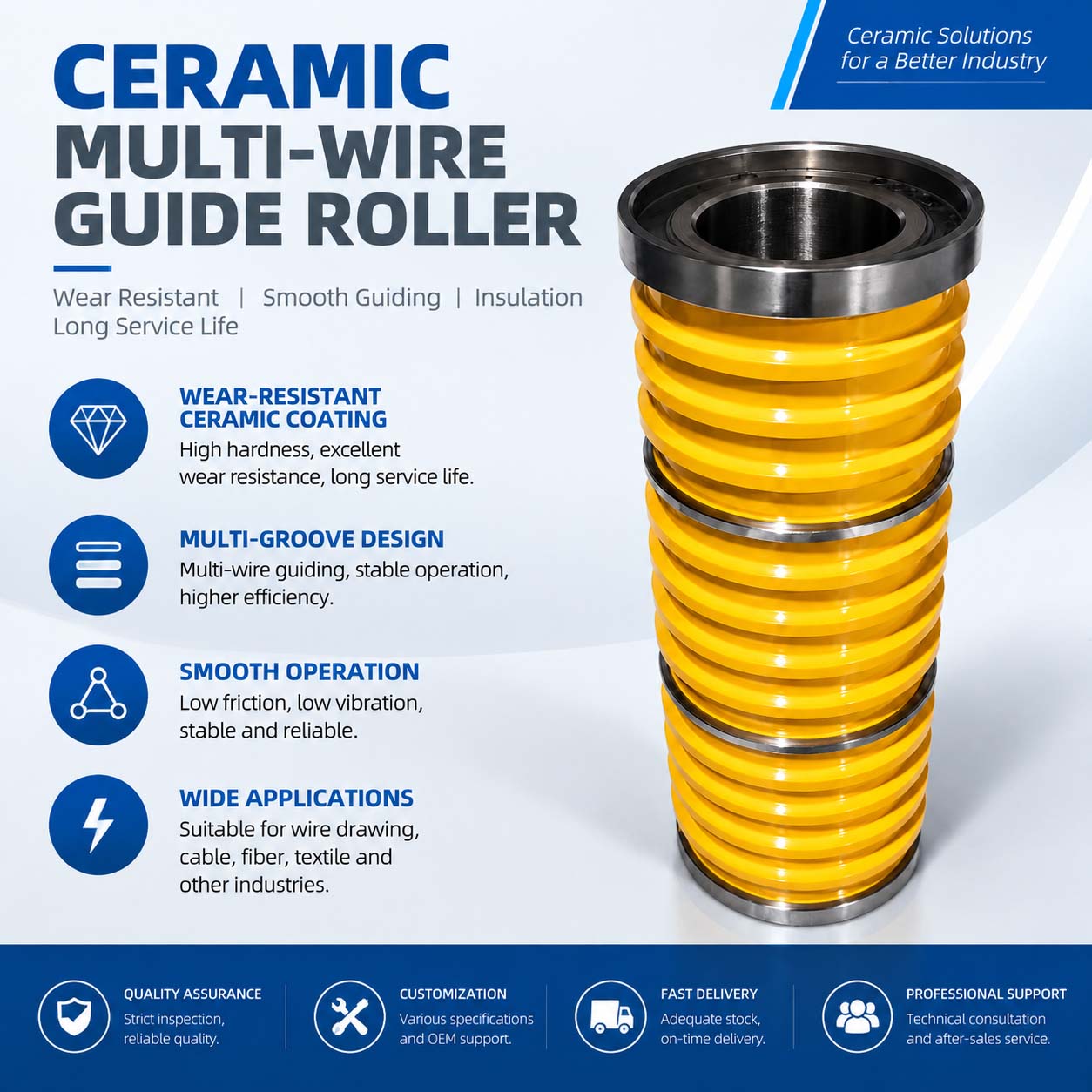
In textile, cable, optical fiber, and wire processing industries, guide rollers continuously contact high-speed moving wires and fibers, experiencing friction, tension, and possible corrosion.
Traditional metal rollers provide good toughness but often suffer from insufficient surface hardness and wear grooves. Full ceramic rollers offer excellent wear resistance but have limited impact resistance and may crack under heavy loads.
Ceramic multi-wire guide rollers with ceramic coating technology combine the advantages of both materials: the metal core provides mechanical strength and impact resistance, while the ceramic coating provides high hardness, low friction, excellent insulation, and corrosion resistance.
This metal ceramic coating process uses thermal spray technology, where ceramic powders are heated to a molten or semi-molten state and sprayed onto the component surface at high speed, forming a dense protective layer. The process significantly extends roller service life and reduces wire scratches and breakage.
What Is Ceramic Coating Processing?
Ceramic coating processing, also known as ceramic spraying, is a surface engineering technology that deposits ceramic materials onto metal or other substrates through thermal spray methods, including:
- Plasma spraying
- HVOF (High Velocity Oxygen Fuel) spraying
Common coating materials include:
- Aluminum oxide (Al₂O₃)
- Chromium oxide (Cr₂O₃)
- Zirconium oxide (ZrO₂)
Typical coating thickness ranges from 0.1–0.5 mm and can be adjusted according to application requirements.
The process does not change the properties of the substrate but significantly improves surface performance, including:
- Wear resistance
- High-temperature resistance
- Electrical insulation
- Corrosion protection
For wire guide rollers, ceramic coatings reduce surface wear and prevent wire damage caused by worn grooves.
Advantages of Ceramic Multi-Wire Guide Rollers
Excellent Wear Resistance
Ceramic coatings can achieve hardness above HRC70, much higher than hardened steel, effectively resisting friction from high-speed wire movement.
Excellent Electrical Insulation
Ceramic materials provide electrical insulation, making them suitable for applications requiring electrical isolation.
Smooth Surface Finish
After grinding and polishing, coating surfaces can achieve roughness below Ra 0.2 μm, reducing friction resistance and protecting wire surfaces.
Corrosion Resistance
Ceramic coatings have excellent chemical stability and can withstand acids, alkalis, moisture, and industrial chemicals.
Strong Mechanical Structure
The metal substrate provides impact resistance and prevents the cracking problems commonly associated with fully ceramic components.
Application Areas
Ceramic multi-wire guide rollers are widely used in:
Textile Machinery
- Chemical fiber spinning equipment
- Texturing machines
- Winding machines
- Yarn guide systems
Wire and Cable Manufacturing
- Copper wire drawing
- Aluminum wire processing
- Cable stranding equipment
- Wire passing systems
Optical Fiber Production
- Fiber coloring equipment
- Fiber ribbon production
- Cable forming processes
Metal Wire Processing
- Steel wire drawing
- Welding wire production
- High-speed wire guiding systems
They are also used in film, tape, and other winding equipment requiring stable guiding performance.
Selection and Customization Guidelines
Substrate Selection
Common substrates include:
- Carbon steel
- Stainless steel
- Aluminum alloy
Aluminum alloy rollers are lightweight and suitable for high-speed, low-load applications. Steel rollers provide higher strength for heavy-duty conditions.
Coating Material Selection
Different ceramic materials provide different advantages:
- Aluminum oxide coating: General-purpose, cost-effective, good wear resistance.
- Chromium oxide coating: Higher density, excellent wear and corrosion resistance.
- Zirconia coating: Excellent thermal shock resistance, suitable for temperature fluctuation environments.
Dimensions and Precision
Roller diameter, groove profile, mounting holes, and other dimensions should be customized according to equipment requirements.
After coating, precision grinding ensures dimensional accuracy and smooth operation.
Coating Thickness and Bond Strength
Typical coating thickness:
- 0.2–0.4 mm
Excessive thickness may affect coating adhesion.
Thermal spray coatings mainly rely on mechanical bonding, with typical bonding strength of approximately 30–50 MPa, meeting most wire guide roller requirements.
Maintenance Recommendations
To maximize service life:
- Regularly inspect coating surfaces for cracks or peeling.
- Clean with soft cloths or brushes and avoid hard tools.
- Ensure bearings operate smoothly to prevent uneven loading.
- Store components in dry environments to prevent substrate corrosion.
Frequently Asked Questions
Will ceramic coatings peel off?
Under proper surface preparation and spraying conditions, ceramic coatings have strong adhesion and normally do not peel. Improper preparation, excessive coating thickness, or severe impact may cause local damage.
Can ceramic coated rollers be used in high-temperature environments?
Yes. Many ceramic coatings can withstand temperatures above 500°C. Zirconia coatings provide even higher temperature resistance for demanding applications.
Can worn ceramic coatings be repaired?
Yes. Damaged rollers can be restored through surface preparation, recoating, and precision grinding, reducing replacement costs.
Does ceramic spraying affect the metal substrate?
Thermal spray processing generally keeps substrate temperatures below approximately 200°C, causing minimal impact on material properties or dimensional stability.
How to select a ceramic coating supplier?
Consider the supplier’s spraying equipment, process control capability, inspection methods, and industry experience. Sample testing and application verification are recommended.
Ceramic coated roller vs. full ceramic roller: which is better?
Full ceramic rollers are suitable for low-impact and high-purity applications. Ceramic coated rollers provide a better balance of toughness, wear resistance, and cost, making them more suitable for applications involving vibration or mechanical impact.
