

Coating Service Overview
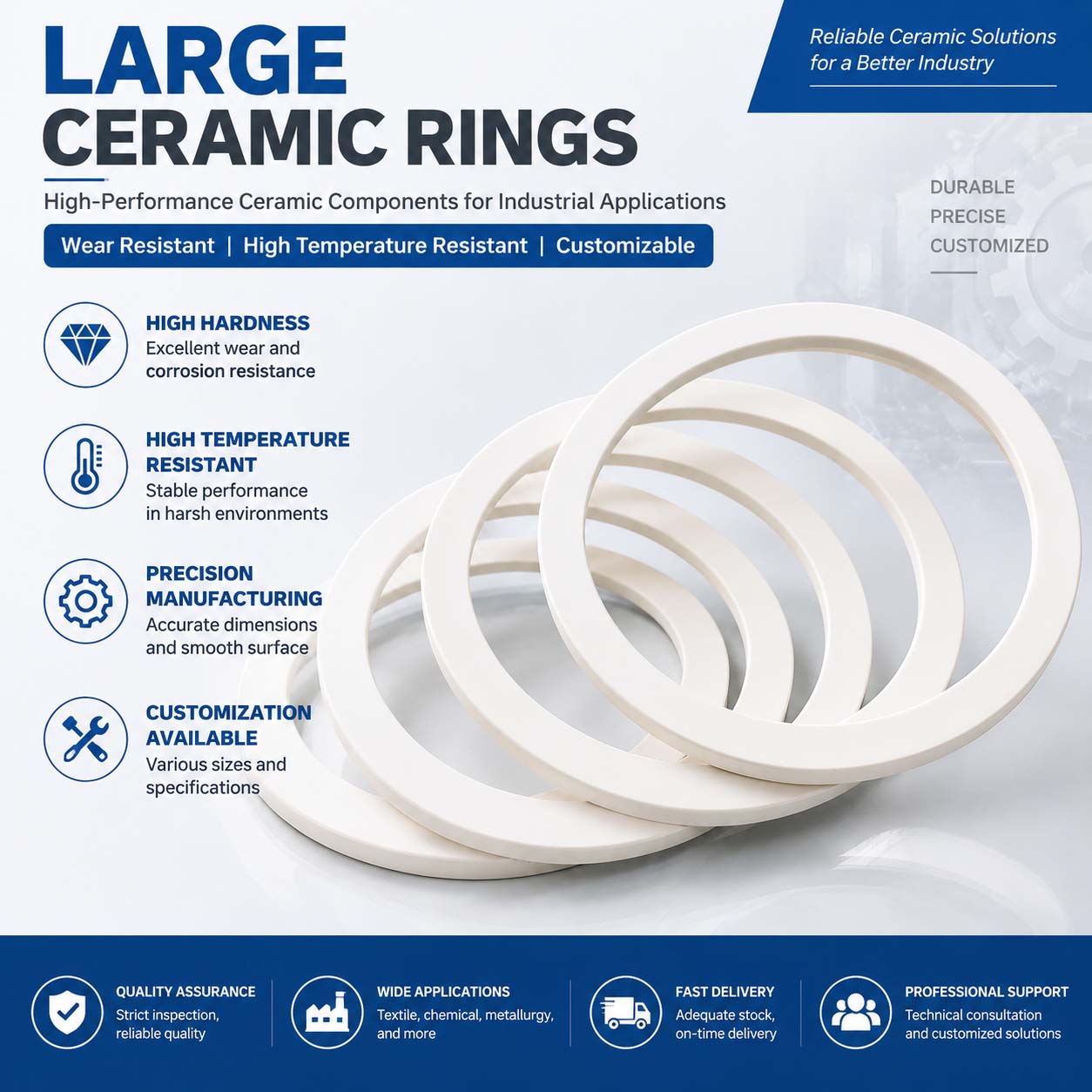
In industrial applications, large ceramic rings are often exposed to wear, corrosion, and harsh operating conditions, which can affect service life and operational stability.
By applying HVOF (High Velocity Oxygen Fuel) thermal spray technology, a tungsten carbide coating can be deposited on the surface of large ceramic rings to significantly improve wear resistance and corrosion protection.
Based on practical processing experience, this article introduces the technology features, applications, material selection, and key considerations for tungsten carbide coated ceramic rings.
HVOF Coating Process and Coating Characteristics
HVOF spraying uses a high-speed flame to heat tungsten carbide powder into a molten or semi-molten state and accelerate it onto the substrate surface at supersonic velocity, forming a dense protective coating.
Main Advantages
High Bonding Strength
The coating forms a strong mechanical bond with the substrate, with bonding strength typically exceeding 70 MPa.
Low Porosity
The coating porosity is generally below 1%, effectively preventing penetration of corrosive media.
High Hardness
Tungsten carbide coatings can achieve approximately 1100–1300 HV, greatly improving wear resistance.
Low Heat Input
The substrate experiences limited thermal influence, reducing the risk of deformation or structural changes.
For large ceramic rings, HVOF coatings provide uniform surface coverage and are suitable for both surface strengthening and refurbishment applications.
Applications and Selection Guidelines
Large ceramic rings are widely used in textile, chemical, metallurgy, and other industries as guiding, sealing, or insulating components.
HVOF tungsten carbide coating is especially suitable for:
- High-speed yarn contact surfaces requiring reduced friction and wear.
- Corrosive environments involving acids, alkalis, or chemical media.
- Refurbishment of worn components to restore dimensions and improve performance.
Coating Material Selection
The most common coating material is WC-Co (tungsten carbide-cobalt).
Typical cobalt contents include:
- WC-12Co
- WC-17Co
These materials provide a balance between hardness and toughness.
For large ceramic rings, WC-12Co is often recommended for applications requiring excellent wear and corrosion resistance.
Substrate Compatibility
Large ceramic rings may use ceramic or metal substrates.
- Ceramic substrates require evaluation of thermal expansion compatibility to prevent coating cracking or peeling.
- Metal substrates such as stainless steel generally provide good coating compatibility but require proper surface preparation.
Processing Steps and Quality Control
The typical HVOF coating process includes:
1. Surface Preparation
The component is cleaned and sandblasted to remove contamination and improve coating adhesion.
2. HVOF Spraying
Tungsten carbide powder is sprayed with controlled parameters to achieve a uniform coating layer.
3. Finishing Process
Grinding or polishing is performed when required to achieve final dimensions and surface finish.
4. Quality Inspection
Coating performance is verified through:
- Microhardness testing
- Bond strength testing
- Porosity analysis
- Thickness measurement
Typical coating thickness ranges from 0.1–0.3 mm, adjustable according to wear requirements.
Maintenance Recommendations
To maximize coating service life:
- Avoid severe impact loads that may cause local coating damage.
- Regularly inspect coating wear and repair damaged areas promptly.
- Clean with suitable neutral cleaning agents and avoid prolonged exposure to strong acids or alkalis.
- Store components in dry conditions to prevent interface corrosion.
Frequently Asked Questions
Can HVOF tungsten carbide coating be applied to all ceramic large rings?
Not always. The compatibility between substrate material and coating thermal expansion must be evaluated. Some ceramics may require process testing before production.
How is coating thickness determined?
Thickness depends on wear rate and expected service life. The typical range is 0.1–0.3 mm. Excessive thickness may increase peeling risk.
Will the size of the ceramic ring change after coating?
Yes. The coating increases the component size. Machining allowance must be reserved before spraying, and final grinding restores the required tolerance.
Can worn large ceramic rings be repaired?
Yes. Damaged areas can be prepared and recoated to restore dimensions and surface performance. However, severely cracked or structurally damaged parts may not be suitable for repair.
What is the difference between HVOF and plasma spraying?
HVOF produces denser coatings with higher bonding strength and is preferred for wear-resistant applications. Plasma spraying is suitable for high-melting-point ceramic materials but generally produces higher porosity coatings.
What is the typical delivery time?
Depending on quantity, size, and processing complexity, delivery usually requires approximately 5–15 working days. Final lead time is confirmed after technical evaluation.
