

Coating Service Overview
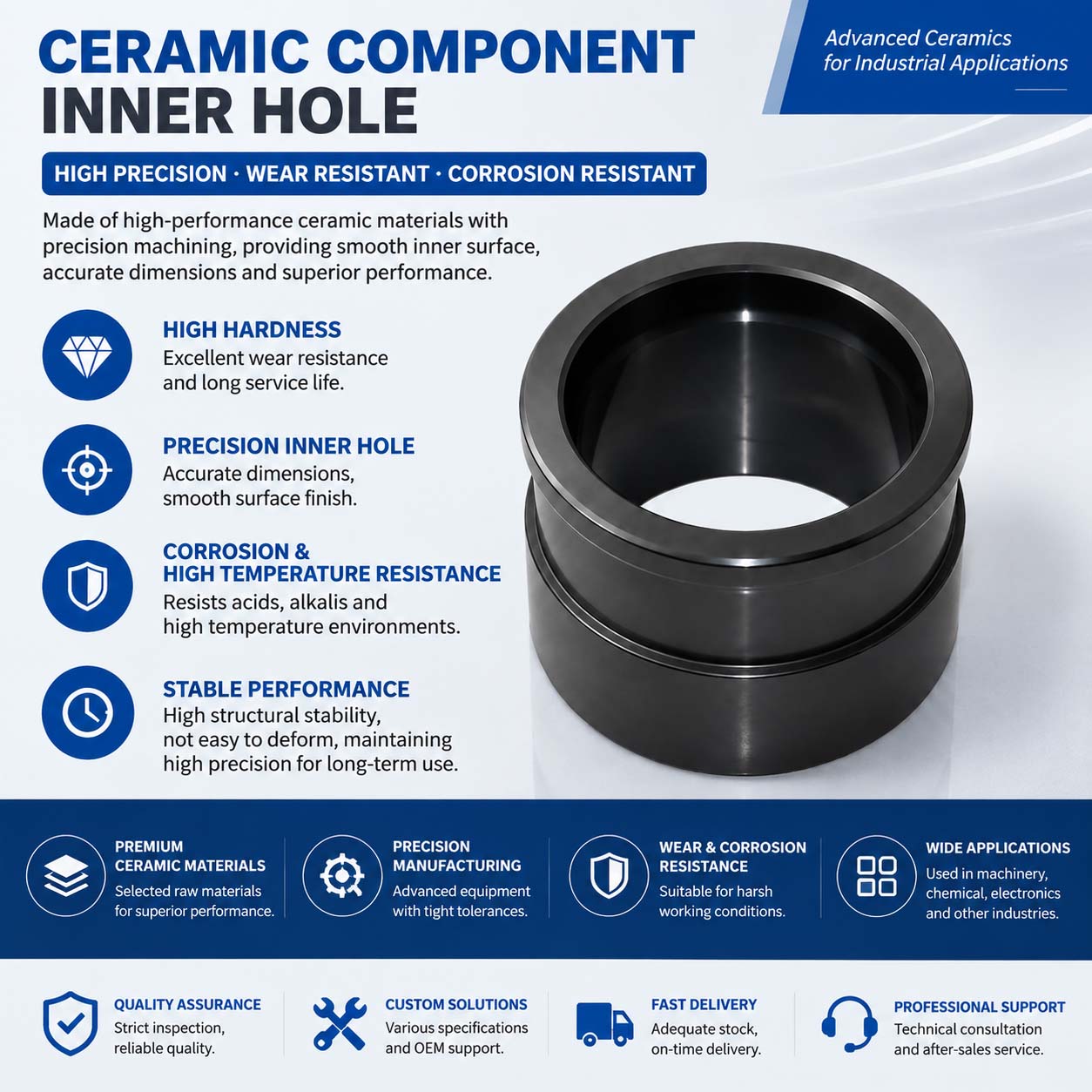
During long-term industrial operation, ceramic components with inner holes may fail due to wear, corrosion, or mechanical damage. Direct replacement of damaged parts often results in high costs, long delivery times, and compatibility issues.
Our thermal spray repair service restores component dimensions and functions by applying high-performance coatings to worn inner surfaces. The repaired parts can achieve improved wear resistance, corrosion resistance, and extended service life, providing a cost-effective alternative to replacement.
Introduction to Thermal Spray Repair Technology
Thermal spraying is an advanced surface engineering technology that uses heat energy to melt or semi-melt coating materials and spray them at high speed onto a pre-treated surface, forming a functional protective coating.
For ceramic component inner holes, we use specialized internal spray equipment and optimized processes. Inner diameters as small as approximately 50 mm can be processed, with strong coating adhesion and low porosity.
Service Range and Applicable Components
We provide thermal spray repair and coating services for various industrial components, including:
- Ceramic inner hole repair: Restoration of worn inner surfaces of ceramic guides, ceramic tubes, ceramic eyes, and similar parts.
- Used component refurbishment: Size recovery and performance improvement for mechanical parts, hardware components, and equipment accessories.
- New component protection: Application of protective coatings on new parts to extend service life.
Common Coating Materials and Performance
According to different operating conditions, we select suitable coating materials:
Ceramic Coatings
Materials such as aluminum oxide and chromium oxide provide:
- Excellent wear resistance
- High-temperature resistance
- Electrical insulation performance
Metal Ceramic Coatings
Materials such as tungsten carbide and chromium carbide combine:
- High hardness
- Good toughness
- Excellent resistance to severe wear conditions
Metal Alloy Coatings
Nickel-based and cobalt-based alloys are used for:
- Corrosion resistance
- Dimensional restoration
- Surface strengthening
Typical coating thickness ranges from 0.1–0.5 mm, adjustable according to customer requirements.
Repair Process
1. Component Evaluation
Used parts are inspected through dimensional measurement and damage analysis to determine repair feasibility and coating selection.
2. Surface Preparation
The surface is cleaned and roughened through processes such as degreasing and sandblasting to improve coating adhesion.
3. Thermal Spray Application
Advanced processes including plasma spraying and HVOF (High Velocity Oxygen Fuel) spraying are used to apply coatings uniformly to inner surfaces.
4. Finishing and Inspection
After coating, precision grinding or polishing is performed to achieve required dimensions. Quality inspection includes:
- Visual inspection
- Coating thickness measurement
- Bonding strength testing
Application Examples
Thermal spray repair solutions are widely used in:
- Textile machinery
- Pumps and valves
- Hydraulic systems
- Chemical processing equipment
For example, worn ceramic guide inner holes in textile equipment can be restored and achieve service life exceeding original components. Ceramic coatings applied to pump sleeve inner surfaces can significantly improve corrosion resistance and operating reliability.
Frequently Asked Questions
What is the minimum inner hole diameter that can be repaired?
Currently, inner holes with diameters of approximately 50 mm can be processed. The actual capability depends on hole depth, geometry, and component structure.
Will the repaired coating peel off?
With proper surface preparation and optimized spraying processes, coatings form strong mechanical and micro-metallurgical bonds. Under normal operating conditions, peeling does not occur. Bond strength inspections are performed according to quality requirements.
How long does the repair process take?
Standard repair usually takes around 3–5 working days. Emergency processing may be completed within 1–2 days depending on component quantity and complexity.
What materials can be repaired?
We can process various materials including steel, aluminum alloys, titanium alloys, and ceramic components. The coating system is selected according to substrate characteristics and working conditions.
How is coating thickness uniformity guaranteed?
Special fixtures, controlled spray movement, and coating thickness measurement methods are used to maintain uniform coating thickness.
Do you provide on-site repair services?
Yes. For large equipment or components that are difficult to remove, on-site thermal spray repair can be provided after evaluating the operating conditions.
