

Coating Service Overview
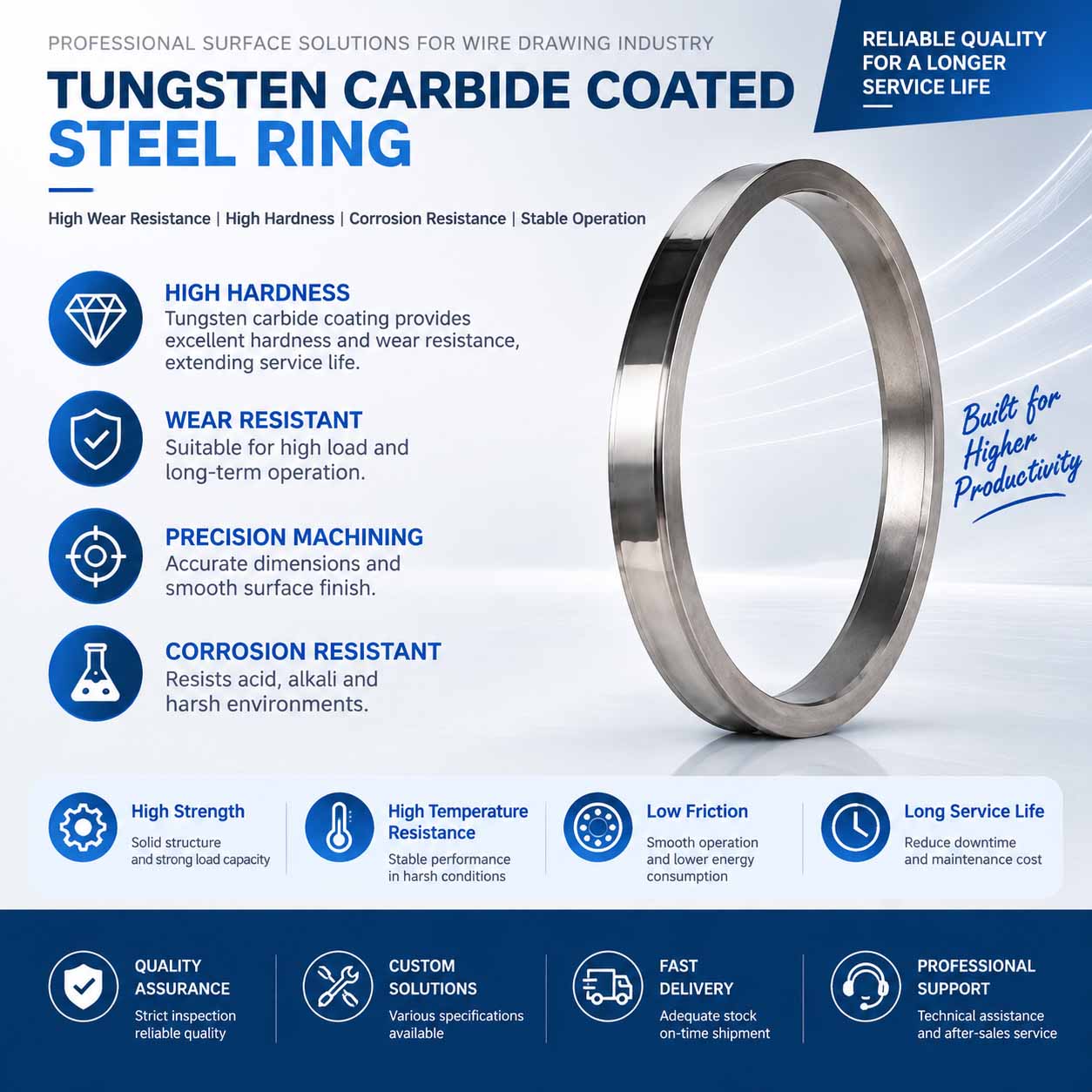
In wire and cable manufacturing, guide rollers and steel rings in wire drawing machines are exposed to continuous high-speed friction, resulting in severe wear over long-term operation.
To extend the service life of these critical components, tungsten carbide coating technology has become a widely used surface protection solution.
We specialize in tungsten carbide coating processing for large wire drawing steel rings, providing professional thermal spray coating services. With a typical coating thickness of 1.0–1.2 mm, our solutions improve wear resistance and help maintain stable production performance.
Tungsten Carbide Coating Material and Process
The coating uses tungsten carbide (WC) as the wear-resistant material.
Through advanced thermal spray technology, tungsten carbide powder is uniformly deposited onto the steel ring surface, forming a dense protective layer.
Tungsten carbide provides:
- Extremely high hardness
- Excellent wear resistance
- Strong friction resistance
The standard coating thickness:
1.0–1.2 mm
This thickness provides effective protection while maintaining component assembly accuracy.
Advantages of Tungsten Carbide Coating
High Hardness
The coating significantly improves surface hardness and wear resistance, extending component service life.
Dense and Reliable Coating Structure
Thermal spray processing ensures:
- Strong bonding with the substrate
- Uniform coating distribution
- Reduced risk of peeling
Wide Application Range
Suitable for different sizes of large wire drawing steel rings and various wire processing equipment.
Applications
Tungsten carbide coated steel rings are widely used in:
Wire Drawing Machines
Including:
- Large wire drawing machines
- Medium wire drawing machines
- Fine wire drawing machines
Cable Manufacturing Equipment
Applied to:
- Guide rollers
- Wire passing wheels
- Tower wheels
- Wear-resistant components
Other Industrial Equipment
Including:
- Annealing machines
- Stranding machines
- Continuous wire processing systems
After coating treatment, components can achieve:
- Reduced wear-related downtime
- Longer replacement cycles
- Improved production efficiency
Selection and Customization Guide
When selecting tungsten carbide coating solutions, consider:
Base Material
Steel rings are commonly made from steel substrates. Compatibility between substrate material and coating process should be evaluated.
Dimensional Accuracy
Since coating increases component dimensions, machining allowance should be considered before processing.
Working Conditions
The coating solution depends on:
- Wire material
- Line speed
- Wire tension
- Lubrication conditions
We provide customized coating services according to:
- Customer drawings
- Samples
- Equipment specifications
Providing detailed specifications helps us recommend the most suitable coating solution.
Maintenance Recommendations
To maximize coating performance:
- Regularly inspect coating surfaces for abnormal wear or peeling.
- Avoid strong impact during installation and operation.
- Clean surfaces with soft materials.
- Avoid corrosive cleaning agents.
Proper maintenance helps extend coating life and maintain stable equipment operation.
Frequently Asked Questions
1. Can tungsten carbide coating thickness be customized?
Yes.
The standard thickness is:
1.0–1.2 mm
It can be adjusted according to specific application requirements after technical evaluation.
2. What is the processing time?
Processing time depends on:
- Order quantity
- Component specifications
- Coating requirements
Small batch orders usually require approximately:
3–5 working days
3. Do you provide on-site spraying service?
Currently, we provide customer-supplied part coating services.
Customers can send steel rings to our factory for coating processing.
4. What types of wires are suitable?
Tungsten carbide coated steel rings are suitable for:
- Copper wire
- Aluminum wire
- Alloy wire
The final coating solution depends on wire hardness and operating conditions.
5. Does coating affect steel ring balance?
The coating process is applied evenly, so the impact on balance is minimal.
For applications requiring high dynamic balance accuracy, additional balancing can be performed.
6. How is coating quality inspected?
Quality evaluation includes:
- Visual inspection
- Coating thickness measurement
- Hardness testing
All products are inspected before shipment to ensure reliable performance.
