

Coating Service Overview
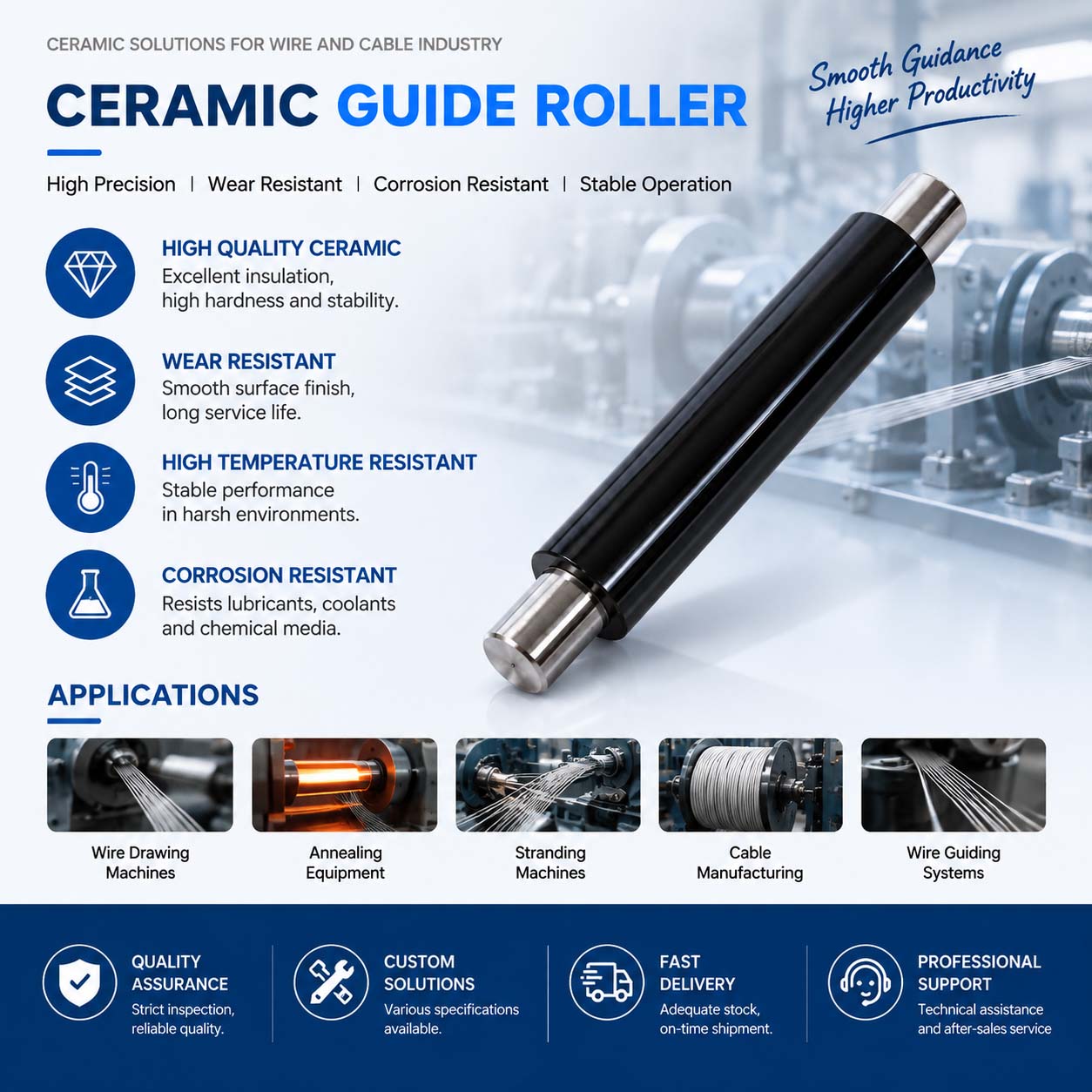
In the wire and cable manufacturing industry, rollers and guide rollers operate under high temperature, continuous friction, and corrosive environments. Surface protection technology plays an important role in improving equipment durability and reducing maintenance costs.
Chromium oxide (Cr₂O₃) ceramic coating is widely used for cable equipment rollers due to its excellent corrosion resistance, high-temperature stability, and wear resistance.
This article introduces the coating specifications, applications, and maintenance recommendations for chromium oxide coated rollers.
Coating Specifications and Performance
The product uses chromium oxide (Cr₂O₃) as the coating material. Through advanced thermal spray technology, a dense protective ceramic layer is formed on the metal substrate.
Main Parameters:
- Coating Material: Chromium Oxide (Cr₂O₃)
- Coating Thickness: 0.2–0.3 mm
Performance Advantages:
Excellent Corrosion Resistance
Chromium oxide coating provides strong resistance against:
- Acids
- Alkalis
- Salt spray corrosion
- Industrial chemicals
It effectively protects rollers from corrosion caused by lubricants and cooling fluids.
High Temperature Resistance
The coating can withstand temperatures above:
800°C
making it suitable for high-temperature cable production processes.
High Hardness and Wear Resistance
The ceramic coating provides:
- High surface hardness
- Good abrasion resistance
- Stable performance under continuous friction
The coating has strong bonding with the substrate and can withstand mechanical contact and friction during operation.
Applications
Chromium oxide coated rollers are widely used in wire and cable production equipment, including:
Wire Drawing Machines
Used for:
- Drawing rollers
- Guide rollers
- Wire passing rollers
The coating reduces wear caused by high-speed wire movement and improves production stability.
Annealing Equipment
Applied to guide rollers operating under:
- High temperature conditions
- Continuous wire movement
- Thermal cycling environments
Stranding and Cable Forming Machines
Used for:
- Wire guide rollers
- Cable guiding components
The coating helps reduce friction damage and extends component life.
Selection and Installation Recommendations
When selecting roller coatings, consider:
Operating Temperature
Chromium oxide coating is suitable for most cable production environments. For extreme temperature conditions, technical evaluation is recommended.
Chemical Environment
Consider exposure to:
- Lubricants
- Cooling fluids
- Cleaning chemicals
Different environments may require customized coating solutions.
Mechanical Load
Evaluate:
- Contact pressure
- Rotation speed
- Friction conditions
to ensure suitable coating performance.
Installation Requirements
Before coating:
- Remove oil and rust from the substrate.
- Ensure the surface is properly prepared.
After coating:
- Avoid strong impact.
- Handle carefully during installation.
Maintenance Recommendations
Proper maintenance can significantly extend coating service life:
- Regularly clean wire residues and contaminants from the roller surface.
- Use neutral cleaning agents and avoid strong acids or alkalis.
- Check regularly for cracks, peeling, or abnormal wear.
- Store rollers in dry environments to prevent substrate corrosion.
If local coating damage occurs, professional recoating can restore surface performance.
Frequently Asked Questions
1. What are the main advantages of chromium oxide coating?
Chromium oxide coating provides:
- Excellent corrosion resistance
- High temperature resistance
- Good wear resistance
- High surface hardness
It effectively protects cable equipment rollers and extends service life.
2. Is a 0.2–0.3 mm coating thickness durable enough?
Yes.
This thickness range has been widely used in industrial applications and provides a good balance between:
- Wear protection
- Bonding strength
- Dimensional accuracy
Thicker coatings can be customized after technical evaluation.
3. What metal substrates are suitable?
Chromium oxide coating can be applied to:
- Carbon steel
- Stainless steel
- Aluminum alloy
The final solution depends on substrate material and operating conditions.
4. Can damaged coatings be repaired?
Yes.
For local damage, repair can be performed through:
- Surface preparation
- Re-spraying chromium oxide coating
- Finishing and inspection
Professional processing is recommended to ensure coating quality.
5. How to determine if the coating needs replacement?
Replacement or repair is recommended when:
- The substrate becomes exposed
- Large-area peeling occurs
- Cracks appear
- Roller performance decreases
6. What is the difference between chromium oxide and tungsten carbide coating?
Chromium oxide coating:
- Better corrosion resistance
- Higher temperature stability
- Suitable for chemical and high-temperature environments
Tungsten carbide coating:
- Higher wear resistance
- Suitable for severe friction and heavy wear conditions
The correct coating should be selected according to actual working conditions.
