

Coating Service Overview
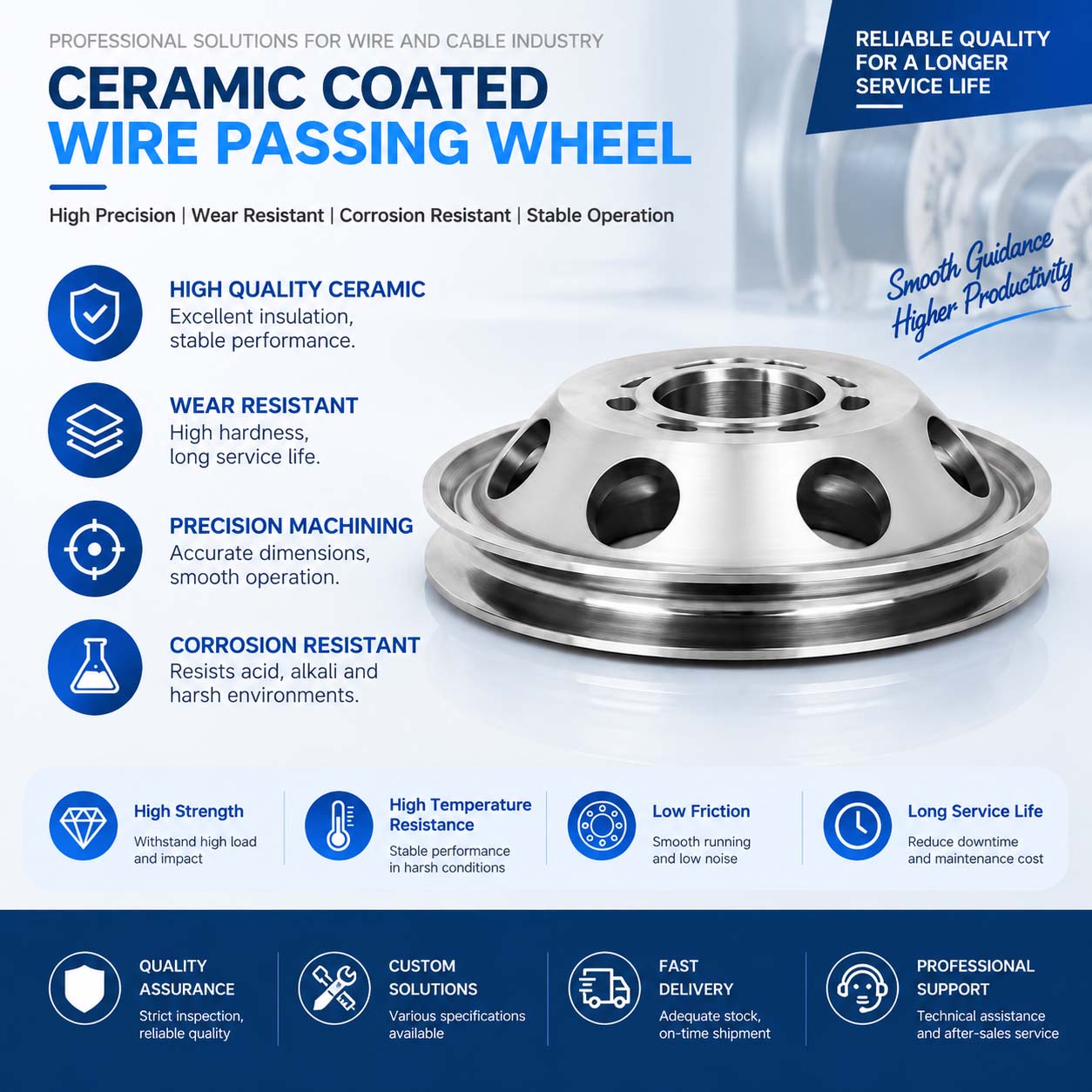
In the wire and cable manufacturing industry, wire passing wheels and ceramic guide rollers are exposed to continuous high-speed friction. Wear of these components directly affects production efficiency, wire surface quality, and equipment stability.
Tungsten carbide coating technology is a proven surface strengthening solution that significantly improves guide wheel wear resistance and extends service life.
This article introduces the features, applications, selection, maintenance, and common issues of tungsten carbide coated wire passing wheels to help customers better understand and choose suitable wear-resistant components.
Features of Tungsten Carbide Coating
Tungsten carbide coating is widely used for industrial surface protection due to its:
- High hardness
- Excellent wear resistance
- Strong friction resistance
For this product, the coating material is tungsten carbide (WC) with a typical thickness of:
1.0–1.2 mm
This thickness provides a good balance between:
- Wear protection
- Coating bonding strength
- Long service life
The coating is applied through advanced thermal spray technology, forming a dense protective layer on various metal guide wheel substrates.
Applications
Tungsten carbide coated wire passing wheels and cable guide rollers are widely used in:
Wire and Cable Production Lines
Applications include:
- Wire guiding systems
- Cable production equipment
- High-speed wire processing lines
The coating helps reduce:
- Wire surface scratches
- Friction damage
- Production interruptions
Wire Drawing Machines
Used for:
- Copper wire drawing
- Aluminum wire processing
- Alloy wire production
Guide wheels must withstand continuous high-speed friction, and tungsten carbide coating helps maintain stable performance.
Annealing Equipment
Used as wear-resistant components under:
- High temperature conditions
- Continuous operation
- Metal wire movement
Surface Treatment Processes
Suitable for wire guiding applications in:
- Tin plating lines
- Silver plating lines
- Other coated wire production systems
Selection and Maintenance Guide
Selection Factors
When choosing tungsten carbide coated wire passing wheels, consider:
Coating Material and Thickness
Confirm:
- Tungsten carbide coating
- Suitable coating thickness (normally 1.0–1.2 mm)
to meet wear resistance requirements.
Base Material
Common substrates include:
- Steel
- Aluminum alloy
The material should match:
- Equipment load
- Working environment
- Coating process requirements
Dimensions and Installation
Important parameters include:
- Outer diameter
- Inner bore size
- Groove design
- Mounting method
Proper matching ensures stable operation.
Working Conditions
Consider:
- Wire speed
- Wire tension
- Operating temperature
- Lubrication conditions
Maintenance Recommendations
To maximize service life:
- Regularly inspect coating wear conditions.
- Replace components when coating damage reaches the substrate.
- Keep the guide wheel surface clean.
- Prevent hard particles from embedding into the coating.
- Lubricate bearings when applicable.
- Avoid impact damage during installation and storage.
Frequently Asked Questions
1. How long is the service life of tungsten carbide coated guide wheels?
Service life depends on:
- Wire material
- Line speed
- Tension
- Operating environment
There is no fixed service period. Regular inspection and replacement records are recommended for accurate evaluation.
2. Can the 1.0–1.2 mm coating thickness be customized?
Yes. The coating thickness can be adjusted according to:
- Component size
- Wear requirements
- Application conditions
Technical evaluation is recommended before customization.
3. What types of wire are suitable for tungsten carbide coated wheels?
Suitable materials include:
- Copper wire
- Aluminum wire
- Alloy wire
- Plated metal wire
Special high-hardness wires require additional evaluation.
4. What should be done if coating peeling occurs?
Stop using the component and check the cause.
Possible reasons include:
- Mechanical impact
- Improper substrate preparation
- Incorrect operating conditions
Minor damage may be repairable through recoating.
5. Why does the guide wheel vibrate during operation?
Possible causes include:
- Bearing damage
- Incorrect installation alignment
- Uneven wear
Check the bearing condition, installation accuracy, and wheel surface condition.
6. How to determine if the coating is excessively worn?
Replacement is recommended when:
- Deep grooves appear on the coating surface
- The substrate becomes exposed
- Wire scratches increase
- Production quality decreases
