

Coating Service Overview
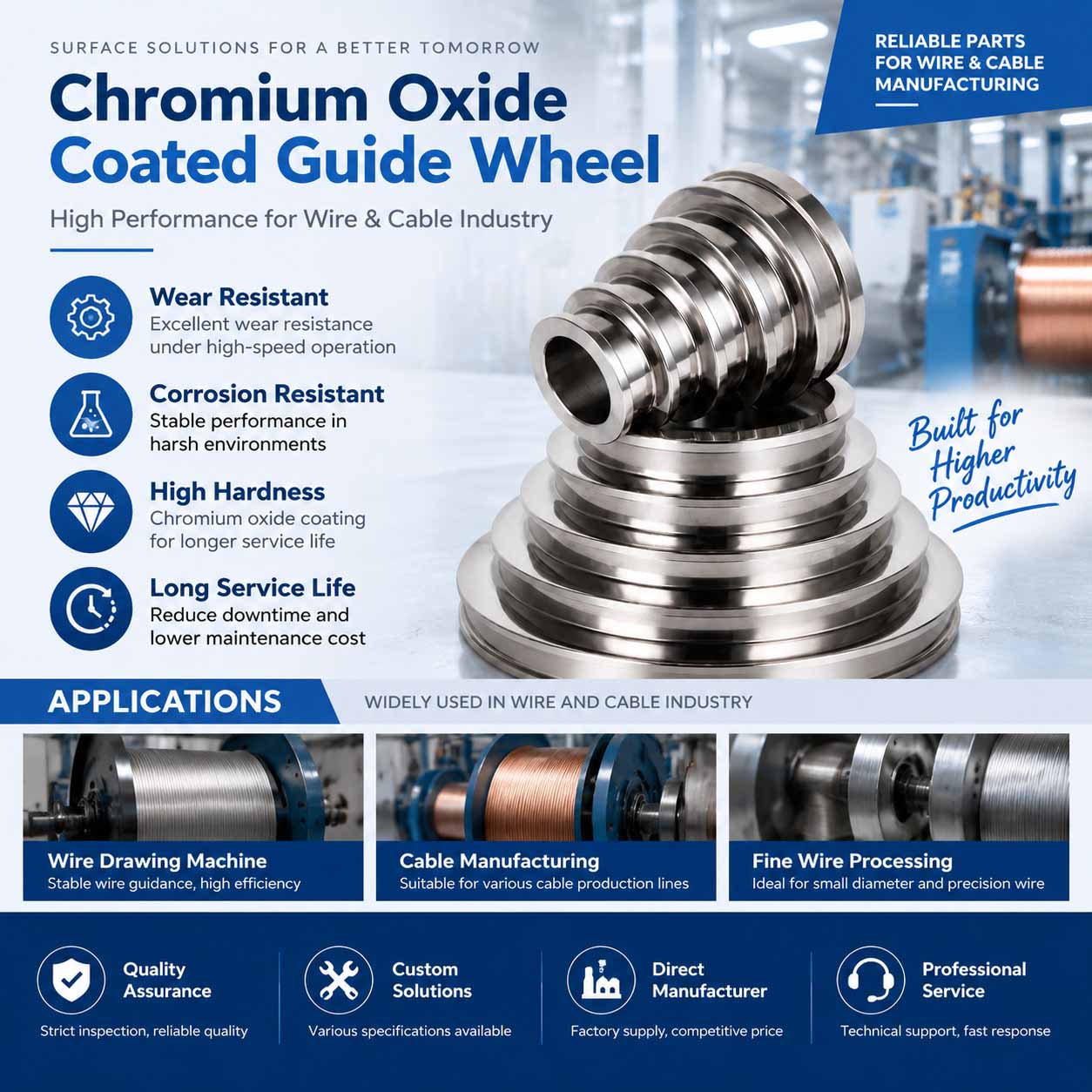
In wire and cable manufacturing, wear resistance of annealing equipment components directly affects wire surface quality and production efficiency.
Components such as fine wire drawing tower wheels, zirconia guide wheels, and combination guide rollers are continuously exposed to high-speed wire friction. Therefore, they require high hardness, low friction, and stable surface performance.
We provide customized wear-resistant solutions using tungsten oxide coating technology. With coating thickness controlled at 1.0–1.2 mm, these guide wheels achieve excellent wear protection, longer service life, and reduced replacement frequency.
Coating Features and Advantages
The tungsten oxide coating provides high hardness and a dense protective surface, effectively resisting sliding wear caused by high-speed metal wire movement.
Main Benefits
High Wear Resistance
The coating provides excellent hardness and durability, allowing guide wheels to withstand continuous friction from:
- Copper wire
- Aluminum wire
- Alloy wire
Uniform Coating Thickness
With precise process control:
- Coating thickness remains stable
- Surface finish is improved
- Wire damage caused by surface defects is reduced
Thermal Shock Resistance
The coating performs reliably under temperature changes during continuous wire drawing and annealing processes, reducing the risk of cracking or peeling.
Product Specifications
Coating Material: Tungsten oxide coating
Coating Thickness: 1.0–1.2 mm
Base Material: High-quality steel (customizable)
Application Speed: Customized according to working conditions
Working Temperature: Suitable for annealing environments
Applications
Fine wire drawing tower wheels and zirconia guide wheels are widely used in:
Wire and Cable Manufacturing
Applications include:
- Copper wire annealing
- Aluminum wire processing
- Alloy wire production
Wire Drawing Machines
Used in:
- Fine drawing lines
- Medium drawing processes
- Large drawing equipment
Combination Guide Systems
Combination guide wheels help:
- Control wire tension
- Improve wire stability
- Reduce vibration during high-speed operation
Annealing Equipment
Guide wheels used at annealing furnace entrances and exits require:
- Wear resistance
- Thermal stability
- Dimensional accuracy
Tungsten oxide coating helps maintain stable dimensions and prevents wire diameter variations caused by wear.
Customization and Selection Guide
We provide customized manufacturing and coating services for:
- Fine wire drawing tower wheels
- Zirconia guide wheels
- Combination guide rollers
Customers can provide:
- Equipment model
- Wire diameter range
- Installation dimensions
- Drawings or samples
When selecting guide wheels, consider:
Wire Material
Including:
- Copper
- Aluminum
- Alloy wire
- Special metal wires
Operating Conditions
Evaluate:
- Maximum wire speed
- Annealing temperature
- Wire tension
- Groove design
- Installation method
For new applications, small-batch testing is recommended to confirm coating performance under actual conditions.
Maintenance Recommendations
Proper maintenance extends guide wheel service life:
- Regularly inspect coating wear and surface condition.
- Remove metal particles and contaminants to prevent scratches.
- Check bearing lubrication to ensure smooth rotation.
- Avoid impact damage on coating surfaces.
- Store spare parts in dry conditions to prevent corrosion.
When coating wear reaches the substrate surface, timely repair or replacement is recommended to protect wire quality.
Frequently Asked Questions
1. What is the difference between tungsten oxide coating and zirconia guide wheels?
Tungsten oxide coating is a wear-resistant layer applied to the guide wheel surface.
Zirconia guide wheels are usually made from zirconia ceramic material or use zirconia ceramic surfaces.
Both provide high hardness, but tungsten oxide coatings are especially suitable for metal wire sliding friction environments and can be restored through coating processes.
2. Can the 1.0–1.2 mm coating thickness be customized?
Yes. Standard thickness is 1.0–1.2 mm. Special requirements can be adjusted after evaluating:
- Bonding strength
- Dimensional accuracy
- Operating conditions
3. How long is the service life of coated guide wheels?
Service life depends on:
- Wire material
- Line speed
- Tension
- Annealing temperature
- Lubrication conditions
In practical applications, coated guide wheels usually provide several times longer service life compared with uncoated wheels.
4. Can samples be provided for testing?
Yes. Standard samples or customized test pieces can be provided according to customer requirements.
5. Can old guide wheels be refurbished?
Yes. Worn guide wheels can be recoated if the substrate has no severe:
- Cracks
- Deformation
- Structural damage
6. What is the delivery time?
Delivery time depends on:
- Quantity
- Component size
- Coating process complexity
Customized orders are normally scheduled after technical confirmation. Urgent orders can be discussed separately.
