

Coating Service Overview
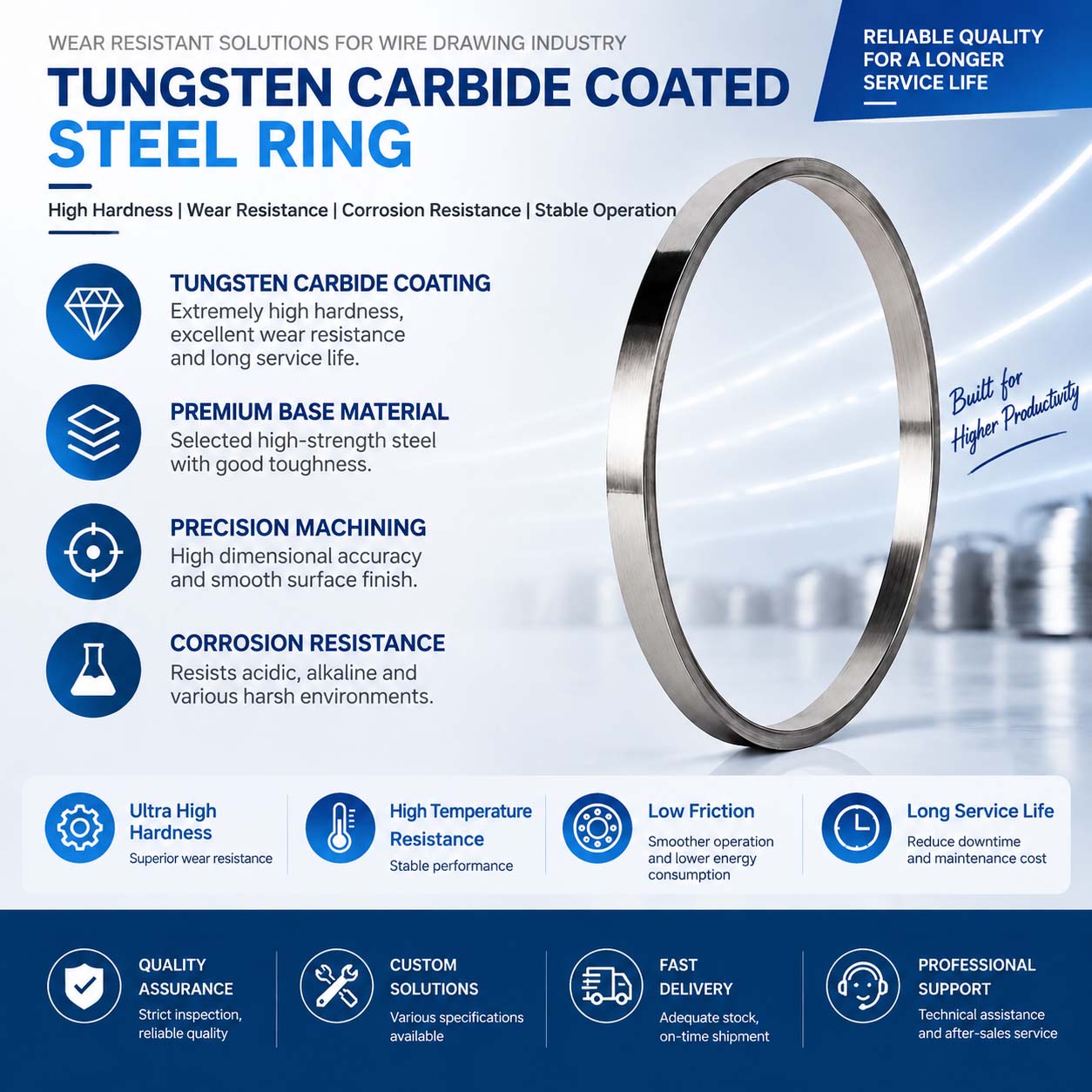
In wire and cable manufacturing, medium wire drawing steel rings are critical guide components that operate under high-speed friction and continuous mechanical stress. Their wear resistance directly affects production efficiency, wire surface quality, and equipment stability.
Tungsten carbide coating technology provides an effective surface protection solution. By applying a high-hardness tungsten carbide layer to the steel ring surface, service life can be significantly extended while reducing replacement frequency.
This article introduces the coating specifications, applications, and maintenance recommendations for tungsten carbide coated medium wire drawing steel rings.
Tungsten Carbide Coating Material and Thickness
The coating material used for medium wire drawing steel rings is tungsten carbide (WC), which is widely known for:
- Extremely high hardness
- Excellent wear resistance
- Strong impact resistance
Through advanced thermal spray coating technology, tungsten carbide powder is deposited onto the steel ring surface to form a dense protective coating.
Typical coating thickness:
1.0–1.2 mm
The thickness can be adjusted according to:
- Component size
- Operating conditions
- Required wear resistance
Too thin a coating may reduce service life, while excessive thickness may increase the risk of coating stress and peeling.
Applications
Tungsten carbide coated steel rings are widely used in:
Medium Wire Drawing Machines
Suitable for processing:
- Copper wire
- Aluminum wire
- Alloy wire
During wire drawing, the steel ring guides the wire under continuous friction. The tungsten carbide coating helps:
- Reduce surface wear
- Maintain wire surface quality
- Lower wire breakage risk
Cable Manufacturing Equipment
Applications include:
- Guide rollers
- Wire passing components
- Tension control parts
The coating improves stability for continuous production lines.
Selection and Customization Guide
When selecting tungsten carbide coated steel rings, consider:
Base Material
Common substrates include:
- Steel
- Alloy steel
The substrate must provide good bonding performance with the coating.
Dimensional Accuracy
After coating, precision grinding may be required to achieve:
- Correct dimensions
- Required tolerances
- Smooth surface finish
Working Conditions
Coating selection depends on:
- Wire material
- Line speed
- Wire tension
- Lubrication conditions
We provide customized coating services according to:
- Customer drawings
- Samples
- Equipment specifications
Maintenance Recommendations
Proper maintenance can maximize coating performance:
- Regularly inspect the coating surface for cracks or peeling.
- Keep lubrication systems clean to prevent hard particles from damaging the coating.
- Protect components from moisture and corrosion during storage.
- Avoid impact damage during installation.
If the coating reaches the wear limit, recoating can restore performance and reduce replacement costs.
Frequently Asked Questions
1. What hardness does tungsten carbide coating provide?
Tungsten carbide coating hardness is typically around:
HV1100–1300
The actual value depends on:
- Spraying process
- Powder composition
- Coating parameters
2. Can the coating thickness exceed 1.2 mm?
Yes, but it requires evaluation of:
- Bonding strength
- Component structure
- Operating conditions
Excessive thickness may increase the risk of coating failure.
3. Is post-processing required after coating?
Normally, grinding or polishing is performed after spraying to achieve:
- Dimensional accuracy
- Surface smoothness
- Proper wire contact performance
4. What types of wire are suitable?
Tungsten carbide coated steel rings are suitable for:
- Copper wire
- Aluminum wire
- Alloy wire
For high-adhesion materials, lubrication conditions should be carefully considered.
5. How to determine whether the coating has failed?
Recoating is recommended when:
- Visible wear grooves appear
- Coating peeling occurs
- Wire surface scratches increase
- Base material becomes exposed
6. What is the delivery time?
Delivery depends on:
- Order quantity
- Component size
- Coating complexity
Typical processing time:
3–7 working days
