

Coating Service Overview
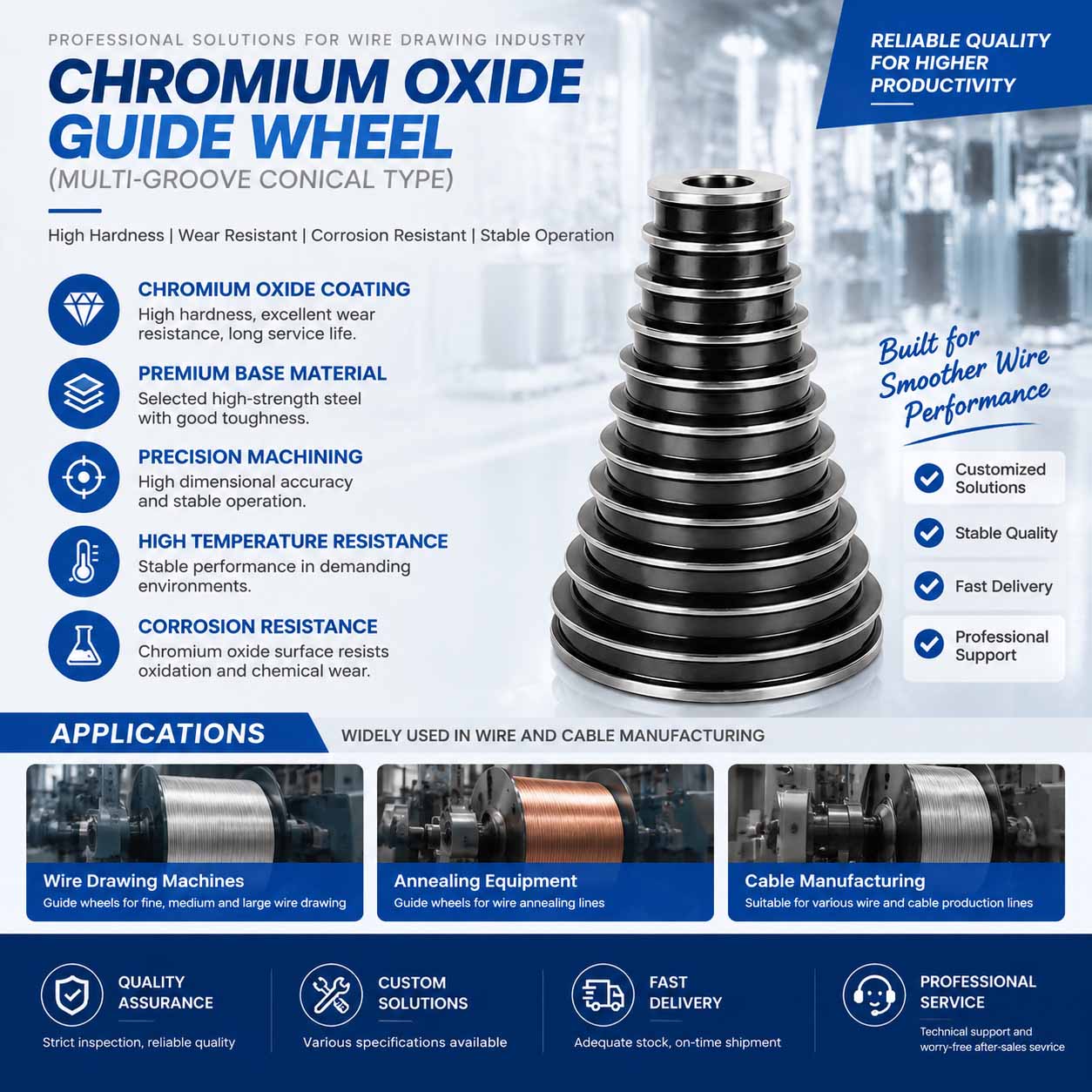
In wire and cable manufacturing, micro wire drawing tower wheels are critical guide components in drawing and annealing equipment. Their surface wear resistance directly affects production efficiency, wire quality, and equipment stability.
Chromium oxide (Cr₂O₃) coating provides excellent hardness, wear resistance, and surface protection, making it an effective solution for extending the service life of micro wire drawing tower wheels.
This article introduces the application, selection, and maintenance of chromium oxide coated tower wheels based on practical processing experience.
Coating Material and Specifications
Micro wire drawing tower wheels are coated with chromium oxide ceramic material through advanced thermal spray processes.
Standard coating thickness:
0.2–0.3 mm
The thickness can be adjusted according to:
- Wear allowance
- Component size
- Operating conditions
Main coating advantages:
- High surface hardness
- Low friction coefficient
- Excellent resistance to high-speed wire sliding wear
The dense ceramic layer helps reduce surface damage caused by continuous wire contact.
Applications
Chromium oxide coated micro wire drawing tower wheels are widely used in:
- Micro wire drawing machines
- Annealing equipment guide systems
- Cable equipment tension control rollers
They are suitable for processing:
- Copper wire
- Aluminum wire
- Alloy wire
The coating can be applied in both:
- Wet drawing processes
- Dry drawing processes
Typical operating temperature:
Below 200°C
Selection and Customization Guide
When selecting chromium oxide coating for micro tower wheels, consider:
Base Material
Common substrates include:
- Steel
- Aluminum alloy
The substrate must be compatible with the coating process to ensure strong bonding.
Coating Thickness
Standard thickness:
0.2–0.3 mm
Special requirements can be customized after evaluating:
- Component structure
- Wear conditions
- Required service life
Dimensional Accuracy
After coating, precision grinding is performed to restore:
- Groove profile
- Diameter accuracy
- Surface finish
Customers are encouraged to provide drawings or samples for accurate processing.
We provide:
- Customer-supplied part coating service
- Complete customized manufacturing
Applicable products include:
- Micro wire drawing tower wheels
- Multi-groove tower wheels
- Fine wire drawing tower wheels
Maintenance Recommendations
To maximize coating service life:
Avoid Impact Damage
Chromium oxide coatings have high hardness but certain brittleness. Proper handling is required during installation.
Regular Inspection
Check regularly for:
- Coating peeling
- Uneven wear
- Surface damage
Repair should be arranged promptly if abnormal wear occurs.
Cleaning and Protection
Remove:
- Metal particles
- Drawing lubricant residue
to prevent surface damage and substrate corrosion.
Under normal conditions, chromium oxide coating can significantly extend guide wheel life. Actual service life depends on:
- Wire speed
- Tension force
- Lubrication conditions
- Operating environment
Frequently Asked Questions
1. What is the difference between chromium oxide and tungsten carbide coating?
Chromium oxide coating:
- Better oxidation resistance
- Lower friction coefficient
- Suitable for medium and low-speed wire drawing applications
Tungsten carbide coating:
- Higher hardness
- Better for heavy-load and severe wear conditions
The correct coating depends on actual production requirements.
2. Can coating thickness exceed 0.3 mm?
Yes. However, excessive thickness may affect bonding strength.
In most applications, coating thickness is recommended to remain below:
0.5 mm
A technical evaluation is required for special applications.
3. How is groove accuracy maintained after coating?
After spraying, the wheel is precision ground to restore the original groove dimensions.
Customers should provide:
- Drawings
- Samples
- Required tolerances
before processing.
4. Can old guide wheels be recoated?
Yes.
The process includes:
- Removing the old coating
- Inspecting the substrate
- Applying a new ceramic coating
Recoating is possible if the base material is not seriously damaged.
5. What types of wire are suitable?
Chromium oxide coated guide wheels are suitable for:
- Copper wire
- Aluminum wire
- Alloy wire
They are not recommended for non-metal materials such as optical fiber.
6. What is the delivery time?
Delivery time depends on:
- Order quantity
- Component size
- Coating complexity
Standard orders usually require:
5–10 working days
