

Coating Service Overview
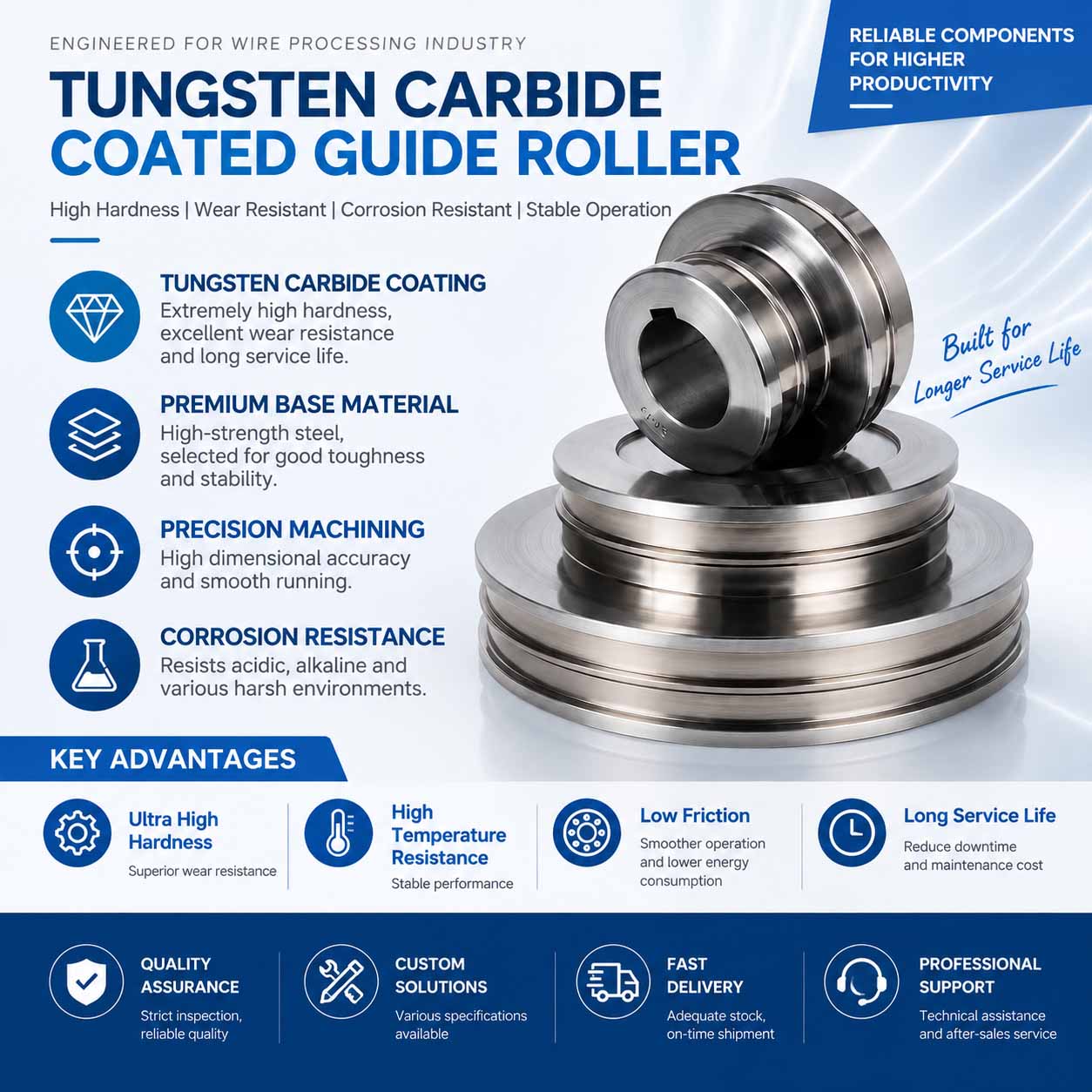
In wire and cable manufacturing, tower wheels and guide rollers used in wire drawing and stranding machines are continuously exposed to high-speed wire friction. Their wear resistance directly affects production efficiency, wire surface quality, and equipment stability.
For fine wire drawing applications, we provide customized solutions including:
- Fine wire drawing tower wheels
- Wire passing rollers
- Tungsten carbide rings
Using advanced chromium oxide (Cr₂O₃) coating technology, with a typical coating thickness of 0.2–0.3 mm, these components achieve improved wear resistance, longer service life, and reduced replacement frequency.
Coating Materials and Process Features
Chromium Oxide Ceramic Coating
Chromium oxide (Cr₂O₃) coating provides:
- High hardness
- Low friction coefficient
- Excellent corrosion resistance
It is especially suitable for high-speed friction environments during fine wire drawing.
Through thermal spray technology, chromium oxide powder is heated and sprayed onto the component surface, forming a dense ceramic protective layer.
The coating thickness is precisely controlled at:
0.2–0.3 mm
This balance provides:
- Strong wear resistance
- Reliable bonding strength
- Reduced risk of cracking or peeling caused by excessive coating thickness
Tungsten Carbide Ring
Tungsten carbide rings are manufactured from high-hardness carbide materials and provide:
- Extremely high wear resistance
- Excellent load-bearing capability
- Long service life under high tension conditions
They are commonly used in:
- High-pressure groove areas of tower wheels
- Wear-resistant inserts inside guide rollers
By combining tungsten carbide rings with chromium oxide coating, the overall durability of wire drawing components can be significantly improved.
Applications
Custom fine wire drawing tower wheels and guide rollers are widely used in:
Fine Wire Drawing Processes
Suitable for:
- Copper wire
- Aluminum wire
- Alloy wire
Especially for fine wires with diameters below:
0.1 mm
Precision Wire Production Equipment
Including:
- Enamel wire machines
- Electronic wire production lines
- Precision cable manufacturing equipment
High-Speed Wire Processing Systems
Suitable for equipment requiring:
- Frequent start and stop operation
- High-speed rotation
- Stable wire guidance
Selection and Customization Guide
Choosing the right tower wheel and guide roller requires consideration of:
Wire Material and Diameter
Different materials create different levels of wear.
Fine wire applications require:
- Higher surface finish
- Accurate groove dimensions
- Low friction performance
Machine Speed and Wire Tension
For high-speed and high-tension applications:
Recommended:
- Tungsten carbide rings
- Enhanced wear-resistant coatings
Working Environment
If exposed to:
- Corrosive liquids
- Chemical environments
Chromium oxide coating provides additional surface protection.
Installation Dimensions
Customers can provide:
- Drawings
- Samples
- Equipment specifications
for customized manufacturing.
Customization includes:
- Outer diameter
- Groove design
- Shaft hole dimensions
- Coating areas
Maintenance Recommendations
To maximize component service life:
- Regularly inspect coating wear conditions.
- Replace components before the substrate becomes exposed.
- Avoid sharp tools when cleaning surfaces.
- Remove wire residues and contaminants during machine shutdown.
- Store components in dry environments to prevent accidental coating damage.
Frequently Asked Questions
1. Why is the chromium oxide coating thickness 0.2–0.3 mm?
This thickness range provides the best balance between:
- Wear resistance
- Coating adhesion
- Service life
Too thin reduces wear protection, while excessive thickness increases internal stress and may cause cracking or peeling.
2. Can tungsten carbide rings and chromium oxide coating be used together?
Yes.
A common solution is:
- Tungsten carbide inserts at high-wear groove areas
- Chromium oxide coating on other surfaces
This combines carbide hardness with ceramic coating protection while improving cost efficiency.
3. What is the delivery time for customized tower wheels?
Delivery depends on:
- Quantity
- Design complexity
- Coating requirements
Typical samples or small-batch orders require approximately:
7–15 working days
4. How to determine whether the coating has failed?
Replacement or recoating is recommended when:
- Deep wear grooves appear
- Coating peeling occurs
- The base material is exposed
- Wire quality decreases
5. Can guide rollers be repaired and recoated?
Yes.
For components without severe deformation:
- Remove the old coating
- Inspect the substrate
- Apply new chromium oxide coating
- Restore surface performance
This is often more economical than purchasing new parts.
6. What wire materials are suitable for chromium oxide coating?
Suitable materials include:
- Copper wire
- Aluminum wire
- Copper-clad aluminum wire
- Copper alloys
For special alloys or extremely hard wires, tungsten carbide coating solutions may be more suitable after evaluation.
