

Coating Service Overview
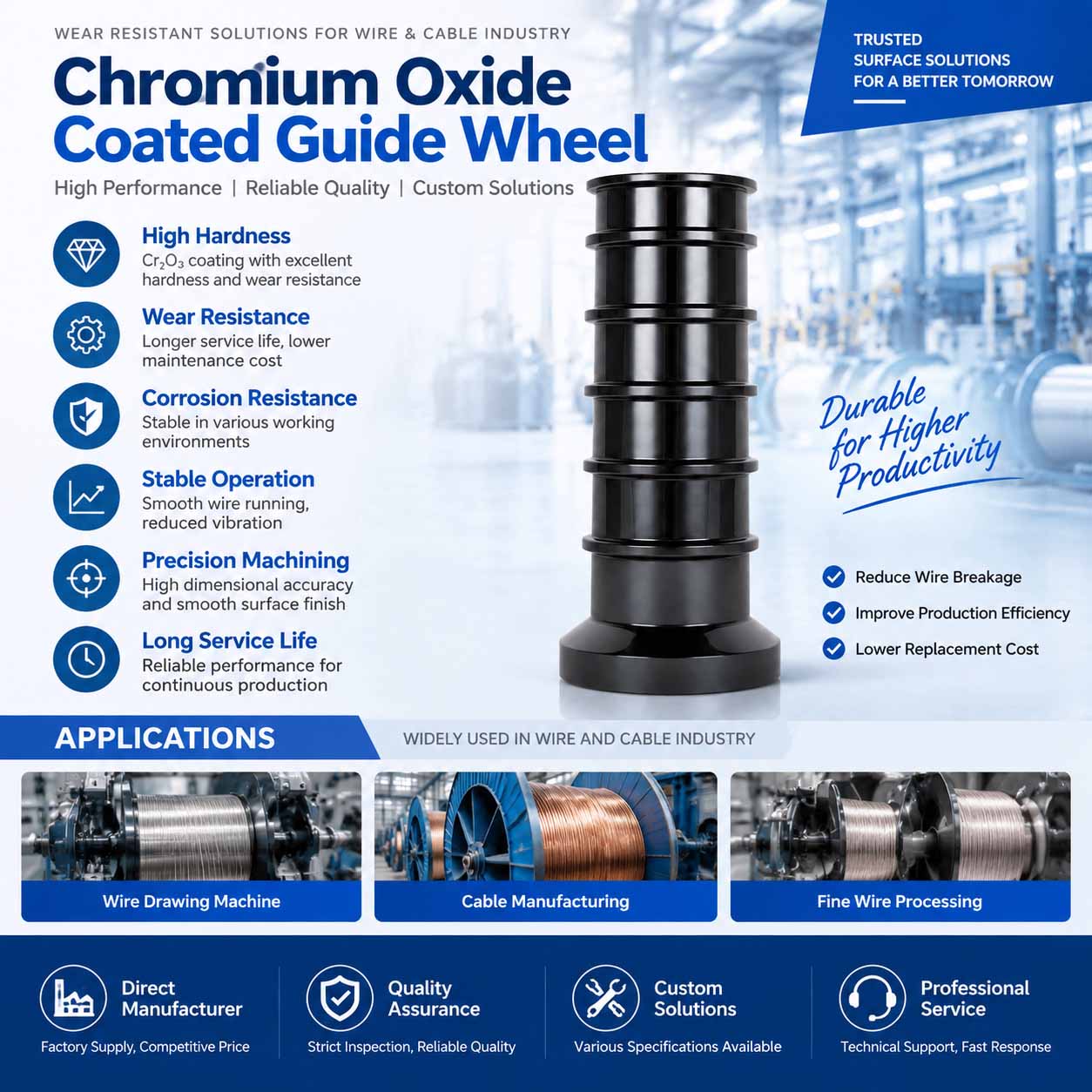
In wire and cable manufacturing, guide rollers, tower wheels, and other wire-contact components are continuously exposed to high-speed friction. Their surface condition directly affects production efficiency, wire quality, and equipment stability.
To extend the service life of these critical components, we apply advanced thermal spray coating technology to create dense chromium oxide (Cr₂O₃) ceramic coatings on metal substrates.
This article introduces our ceramic coating services for multi-groove tower wheels, aluminum guide rollers, wire passing wheels, and other wire drawing components, including coating performance, applications, selection, and maintenance recommendations.
Coating Materials and Process Features
We mainly use chromium oxide ceramic coating as the wear-resistant layer.
Through advanced processes such as:
- Plasma spraying
- HVOF (High Velocity Oxygen Fuel) spraying
ceramic powder is heated to a molten or semi-molten state and sprayed onto the pretreated component surface at high speed, forming a strong layered coating structure.
Main Advantages
High Hardness and Wear Resistance
Chromium oxide coating can achieve:
HV 800–1200 hardness
providing excellent resistance against:
- Wire friction
- Abrasive wear
- Surface micro-cutting damage
Excellent Chemical Stability
Chromium oxide has strong chemical resistance and performs well against:
- Acidic environments
- Alkaline solutions
- Lubricating and cooling fluids
Strong Coating Adhesion
After proper surface preparation, including:
- Cleaning
- Degreasing
- Grit blasting
the coating achieves strong bonding with the substrate, typically above 30 MPa.
Controlled Coating Thickness
Standard coating thickness:
0.2–0.3 mm
The thickness can be adjusted according to component size and operating requirements.
Coated Components and Applications
Our ceramic coating service applies to:
- Multi-groove tower wheels
- Aluminum guide rollers
- Wire passing wheels
- Steel rings
- Other wire processing components
Compatible substrate materials include:
- Carbon steel
- Stainless steel
- Aluminum alloy
Before spraying, components undergo strict surface preparation to ensure reliable coating adhesion.
Typical Applications
Wire Drawing Machines
Ceramic coated tower wheels and guide rollers are widely used in:
- Large wire drawing lines
- Medium wire drawing machines
- Fine wire drawing equipment
- Micro wire drawing systems
They withstand continuous friction from high-tension wires and help reduce:
- Wire scratches
- Breakage
- Uneven wear
Annealing Equipment
Guide rollers used in annealing processes require:
- High-temperature resistance
- Oxidation resistance
- Stable surface performance
Chromium oxide coating provides reliable protection under these conditions.
Stranding and Cable Machines
Applied to:
- Guide rollers
- Wire separators
- Tension control wheels
The smooth ceramic surface helps protect wire surfaces during high-speed operation.
Cable Extrusion Lines
Ceramic coated rollers can be used for:
- Preheating rollers
- Cooling rollers
- Auxiliary guide components
to improve production stability.
Selection and Customization Guide
When selecting ceramic coated guide rollers, consider:
Substrate Material and Structure
The component material and design should be suitable for coating.
Special structures such as:
- Deep holes
- Narrow grooves
may require process evaluation.
Coating Thickness
Typical thickness:
0.2–0.3 mm
The correct thickness depends on:
- Wear allowance
- Operating conditions
- Service requirements
Surface Finish
After coating, precision grinding or polishing can achieve:
Ra 0.4–0.8 μm
according to application requirements.
Dimensional Accuracy
Because coating increases component dimensions, machining allowance should be considered before spraying. Final grinding restores the required size.
We provide customer-supplied part coating services. New or worn components can be evaluated and processed according to drawings or samples.
Usage and Maintenance Recommendations
To maximize service life:
- Ensure correct installation alignment to prevent uneven wear.
- Maintain proper lubrication and cooling conditions.
- Regularly inspect coating surfaces for:
- Cracks
- Peeling
- Abnormal wear
- Clean metal particles and contaminants during maintenance.
If the substrate remains in good condition, locally damaged coatings can often be repaired or recoated to reduce replacement costs.
Frequently Asked Questions
1. What is the difference between chromium oxide and tungsten carbide coating?
Chromium oxide coating:
- Better chemical stability
- Excellent corrosion resistance
- Suitable for general wear applications
Tungsten carbide coating:
- Higher hardness
- Better extreme wear resistance
- Suitable for severe friction conditions
The best choice depends on wire material, speed, and lubrication conditions.
2. Can aluminum guide rollers be ceramic coated?
Yes. Aluminum substrates require special surface preparation and controlled spraying temperatures to prevent deformation.
3. Is thicker coating always better?
No. Excessive thickness increases internal stress and may cause cracking or peeling.
A thickness of 0.2–0.3 mm is commonly used for reliable performance.
4. How long can repaired guide rollers last?
Service life depends on:
- Base material condition
- Coating quality
- Operating environment
Well-maintained repaired components can achieve performance close to new parts.
5. What is the delivery time?
Processing time depends on quantity and complexity.
Typical small batch orders:
3–7 working days
Urgent processing can be discussed in advance.
6. Do you provide on-site spraying service?
Currently, we provide customer-supplied part coating services only. Customers can send components to our facility for coating and return shipment after completion.
