

Coating Service Overview
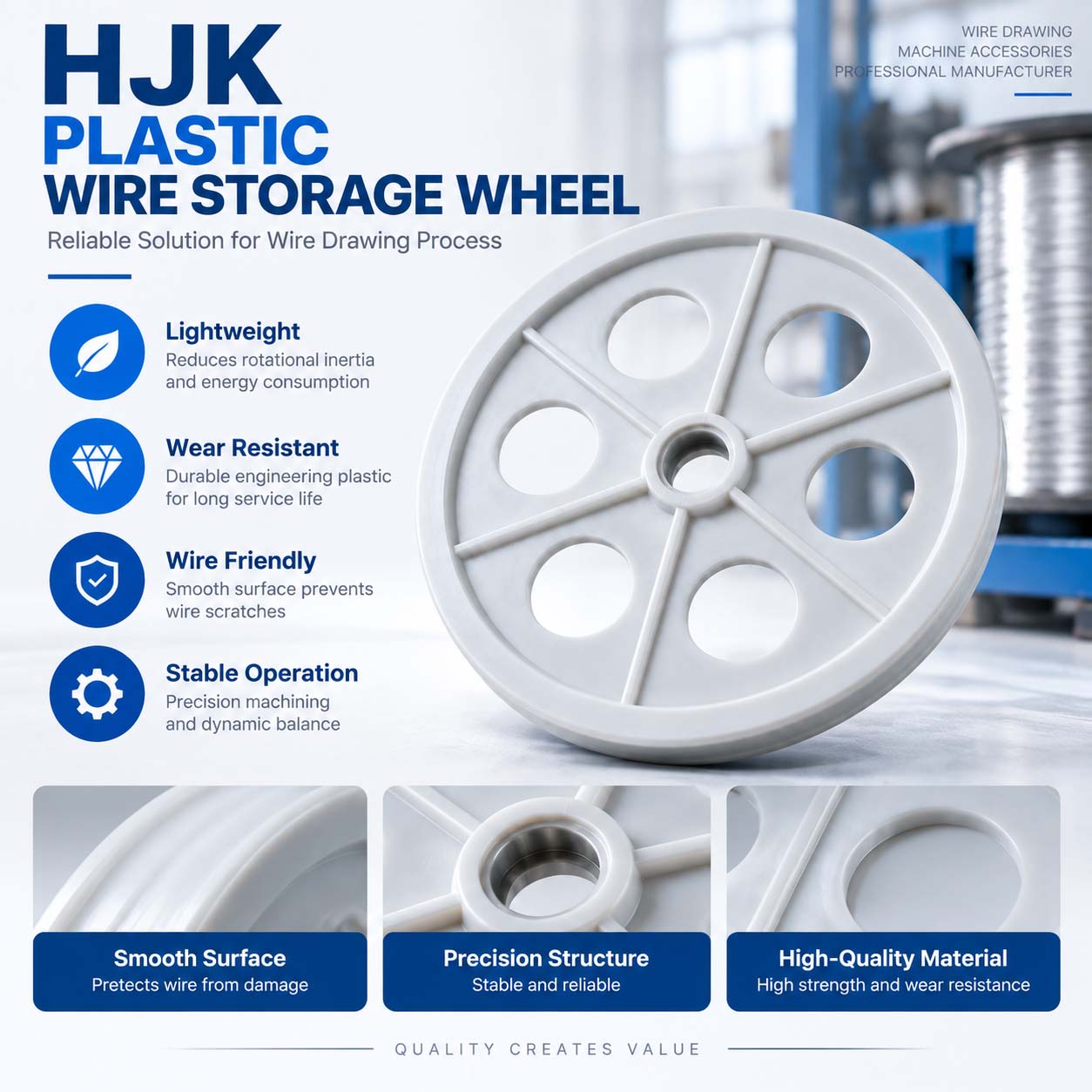
In metal wire drawing production, the wire storage pulley is an important component for maintaining continuous and stable operation. It temporarily stores wire and compensates for speed differences between different sections of the production line, helping reduce tension fluctuations, wire breakage, and slack.
The HJK Plastic Wire Storage Pulley is manufactured from high-quality engineering plastics, combining lightweight construction, wear resistance, and stable running performance. It is suitable for various wire drawing machines and annealing production lines.
Product Features and Structure
The HJK plastic wire storage pulley generally consists of a plastic pulley body, bearing, and mounting structure. High-strength engineering plastics such as nylon or polyurethane are commonly used.
Main advantages include:
- Wear Resistance: Smooth pulley surfaces reduce friction and help extend service life.
- Impact Resistance: The pulley can withstand repeated impact during high-speed wire movement.
- Lightweight Design: Compared with metal pulleys, plastic pulleys reduce rotational inertia and equipment load.
- Corrosion Resistance: Engineering plastics offer good resistance to lubricants, moisture, and common production environments.
- Stable Rotation: Precision structure and dynamic balance help maintain smooth operation at higher speeds.
Some models can be equipped with standard bearings for convenient installation and replacement.
Typical Applications
HJK plastic wire storage pulleys are suitable for a variety of wire processing equipment, including:
- Fine Wire Drawing Machines: Suitable for copper wire, fine steel wire, and other small-diameter wires requiring low inertia and sensitive tension control.
- Medium Wire Drawing Machines: Used for medium-diameter wire where both wear resistance and buffering performance are required.
- Annealing Lines: Provides temporary wire storage and tension compensation when production speeds change.
- Continuous Wire Processing Lines: Helps synchronize different production stages and reduce tension fluctuations during reel changes or multi-stage drawing.
Selection Guide
When selecting a plastic wire storage pulley, the following factors should be considered:
Wire Type and Diameter
Fine wire requires narrower grooves and higher dimensional accuracy. Larger-diameter wire requires deeper grooves and greater load capacity.
Wire Storage Capacity
Pulley diameter and groove quantity should be selected according to the required temporary wire storage length.
Rotational Speed and Dynamic Balance
For high-speed applications, good dynamic balance is essential to reduce vibration and maintain stable wire tension.
Installation Dimensions
Check shaft diameter, bore size, keyway, bearing type, and fastening method to ensure compatibility with the existing machine.
Material Selection
Different engineering plastics provide different levels of strength, elasticity, wear resistance, and temperature resistance. The material should match the actual operating conditions.
Customized pulley sizes, groove profiles, and materials can also be produced according to customer drawings or samples.
Maintenance and Care
Proper maintenance can significantly extend the service life of the HJK plastic wire storage pulley.
- Regular Cleaning: Remove wire residue, metal particles, oil, and contaminants from the pulley grooves.
- Wear Inspection: Check the groove bottom and side walls regularly. Replace the pulley if deep grooves, cracks, or obvious deformation appear.
- Bearing Maintenance: Lubricate bearings according to equipment requirements and check for abnormal noise or resistance.
- Dynamic Balance Inspection: If unusual vibration occurs, inspect the pulley body for damage, deformation, or imbalance.
- Installation Check: Make sure the pulley is correctly aligned and rotates freely without sticking.
Frequently Asked Questions
What Are the Advantages of Plastic Storage Pulleys Compared with Metal Pulleys?
Plastic pulleys are lighter and have lower rotational inertia, allowing faster response to tension changes. They also help reduce vibration and operating noise while protecting the wire surface.
Metal pulleys may still be more suitable for extremely heavy loads or high-temperature environments.
When Should the Pulley Be Replaced?
Replacement is recommended when the groove has severe wear, the edge is damaged, the pulley body is cracked or deformed, or radial runout exceeds acceptable limits.
Regular inspection helps prevent wire quality problems and unexpected production downtime.
Can HJK Plastic Wire Storage Pulleys Be Used for Stainless Steel Wire?
Yes, depending on the wire diameter, surface condition, tension, and operating speed. Higher-strength engineering plastics are recommended for stainless steel wire applications.
What Should Be Checked During Installation?
Make sure the shaft and bore dimensions match correctly, tighten all fasteners evenly, and manually rotate the pulley after installation to confirm smooth movement. Radial runout should also be checked for precision applications.
How Long Is the Service Life?
Service life varies depending on wire material, speed, tension, operating environment, and maintenance conditions. High-quality plastic pulleys can provide long-term operation when properly selected and maintained.
Can Custom Sizes and Materials Be Supplied?
Yes. HJK plastic wire storage pulleys can be customized according to customer requirements, including outer diameter, groove design, bore size, bearing configuration, and plastic material.
