

Coating Service Overview
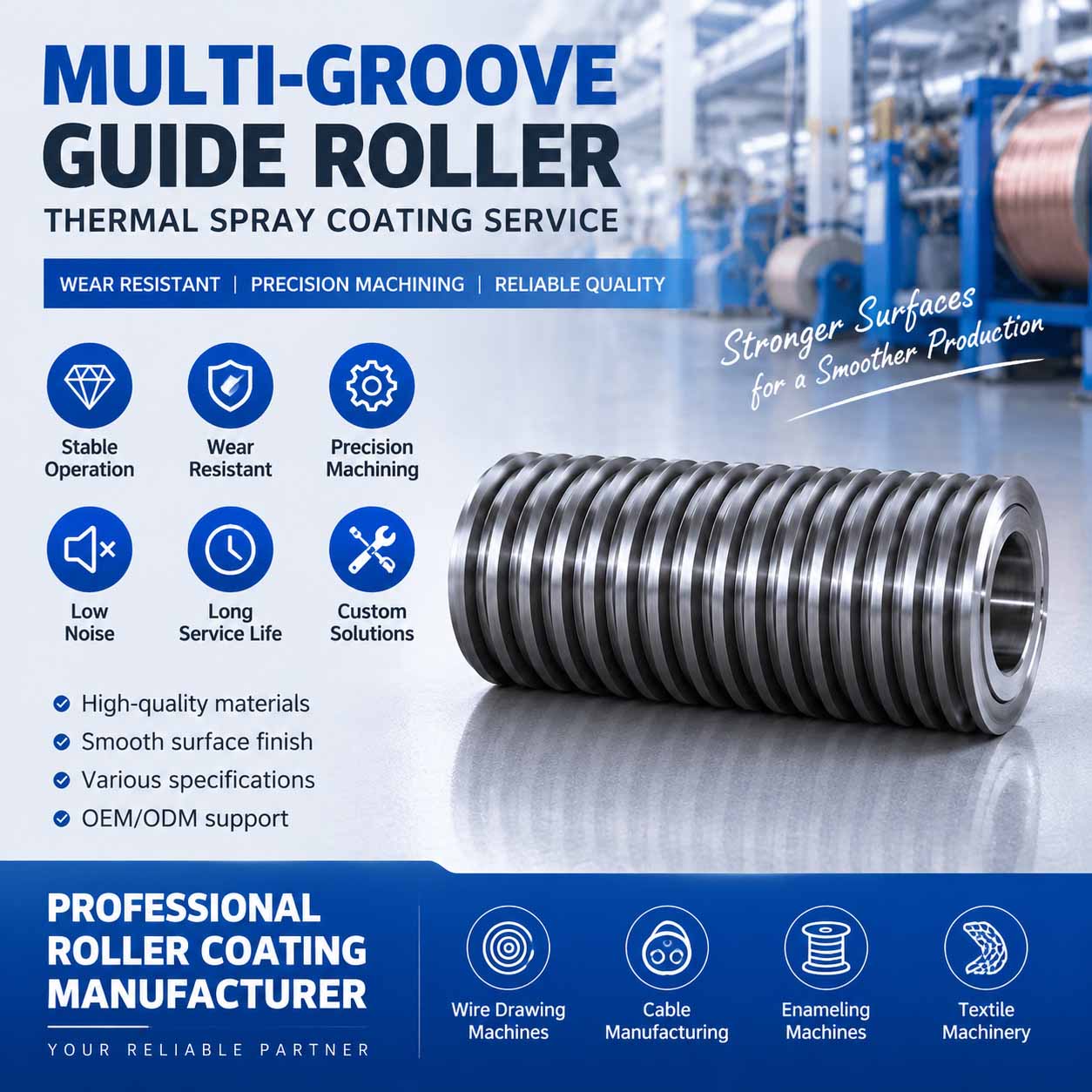
In continuous production lines such as wire drawing, cable manufacturing, and textile machinery, multi-groove guide rollers are critical components for guiding and supporting materials. After long-term operation, groove wear, corrosion, and surface scratches may cause wire vibration, increased breakage rates, and surface damage.
Through professional thermal spray coating and surface treatment technology, worn guide rollers can be restored and upgraded with improved wear resistance, corrosion resistance, and service life, helping reduce downtime and replacement costs.
Multi-Groove Guide Roller Coating Technology
According to different working conditions, we provide advanced thermal spray solutions, including:
- HVOF (High Velocity Oxygen Fuel) coating
- Plasma spray coating
- Ceramic coating
- Tungsten carbide coating
The coating material is selected according to the base material, wire type, operating speed, and application environment.
Tungsten Carbide Coating
Tungsten carbide coating provides extremely high hardness (typically HV0.3 1100–1300) and excellent resistance to abrasive wear and friction wear.
It is widely used for high-speed wire drawing, steel wire processing, cable manufacturing, and other heavy-duty applications. The dense coating structure, high bonding strength, and low porosity effectively protect the roller surface from continuous wear and extend service life.
Ceramic Coating
Ceramic coatings, such as chromium oxide and aluminum oxide coatings, feature low friction, excellent anti-sticking performance, and high surface hardness.
They are suitable for soft materials such as copper wire, aluminum wire, and optical fiber. Ceramic coatings help prevent material adhesion, reduce surface damage, and maintain excellent product quality. They are also widely used in enamel wire machines due to their insulation and high-temperature resistance.
Roller Repair and Remanufacturing
A worn multi-groove guide roller does not always need to be replaced. Through coating repair technology, the original dimensions and performance can be restored.
The typical repair process includes:
- Cleaning and degreasing
- Sand blasting surface preparation
- Applying bonding layer and wear-resistant coating
- Precision grinding and finishing to drawing specifications
After repair, the roller can achieve performance comparable to or better than a new component while significantly reducing replacement costs.
Application Areas
Wire Drawing Machines
Used for tower pulleys, guide rollers, and tension rollers requiring high wear resistance under high-speed operation.
Enameling Machines
Ceramic-coated guide rollers provide insulation, anti-adhesion properties, and high-temperature resistance.
Cable Manufacturing Equipment
Multi-groove rollers and wire guides require smooth surfaces and excellent wear resistance to protect cable insulation layers.
Textile Machinery
Guide rollers and yarn rollers require resistance to fiber abrasion and stable surface performance.
Selection Guide
When selecting a suitable coating solution, consider:
- Wire Material: Tungsten carbide coating is recommended for hard materials such as steel wire; ceramic coating is suitable for copper, aluminum, and other soft wires.
- Operating Speed: High-speed applications require dense coatings with strong bonding strength, where HVOF coating is preferred.
- Working Environment: Corrosive environments require ceramic or alloy protective coatings.
- Groove Accuracy: Customers can provide drawings or samples to ensure precise groove dimensions after coating.
Frequently Asked Questions
Can thermal spray coating restore the original size of the roller?
Yes. The worn area can be rebuilt by coating and then precision-machined to the required dimensions. Accuracy can reach ±0.01 mm.
Will the coating peel off during operation?
With proper surface preparation and process control, coating bonding strength can exceed 70 MPa, ensuring reliable performance under normal working conditions.
How long does the repair process take?
Normally 5–10 working days, depending on roller size, quantity, and damage condition.
What is the typical coating thickness?
Generally 0.2–0.5 mm, adjustable according to wear allowance and application requirements.
Repair or replacement—which is better?
For rollers with surface wear, grooves, or dimensional deviation, coating repair is usually a cost-effective solution. Severely deformed or cracked parts may require replacement.
Multi-Groove Guide Roller Thermal Spray Coating Service provides an economical and reliable solution for extending the service life of industrial rollers. With advanced HVOF, ceramic, and tungsten carbide coating technologies, we help customers improve equipment performance, reduce maintenance costs, and achieve stable production efficiency.
