

Coating Service Overview
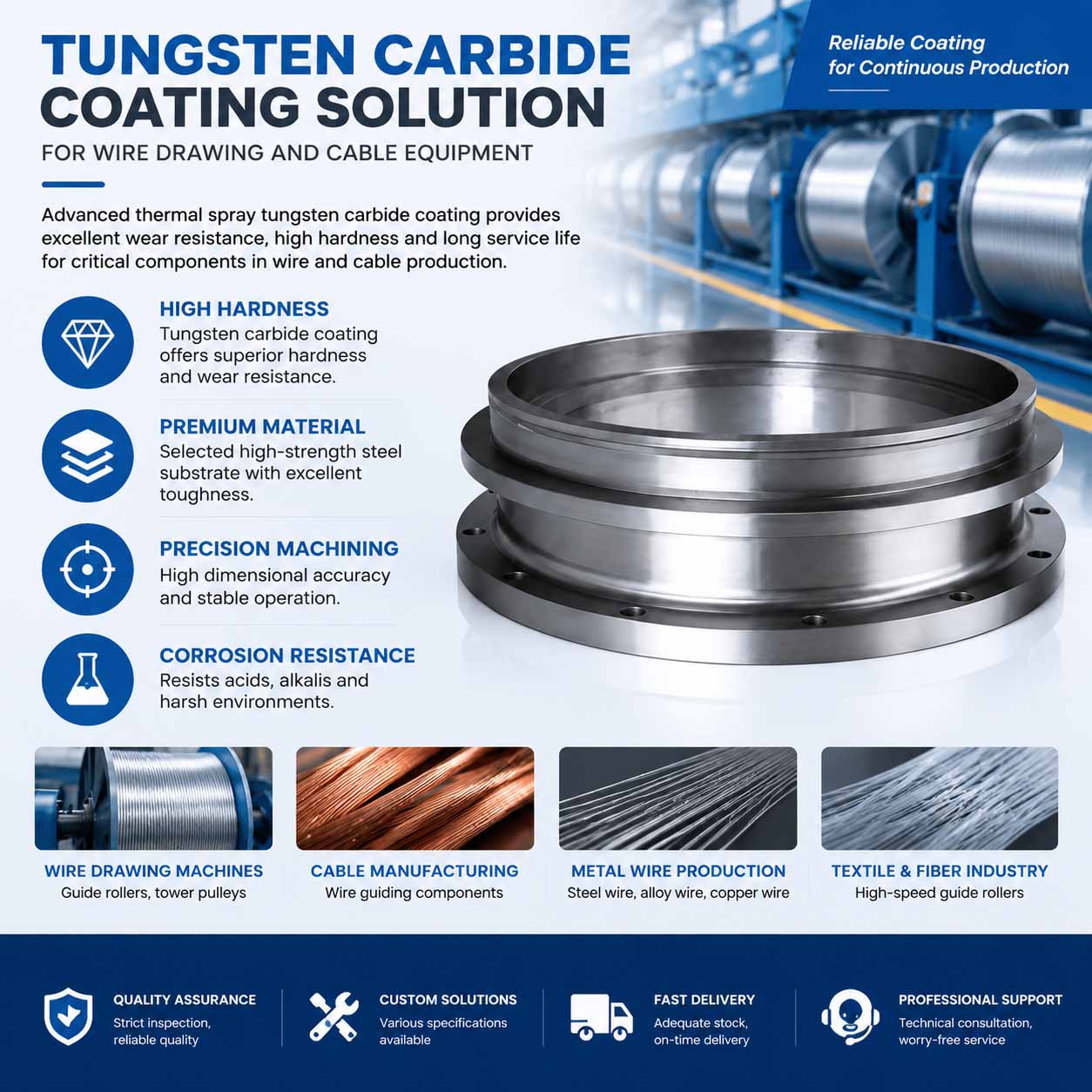
In wire and cable manufacturing, steel wire production, and metal wire processing, guide rollers are critical components that continuously experience friction and wear.
To extend roller service life and ensure stable production, surface strengthening technologies such as tungsten carbide coating have become widely adopted in the industry.
This article introduces the processing parameters, application areas, and maintenance recommendations for ceramic coated aluminum guide rollers and tungsten carbide coated guide rollers.
Coating Material and Thickness
The most commonly used coating material for guide rollers is tungsten carbide (WC).
Due to its high hardness and excellent wear resistance, tungsten carbide coatings effectively protect roller surfaces from wear caused by high-speed wire movement.
Typical coating specifications:
- Coating material: Tungsten Carbide (WC)
- Coating thickness: 0.2–0.3 mm
This thickness range provides an optimal balance between wear resistance and coating adhesion. Excessive thickness may increase internal stress and create a higher risk of cracking or peeling.
Features of Ceramic Coated Aluminum Guide Rollers
Ceramic coated aluminum guide rollers use an aluminum alloy substrate with a ceramic or tungsten carbide surface coating applied through thermal spray technology.
They combine:
- Lightweight structure
- Good thermal performance
- High wear resistance
These rollers are suitable for medium and high-speed wire drawing equipment.
Ceramic guide rollers usually refer to rollers made from ceramic materials or ceramic-coated surfaces. They offer:
- Smooth surface finish
- Low friction coefficient
- Excellent temperature resistance
However, traditional ceramic materials can be relatively brittle. Tungsten carbide coating can improve impact resistance and durability for more demanding applications.
Application Areas
Tungsten carbide coated guide rollers are widely used in:
- Wire stranding and cable manufacturing equipment
- Steel wire rope machines and wire drawing machines
- Tower pulleys and speed control rollers
- Continuous annealing and coating production lines
- Textile and chemical fiber high-speed guide rollers
In these applications, coated rollers help:
- Reduce wire surface scratches
- Maintain stable wire tension
- Reduce roller replacement frequency
- Improve production efficiency
Selection and Maintenance Guidelines
How to Select the Right Guide Roller
Selection should consider:
Wire Material and Hardness
Harder wire materials usually require rollers with higher wear resistance and optimized coating thickness.
Operating Speed
For high-speed applications, coating uniformity and bonding strength are critical factors.
Working Environment
For humid or corrosive environments, substrate corrosion resistance should be considered. Stainless steel substrates may be recommended when necessary.
Installation Dimensions
The inner diameter, outer diameter, groove profile, and mounting dimensions must match the equipment requirements.
Maintenance Recommendations
To maximize coating life:
- Regularly inspect coating wear and repair or replace rollers before substrate exposure occurs.
- Keep roller surfaces clean to prevent abrasive particles from damaging the coating.
- Use proper installation tools and avoid impact on coated surfaces.
- Store rollers carefully and use soft protective materials between stacked components.
Frequently Asked Questions
How long is the service life of tungsten carbide coated guide rollers?
Service life depends on wire material, tension, speed, lubrication, and operating conditions. In practical applications, coated rollers typically provide several times longer service life than uncoated rollers.
Is a thicker coating always better?
No. Excessive coating thickness increases internal stress and may cause cracks or peeling. A thickness of 0.2–0.3 mm provides a reliable balance between wear resistance and durability.
Can ceramic coated aluminum guide rollers be repaired?
Yes. Worn rollers can be refurbished by removing the damaged coating, reapplying tungsten carbide or ceramic coating, and restoring the original dimensions through precision machining.
What wire materials are suitable for tungsten carbide coated rollers?
They are suitable for steel wire, copper wire, aluminum wire, alloy wire, and some non-metallic wire applications. For very soft or adhesive materials, surface finish requirements should be evaluated carefully.
How can coating failure be identified?
The coating should be considered failed when large-area peeling occurs, cracks extend to the substrate, or wear depth exceeds approximately 80% of the original coating thickness.
What is the difference between tungsten carbide and ceramic coatings?
Tungsten carbide coatings provide higher hardness, toughness, and wear resistance, making them suitable for heavy-duty friction applications. Ceramic coatings offer lower friction and better high-temperature performance but generally have lower impact resistance. The best solution depends on the specific working environment.
