

Coating Service Overview
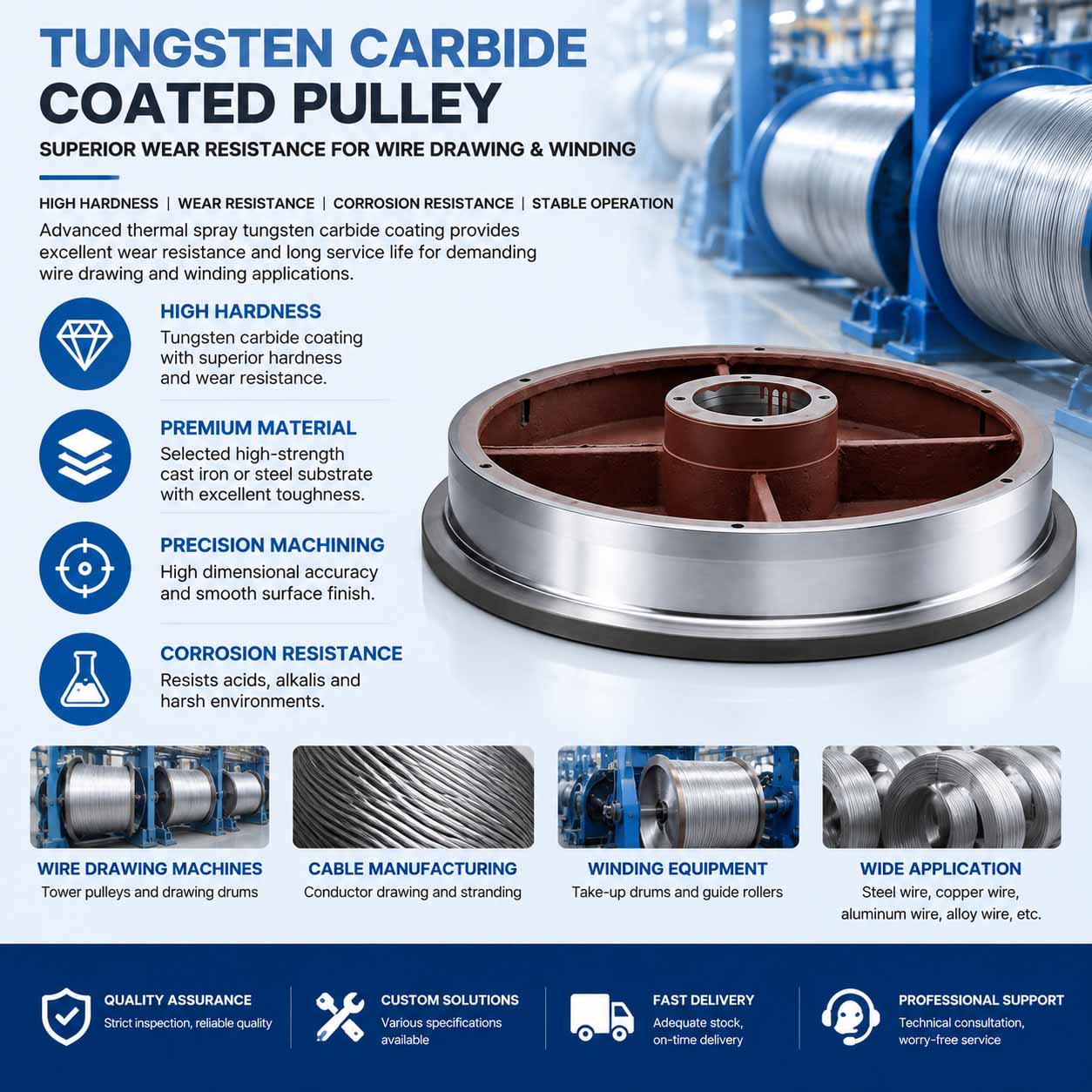
During metal wire drawing and winding processes, tower pulleys and take-up drums are critical components that directly affect production efficiency and product quality. Continuous contact with high-speed wire causes severe friction and wear, which may lead to wire surface defects, equipment downtime, and increased maintenance costs.
Tungsten carbide coating technology provides a high-hardness and wear-resistant surface protection solution. It can significantly extend component service life and is also suitable for refurbishing worn parts, restoring original dimensions and performance.
Features of Tungsten Carbide Coating Process
Tungsten carbide coatings are applied using advanced thermal spray technologies such as High Velocity Oxygen Fuel (HVOF) spraying.
Typical coating specifications:
- Coating material: Tungsten Carbide (WC)
- Coating thickness: 0.2–0.3 mm
- Hardness: HV1100+
- Bonding strength: Over 70 MPa
- Low porosity and dense coating structure
The coating effectively resists abrasive wear, sliding friction, and wire-induced surface damage. It is suitable for drawing steel wire, copper wire, alloy wire, and other metal materials.
Application Areas
Tower Pulleys
Tower pulleys are key transmission components in wire drawing machines. Their grooves and side surfaces are continuously exposed to wire friction.
After tungsten carbide coating, the wear resistance of groove surfaces is significantly improved, reducing wire scratches, dimensional deviation, and production interruptions.
Take-Up Drums
During high-speed winding operations, take-up drums remain in continuous contact with wire. Tungsten carbide coatings help maintain a smooth surface finish, reduce wire damage, and extend replacement intervals.
Other Related Components
The same coating technology can also be applied to:
- Wire drawing steel rings
- Guide rollers
- Wire passing rollers
- Other wear-resistant rotating components
Custom Coating and Repair Services
We provide customized tungsten carbide coating solutions for both new components and worn parts.
New Component Coating
According to customer drawings or samples, coating parameters are optimized to achieve:
- Accurate dimensions
- Uniform coating thickness
- Stable surface performance
Used Component Refurbishment
For worn tower pulleys and take-up drums, the repair process includes:
- Cleaning and surface preparation
- Removal of damaged layers and contaminants
- HVOF tungsten carbide coating application
- Precision grinding to required dimensions
- Final quality inspection
Refurbished components can achieve performance close to new parts while significantly reducing replacement costs.
Selection and Maintenance Recommendations
When selecting tungsten carbide coating services, consider:
- Substrate material: Steel, aluminum alloy, and other substrates require suitable surface preparation processes.
- Coating thickness: 0.2–0.3 mm is commonly recommended. Excessive thickness may increase internal stress and reduce bonding reliability.
- Surface finish: Precision grinding after spraying can achieve the required smoothness for different wire materials.
- Repair evaluation: Components with severe deformation or cracks may not be suitable for coating refurbishment.
Maintenance Guidelines
To maximize coating service life:
- Avoid impact loads during installation and operation.
- Regularly inspect coating surfaces for cracks or peeling.
- Remove metal debris and contaminants to prevent surface damage.
- Maintain proper lubrication when applicable and ensure lubricant compatibility with the coating.
Frequently Asked Questions
Why is the tungsten carbide coating thickness 0.2–0.3 mm?
This thickness range provides an optimized balance between wear resistance and coating reliability. Excessive thickness may increase internal stress and reduce bonding strength.
Can tungsten carbide coated parts be machined after spraying?
Yes. The coating can be precision-ground using diamond grinding wheels to achieve the required dimensions and surface finish. Conventional turning is generally not recommended.
What preparation is required before repairing old tower pulleys?
Components must be cleaned, degreased, and sandblasted to remove fatigue layers and contaminants, ensuring strong coating adhesion. Severely worn areas may require additional surface restoration.
What wire materials are suitable for tungsten carbide coating?
The coating is suitable for steel wire, copper wire, aluminum wire, alloy wire, and other metal wire drawing applications. For highly adhesive materials, surface finish requirements should be evaluated.
How long does the coating last?
Service life depends on wire material, drawing speed, tension, lubrication conditions, and operating environment. Under normal conditions, tungsten carbide coatings can extend component life several times compared with uncoated parts.
What is the surface appearance after coating?
Tungsten carbide coatings typically have a dark gray appearance. The sprayed surface is slightly rough, while precision grinding can achieve a smooth or mirror-like finish. Color variation caused by spraying parameters does not affect performance.
