

Coating Service Overview
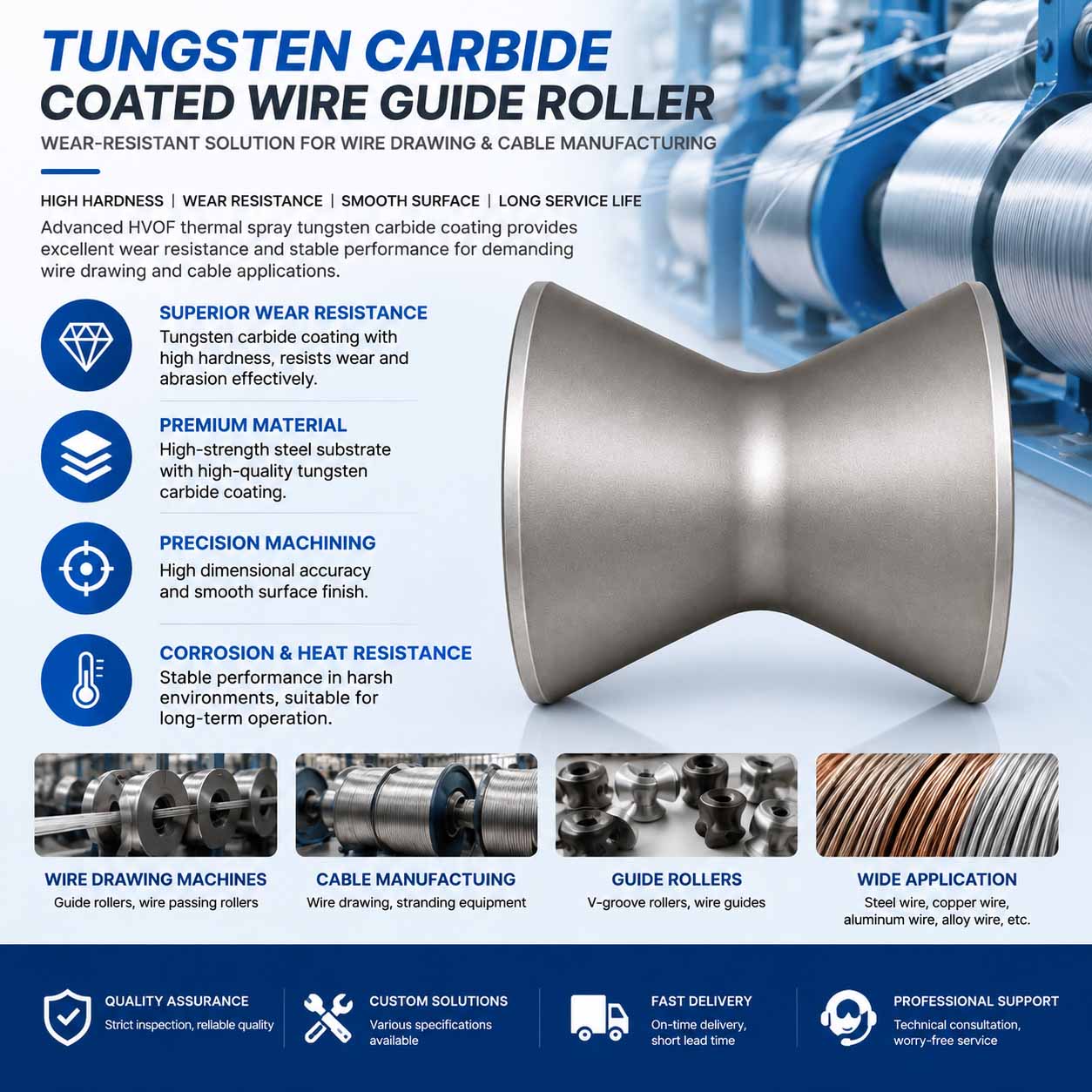
During steel wire and cable drawing processes, components such as guide rollers and tower pulleys are continuously exposed to high-speed friction and wire tension, resulting in severe surface wear over time.
To extend the service life of these critical components, we apply advanced HVOF tungsten carbide coating technology to create a highly wear-resistant surface layer. The coating thickness is typically controlled at 1–1.2 mm, significantly improving wear resistance and reducing maintenance frequency.
This article introduces tungsten carbide coated tower pulleys, ceramic coated guide rollers, coating technologies, selection methods, and maintenance recommendations.
Coating Materials and Process
We mainly use tungsten carbide (WC) as the coating material and apply it through High Velocity Oxygen Fuel (HVOF) spraying technology.
The HVOF process produces high particle velocity, creating a dense coating structure with:
- High bonding strength
- Low porosity
- Excellent resistance to abrasive and sliding wear
The standard coating thickness is 1–1.2 mm, which can be adjusted according to component wear allowance while maintaining final dimensional accuracy.
Advantages of Tungsten Carbide Coating
High Hardness
Tungsten carbide coatings can achieve hardness above HV1100, effectively resisting friction and wear caused by high-speed wire movement.
Dense and Uniform Structure
The HVOF process creates a uniform coating layer, reducing the risk of cracking and peeling.
Excellent Repair Capability
Worn tower pulleys and guide rollers can be recoated and restored, reducing replacement costs and extending component life.
Applicable Components
Tungsten carbide coatings are widely used on wire processing equipment, including:
Tower Pulleys (Wire Drawing Drums)
Tower pulleys are key traction components in wire drawing machines. After tungsten carbide coating, their wear resistance is significantly improved, making them suitable for steel wire, alloy wire, and other high-strength wire drawing applications.
Guide Rollers and Wire Passing Rollers
Guide rollers control wire direction during processing. Ceramic or tungsten carbide coatings reduce wire scratches, lower friction, and protect the roller surface.
Steel Rings
Tungsten carbide coated steel rings can be used in tower pulley assemblies or independent guide roller systems. They are convenient to replace and maintain.
Rollers and Drums
Coated winding and unwinding rollers improve wire stability, prevent slipping, and extend service life.
These components are commonly used in inverted wire drawing machines, vertical wire drawing machines, water tank drawing machines, and other wire processing equipment.
Selection and Customization
The correct coating solution depends on:
- Wire material
- Wire diameter
- Drawing speed
- Wire tension
- Working environment
For hard materials such as steel wire and stainless steel wire, tungsten carbide coating is recommended due to its excellent wear resistance.
For some non-ferrous metal wires, ceramic coatings may be preferred to reduce adhesive wear.
We provide both refurbishment and customized coating services:
- Worn tower pulleys and guide rollers can be inspected, surface-treated, recoated, and restored to original dimensions.
- New aluminum alloy or steel components can be machined with coating allowance and finished after spraying.
- Customized tungsten carbide steel rings are available for different machine models.
Customers can provide drawings or samples for evaluation of coating area, thickness, and machining requirements.
Maintenance Recommendations
To maximize coating service life:
- Avoid impact on the coated surface during installation.
- Regularly inspect coating wear and repair before substrate exposure.
- Keep wire surfaces clean to prevent abrasive particles from damaging the coating.
- Store components away from moisture and corrosive environments.
Under normal operating conditions, tungsten carbide coated tower pulleys can achieve several times longer service life than conventional hardened steel rollers, depending on actual working conditions.
Frequently Asked Questions
Is a 1–1.2 mm tungsten carbide coating easy to wear through?
No. This thickness range is optimized to balance wear resistance and coating reliability. Under normal wire friction conditions, the wear rate is low. When the coating approaches its service limit, recoating can restore performance.
What is the difference between ceramic and tungsten carbide coated guide rollers?
Ceramic coatings, such as chromium oxide, provide lower friction and are suitable for non-ferrous wires where adhesion prevention is important. Tungsten carbide coatings offer higher hardness and better wear resistance for steel wire and other hard materials.
Can refurbished tower pulleys perform like new components?
Yes. Qualified components can be restored through fatigue layer removal, surface preparation, coating, and precision machining. Final dimensions and performance can meet original requirements.
Which wire drawing machines are suitable for tungsten carbide coated pulleys?
They are suitable for various dry drawing and wet drawing machines, including inverted, vertical, and horizontal wire drawing equipment.
How long does coating processing take?
Processing time depends on component size, quantity, and complexity. Lead time should be confirmed according to specific requirements.
When should the coating be repaired?
Repair is recommended when visible wear grooves appear, the substrate becomes exposed, or abnormal scratches appear on the processed wire.
