

Coating Service Overview
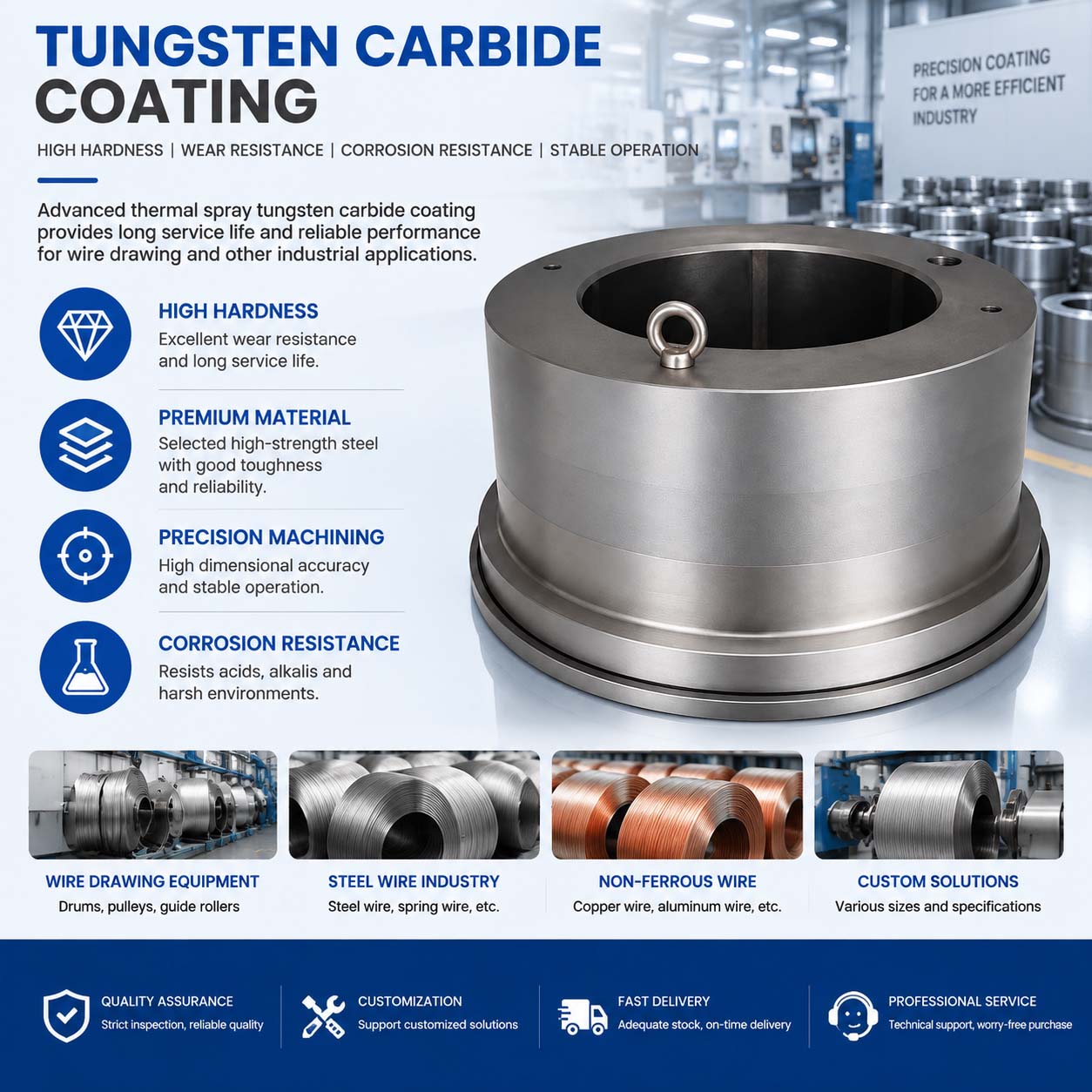
In the wire and cable manufacturing industry, the wear resistance of key wire drawing components directly affects production efficiency and product quality. Inverted wire drawing drums, tower pulleys, and steel rings are continuously exposed to high-speed wire friction, making traditional surface treatments insufficient for demanding operating conditions.
Tungsten carbide coating technology provides a high-hardness and wear-resistant surface protection solution for these components. It is especially suitable for refurbishment of worn parts, significantly reducing replacement costs and extending service life.
Features and Applications of Tungsten Carbide Steel Rings
Tungsten carbide steel rings are commonly used wear-resistant components in wire drawing machines. A tungsten carbide coating is applied to the surface, typically with a thickness of 0.2–0.3 mm.
With extremely high hardness and excellent wear resistance, tungsten carbide coatings effectively resist friction and scratching caused by high-speed wire movement. They help maintain surface smoothness, reduce wire vibration, and minimize wire breakage.
These coated steel rings are widely used in various wire drawing equipment, including:
- Inverted wire drawing drums
- Take-up drums
- Tower pulleys
- Guide rollers
They are suitable for processing copper wire, aluminum wire, alloy wire, and other metal wires under both dry and wet drawing conditions. The uniform coating structure also reduces friction and improves energy efficiency.
Refurbishment Process for Old Tower Pulleys
Tower pulleys are important transmission components in wire drawing machines. After long-term operation, surface grooves and wear may affect wire speed synchronization and product quality.
Reconditioning worn tower pulleys with tungsten carbide coating is an economical and efficient remanufacturing solution.
The repair process includes:
- Surface cleaning and removal of worn layers and contaminants.
- Application of HVOF (High Velocity Oxygen Fuel) tungsten carbide coating.
- Control of coating thickness at 0.2–0.3 mm.
- Precision grinding to restore original dimensions and surface finish.
After refurbishment, tower pulleys can achieve performance comparable to new components, while reducing costs to approximately 30–50% of replacement expenses.
The same technology can also be applied to wire drawing drums, take-up drums, guide rollers, and other wear-resistant components.
Selection and Maintenance Guidelines
How to Select the Right Tungsten Carbide Steel Ring
Selection should consider:
- Wire drawing machine model
- Wire material
- Wire diameter range
- Drawing speed
- Lubrication conditions
Important parameters include inner and outer diameter, width, installation method, coating bonding strength, and porosity.
Providing detailed operating conditions allows engineers to recommend the most suitable coating solution.
Maintenance Recommendations
To maximize service life:
- Regularly inspect coating wear and repair local damage promptly.
- Avoid hard tools that may scratch the coating surface.
- Maintain clean lubrication and cooling systems to prevent abrasive particle damage.
- Keep repaired components properly stored to avoid impact and corrosion.
Frequently Asked Questions
What hardness can tungsten carbide coating achieve?
Tungsten carbide coatings typically reach 1100–1300 HV, providing much higher wear resistance than hardened steel.
How long can refurbished tower pulleys last?
Under normal operating conditions, refurbished pulleys can achieve service life comparable to new components. Actual performance depends on wire material, speed, and tension.
Will the coating peel off?
With proper surface preparation and HVOF spraying processes, tungsten carbide coatings have strong bonding strength and are not easy to peel during normal operation. Improper preparation or severe impact may cause local damage.
Which components can be coated with tungsten carbide?
Besides steel rings and tower pulleys, wire drawing drums, take-up drums, guide rollers, and wire passing rollers can also receive tungsten carbide coatings to improve wear resistance.
How long does the refurbishment process take?
Depending on component quantity and damage level, repair usually takes approximately 3–7 working days. Expedited processing may be available.
What wire materials are suitable for tungsten carbide coated steel rings?
They are suitable for copper, aluminum, copper alloy, aluminum alloy, stainless steel, and many other metal wire drawing applications. For special materials, coating selection should be evaluated according to actual working conditions.
