

Coating Service Overview
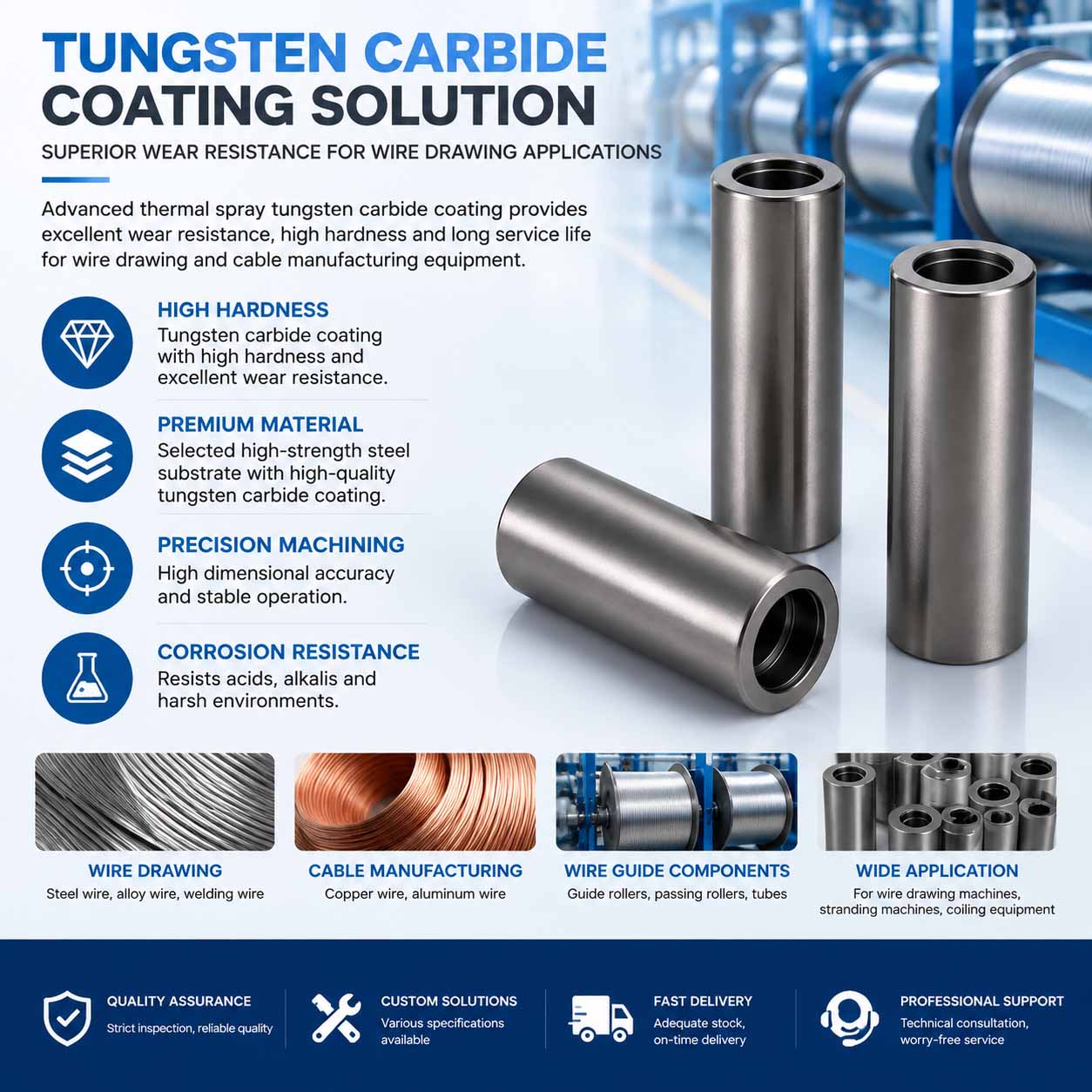
In the steel wire and metal wire industries, the wear resistance of wire passing rollers and guide rollers directly affects production efficiency and product quality.
Tungsten carbide and ceramic coating technologies provide effective surface protection solutions by improving hardness, wear resistance, and service life. This article introduces the application of ceramic coating and tungsten carbide coating technologies for wire passing rollers and cable guide rollers, including process features, applications, and selection guidelines.
Tungsten Carbide Coating Process
Tungsten carbide coatings are applied using advanced thermal spray technologies, including High Velocity Oxygen Fuel (HVOF) spraying.
Typical coating specifications:
- Coating material: Tungsten Carbide (WC)
- Coating thickness: 0.2–0.3 mm
- High bonding strength
- Low porosity
- Improved surface hardness
Key Advantages
High Hardness
Tungsten carbide coatings can achieve hardness above HV1100, providing excellent resistance against abrasive wear and wire friction.
Precise Thickness Control
A coating thickness of 0.2–0.3 mm provides sufficient wear protection while maintaining component dimensional accuracy.
Strong Bonding Performance
The thermal spray process creates a reliable bond between the coating and metal substrate, reducing the risk of peeling during operation.
Application Areas
Tungsten carbide coated wire passing rollers and guide rollers are widely used in:
- Wire drawing machines
- Stranding machines
- Cable manufacturing equipment
- Steel wire production lines
- Welding wire production lines
- Tension control systems
Typical Components
- Wire drawing machine tower pulleys and steel rings
- Stranding machine guide rollers and passing rollers
- Winding and unwinding rollers
These coated components help guide wire movement, reduce friction, and maintain stable production under high-speed operating conditions.
Selection and Maintenance Guidelines
When selecting ceramic or tungsten carbide coated rollers, consider:
- Wire material
- Wire tension
- Operating speed
- Working environment
- Required surface finish
For most applications, a tungsten carbide coating thickness of 0.2–0.3 mm provides a good balance between wear resistance and reliability.
During operation:
- Clean roller grooves regularly to prevent foreign particles from damaging the coating.
- Check bearing lubrication to avoid abnormal wear caused by roller seizure.
- Inspect coating surfaces regularly and repair cracks or peeling promptly.
If local coating damage occurs, refurbishment or recoating can restore component performance and extend service life.
Frequently Asked Questions
What is the difference between tungsten carbide and ceramic coatings?
Tungsten carbide is a metal-ceramic composite coating with high hardness and good toughness. Traditional ceramic coatings, such as oxide ceramics, provide excellent high-temperature resistance but are more brittle. For wire passing rollers, tungsten carbide coatings are often preferred due to their better impact resistance and wear performance.
Can the 0.2–0.3 mm coating thickness be customized?
Yes. The coating thickness can be adjusted according to application requirements, but coating stress and bonding strength must be considered during design.
Can worn guide rollers be repaired?
Yes. Used rollers can be restored by removing the damaged surface, performing proper surface preparation, recoating with tungsten carbide, and precision machining back to the required dimensions.
What wire materials are suitable for tungsten carbide coated rollers?
They are suitable for steel wire, copper wire, aluminum wire, and other metal wire applications. For softer materials, surface roughness must be carefully controlled to prevent scratching.
How is coating quality evaluated?
Quality can be checked through coating thickness measurement, hardness testing, bonding strength testing, and metallographic analysis.
How long is the service life of coated rollers?
Service life depends on wire material, speed, tension, lubrication, and operating conditions. With proper use and maintenance, tungsten carbide coated rollers can achieve several times longer service life compared with conventional hardened steel rollers.
