

Coating Service Overview
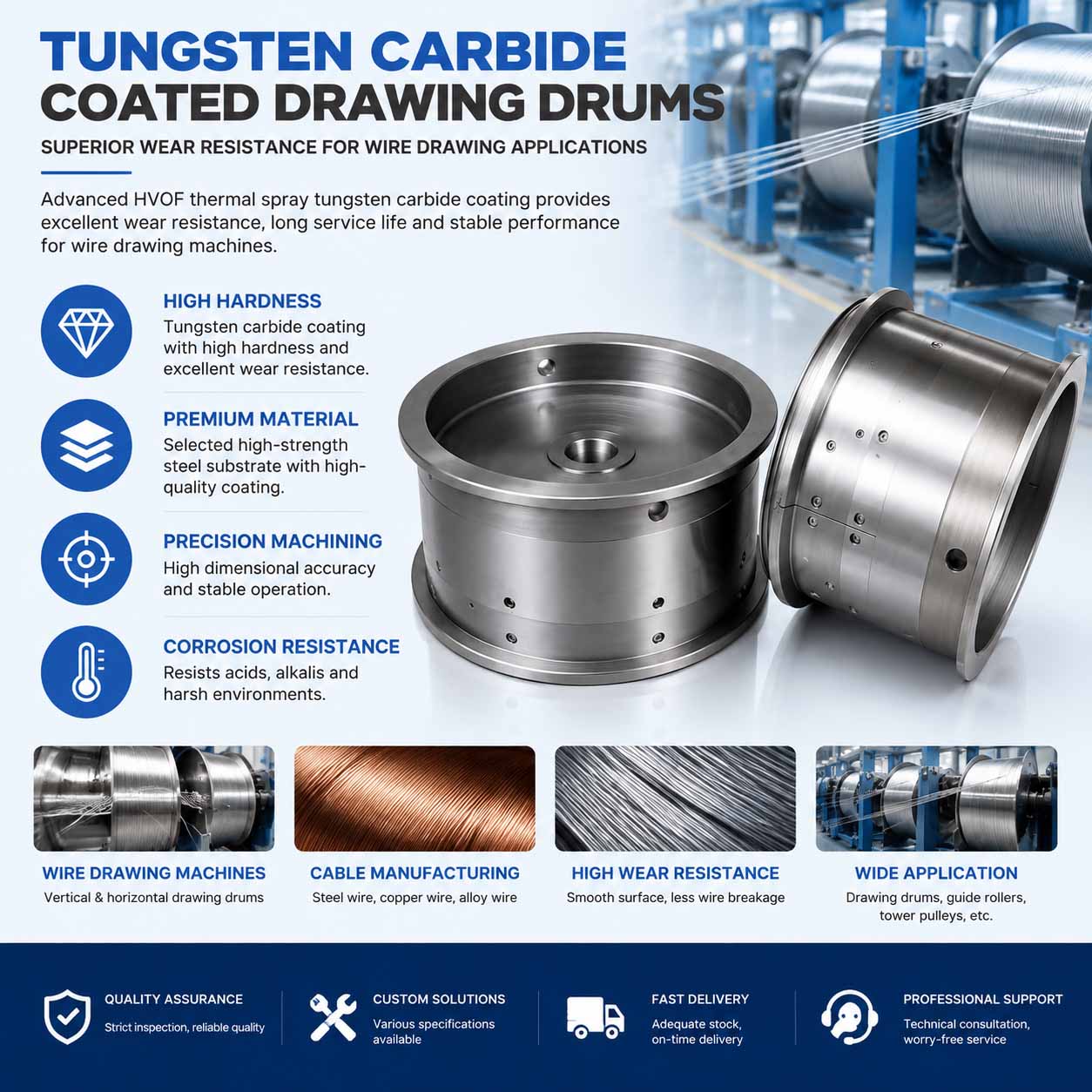
In wire and cable manufacturing, wire drawing, and winding processes, components such as guide rollers, drawing drums, and tower pulleys are continuously exposed to high-speed wire friction, resulting in severe wear over time.
By applying advanced tungsten carbide coating technology, a high-hardness and wear-resistant protective layer can be formed on component surfaces. This significantly extends service life, reduces replacement frequency, and improves production stability.
This article introduces tungsten carbide coating solutions for vertical wire drawing drums, enameling machine guide rollers, and winding machine guide rollers, including coating parameters, applications, and maintenance recommendations.
Coating Material and Process
We use HVOF (High Velocity Oxygen Fuel) thermal spray technology to apply tungsten carbide powder onto component surfaces, forming a dense and durable coating.
Typical coating specifications:
- Coating material: Tungsten Carbide (WC-Co)
- Coating thickness: 0.2–0.3 mm (adjustable)
- Bonding strength: ≥70 MPa
- Hardness: HV0.3 1100–1300
- Porosity: <1%
The coating combines high hardness with good toughness, effectively resisting sliding wear, fretting wear, and abrasive erosion caused by continuous wire contact.
Applicable Components and Industries
Vertical Wire Drawing Drums
Vertical wire drawing drums are key components in wire drawing machines. High-speed wire movement creates continuous friction on the drum surface, causing wear grooves over time.
After tungsten carbide coating, the surface hardness and smoothness are improved, reducing wire breakage and maintaining consistent wire quality.
Enameling Machine Guide Rollers
Enameling machine guide rollers operate under high temperature and high-speed conditions. Conventional materials may suffer from wear and enamel residue adhesion.
Tungsten carbide coatings provide excellent wear resistance, temperature stability, and anti-stick performance, helping maintain groove accuracy and extend cleaning intervals.
Winding Machine Guide Rollers
Winding guide rollers require low friction and high wear resistance to maintain stable winding tension.
Tungsten carbide coatings improve surface finish, reduce wire scratches, and are suitable for precision winding applications.
Additional applications include:
- Tower pulleys
- Wire passing rollers
- Guide rollers
- Stranding machine rollers
- Cable rollers
- Steel rings and industrial drums
Selection and Customization
When selecting tungsten carbide coating services, consider:
Substrate Compatibility
Carbon steel, alloy steel, stainless steel, and aluminum alloy substrates can be coated. The substrate temperature resistance and thermal expansion characteristics should be evaluated.
Coating Thickness
The standard thickness is 0.2–0.3 mm. For severe wear conditions, thicker coatings may be considered with sufficient machining allowance.
Surface Finishing
After spraying, precision grinding or polishing can achieve surface roughness below Ra 0.4 μm, meeting high-precision wire guiding requirements.
Refurbishment Evaluation
Used components should be inspected for cracks, deformation, and excessive wear. Severely damaged parts may require rebuilding before coating.
We provide complete coating solutions, including surface preparation, thermal spraying, precision grinding, and final inspection. Customized processing is available according to drawings or samples.
Maintenance Recommendations
Although tungsten carbide coatings provide excellent wear resistance, proper maintenance further extends service life:
- Avoid impact on coating edges during installation.
- Regularly inspect roller grooves and repair abnormal wear promptly.
- Clean with soft cloths or plastic tools; avoid metal scrapers.
- Store components in dry environments to prevent corrosion and coating failure.
Frequently Asked Questions
What is the difference between tungsten carbide and ceramic coatings?
Tungsten carbide is a metal-ceramic composite coating with higher toughness and impact resistance. Pure ceramic coatings are more brittle and have lower impact resistance. For guide rollers, tungsten carbide is often more suitable for mechanical shock and thermal cycling conditions.
Will tungsten carbide coating peel off?
Under normal operating conditions, the coating provides strong bonding and is not easy to peel. Improper surface preparation, overload operation, or unexpected impact may cause local damage.
Can worn guide rollers be repaired?
Yes. After evaluation, worn rollers can be ground to remove damaged layers, recoated with tungsten carbide, and precision-machined back to original dimensions. This is usually more economical than replacement.
Is thicker coating always better?
No. Excessive coating thickness may increase internal stress and reduce bonding strength. The standard 0.2–0.3 mm thickness provides a good balance between wear resistance and reliability.
What is the typical delivery time?
Processing time depends on component quantity and complexity. Small batches usually require around 5–7 working days, while large or complex components require further evaluation.
How is coating quality inspected?
Quality control includes coating thickness measurement, hardness testing, metallographic analysis, and bonding strength testing. Inspection reports can be provided according to customer requirements.
