

Coating Service Overview
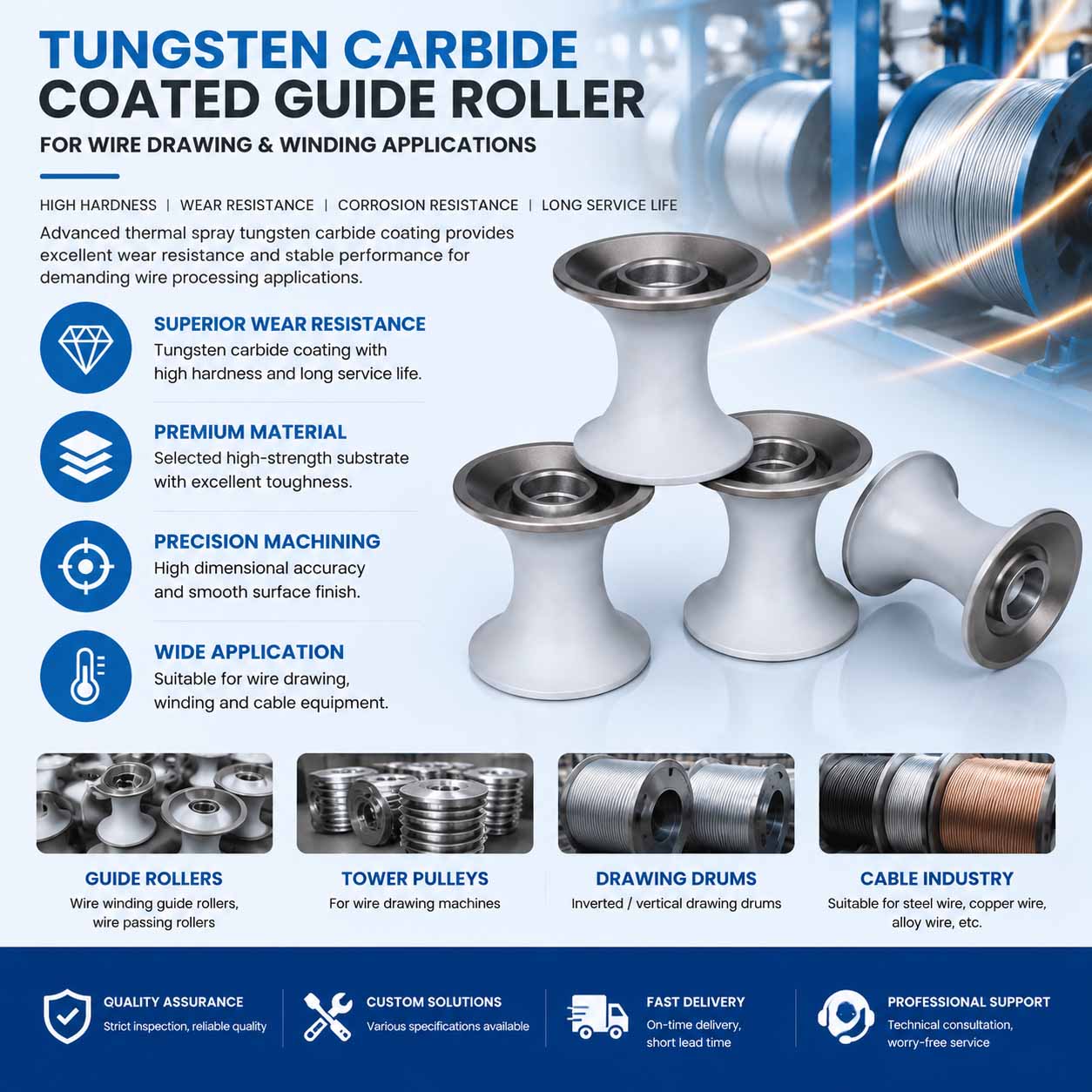
In steel wire, cable, and metal wire processing industries, guide rollers and tower pulleys are critical contact components that continuously withstand high friction and wear during drawing and winding operations.
By applying tungsten carbide coating technology, the surface hardness and wear resistance of these components can be significantly improved, extending service life and reducing maintenance downtime.
We specialize in tungsten carbide coating processing for winding guide rollers and wire drawing tower pulleys. The coating thickness is typically controlled at 1–1.2 mm, providing reliable protection for demanding wire processing applications.
Key Parameters of Tungsten Carbide Coating
The tungsten carbide (WC) coating is applied through advanced thermal spray processes, providing excellent wear performance.
Typical characteristics:
- Coating material: Tungsten Carbide (WC)
- Coating thickness: 1–1.2 mm
- High bonding strength
- Excellent wear resistance
- Surface hardness significantly higher than the substrate
Actual coating parameters can be adjusted according to component size and operating conditions.
Applicable Components and Industries
Tungsten carbide coating is widely used for wire processing equipment, including:
- Winding guide rollers
- Wire drawing tower pulleys
- Drawing drums and take-up drums
- Cable guide rollers and wire passing rollers
- Steel rings and industrial rollers
These solutions are mainly applied in steel wire, cable, welding wire, and other metal wire industries, especially for high-speed and high-tension working conditions.
Coating Services
We provide two types of tungsten carbide coating solutions:
New Component Coating
According to customer drawings or samples, tungsten carbide coatings are applied to new components to ensure:
- Accurate dimensions
- Uniform coating thickness
- Stable surface performance
Used Component Refurbishment
For worn tower pulleys and guide rollers, we provide surface restoration services. After proper surface preparation, tungsten carbide coating is reapplied to restore wear resistance and extend service life while reducing replacement costs.
Selection and Maintenance Guidelines
When selecting tungsten carbide coated rollers or pulleys, consider:
- Wire material and diameter: Different wire hardness levels create different wear conditions.
- Line speed and tension: High-speed and high-tension applications require stronger coating adhesion.
- Operating environment: Temperature and corrosive conditions should be considered.
For maintenance:
- Regularly inspect coating surface conditions.
- Prevent foreign particles from damaging the coating.
- Clean with soft tools to avoid scratches.
- Repair coating damage promptly to prevent further wear.
Frequently Asked Questions
Why is the tungsten carbide coating thickness 1–1.2 mm?
This thickness range provides a balance between wear resistance and coating stress control. Excessive thickness may increase the risk of cracking or peeling, while insufficient thickness may reduce service life.
Will the coating peel off?
Under normal operating conditions, HVOF tungsten carbide coatings provide strong bonding strength and are not easy to peel. Improper substrate preparation or severe impact may cause local damage.
Can worn tower pulleys be refurbished?
Yes. Refurbished pulleys can achieve surface hardness and wear resistance comparable to new components after recoating and precision machining, provided the substrate remains structurally sound.
Are tungsten carbide coatings suitable for all wire materials?
They are mainly suitable for steel wire, copper wire, and other metal wires. For very soft or highly adhesive materials, surface finish requirements should be evaluated.
What is the delivery time?
The processing time depends on component size, quantity, and complexity. Standard orders are usually completed within several weeks. Exact delivery time can be confirmed according to project requirements.
When should coating repair be considered?
Repair is recommended when visible wear grooves appear, wire surface quality decreases, or component dimensions exceed tolerance limits.
