

Coating Service Overview
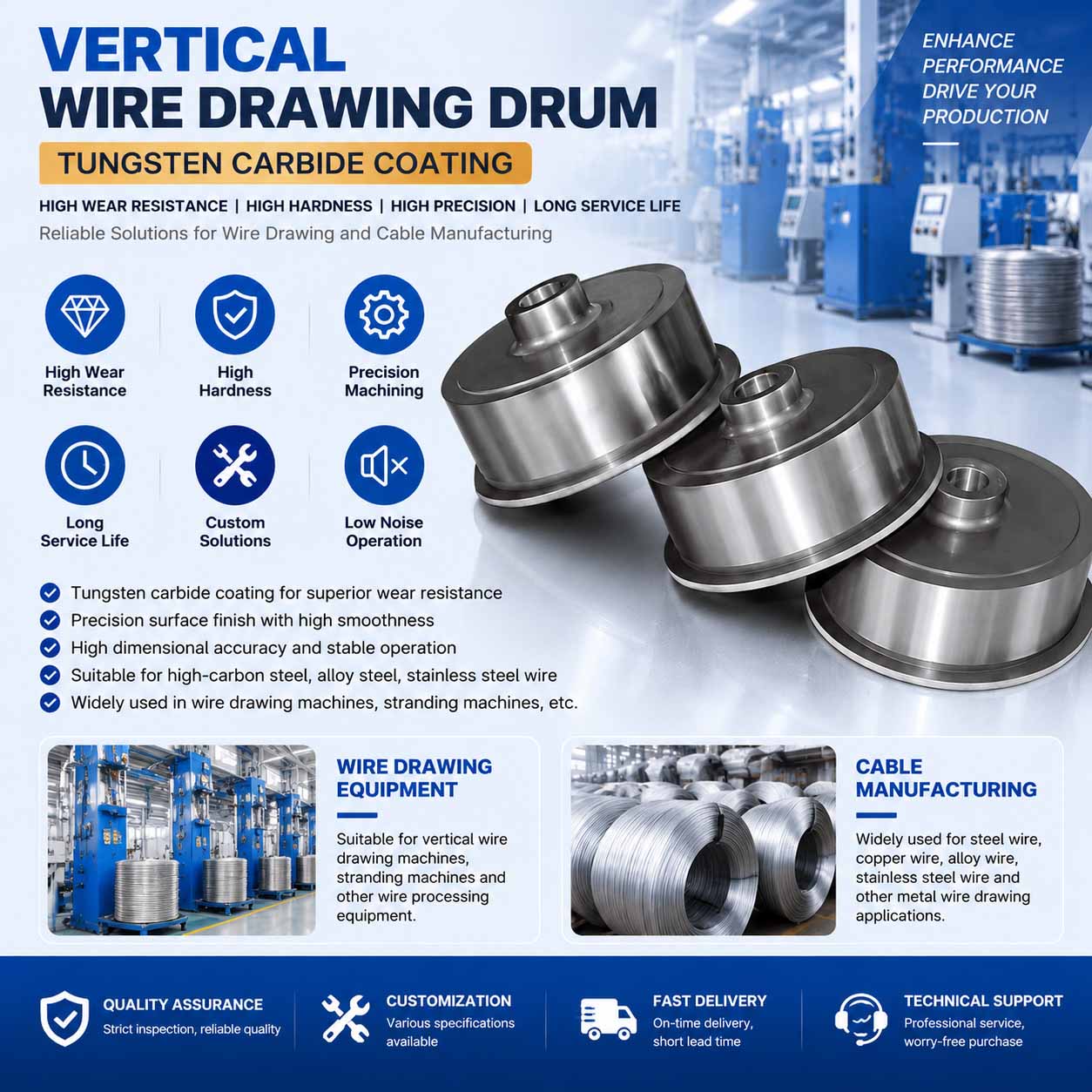
In metal wire drawing processes, wire drawing drums and tower pulleys are critical components that continuously withstand high friction and wire tension. Long-term operation can cause severe surface wear, affecting wire quality and potentially leading to equipment downtime.
By applying tungsten carbide coating technology, these components can receive a high-hardness, wear-resistant protective surface. The technology is also widely used for refurbishing worn parts, restoring or even improving original performance.
Coating Material and Specifications
We use tungsten carbide (WC) as the coating material and apply it through advanced processes such as High Velocity Oxygen Fuel (HVOF) spraying.
Typical coating specifications:
- Coating thickness: 0.2–0.3 mm
- Hardness: HV1100+
- High bonding strength
- Low porosity structure
The coating effectively resists sliding wear, fretting wear, and abrasive erosion caused by high-speed wire movement. It is suitable for drawing steel wire, copper wire, alloy wire, and other metal materials.
Applicable Components and Processing Capabilities
Our tungsten carbide coating services cover various wire drawing components:
Vertical Wire Drawing Drums
Full or partial tungsten carbide coating can be applied to improve drum surface wear resistance, reduce wire scratches, and extend service life.
Tower Pulleys
We provide tungsten carbide coating for different types of tower pulleys, including aluminum alloy pulleys and customized tungsten carbide pulleys. Special surface preparation and bonding layers allow aluminum alloy substrates to achieve both lightweight performance and excellent wear resistance.
Tungsten Carbide Steel Rings
Steel rings used in tower pulleys and guide rollers can be individually coated or completely refurbished to restore performance.
Guide Rollers and Wire Passing Rollers
Ceramic or tungsten carbide coatings can be applied to reduce friction, improve wear resistance, and extend component life.
We provide complete processing capabilities, including substrate preparation, thermal spraying, precision machining, and quality inspection. Customized solutions are available according to customer drawings or samples.
Repair Service and Process
For worn tower pulleys and wire drawing drums, we provide professional refurbishment services:
- Inspection: Evaluate wear condition, substrate damage, and repair feasibility.
- Surface Preparation: Cleaning, degreasing, and sandblasting to remove damaged layers.
- Coating Application: Apply tungsten carbide coating using HVOF technology to the required thickness.
- Finishing: Precision grinding and polishing to achieve specified dimensions and surface roughness.
- Quality Inspection: Check hardness, coating thickness, bonding strength, and surface finish.
Refurbished components can achieve performance comparable to new parts while reducing costs and shortening delivery time.
Applications and Selection Guide
Tungsten carbide coated components are widely used in:
- Wire and cable manufacturing
- Steel wire production
- Welding wire processing
- Spring wire manufacturing
For example, in high-speed copper wire drawing applications, aluminum alloy tower pulleys with tungsten carbide coatings maintain lightweight advantages while significantly improving wear resistance. In many cases, replacement intervals can be extended by more than three times.
When selecting a coating solution, consider:
- Wire material
- Drawing speed
- Wire tension
- Lubrication conditions
- Operating environment
Our engineers can recommend suitable coating systems based on actual working conditions.
Maintenance Recommendations
To maximize coating service life:
- Avoid severe impact and localized overload.
- Regularly inspect coating wear conditions.
- Repair promptly if peeling or substrate exposure occurs.
- Clean with soft cloths and neutral cleaning agents.
- Avoid hard scrapers and corrosive storage environments.
Frequently Asked Questions
Is a 0.2–0.3 mm tungsten carbide coating thick enough for wear resistance?
Yes. This optimized thickness provides excellent wear protection while avoiding excessive internal stress caused by overly thick coatings.
Can aluminum alloy tower pulleys be coated with tungsten carbide?
Yes. With proper surface preparation and bonding layers, tungsten carbide coatings can achieve strong adhesion on aluminum alloy substrates.
How is dimensional accuracy maintained after repair?
After coating, precision grinding restores the component to the required dimensions and surface roughness, ensuring proper equipment compatibility.
What is the difference between tungsten carbide and ceramic coatings?
Tungsten carbide provides higher hardness and better wear resistance, making it suitable for metal wire drawing applications. Ceramic coatings offer better high-temperature resistance and electrical insulation for specific environments.
What is the delivery time?
Processing time depends on component size and complexity. Repair projects typically require 5–10 working days, while new components may require additional manufacturing time.
Do you provide on-site coating services?
Our main service is factory-based thermal spray processing. Customers can send components to our facility. On-site solutions for large equipment can be discussed separately.
