

Coating Service Overview
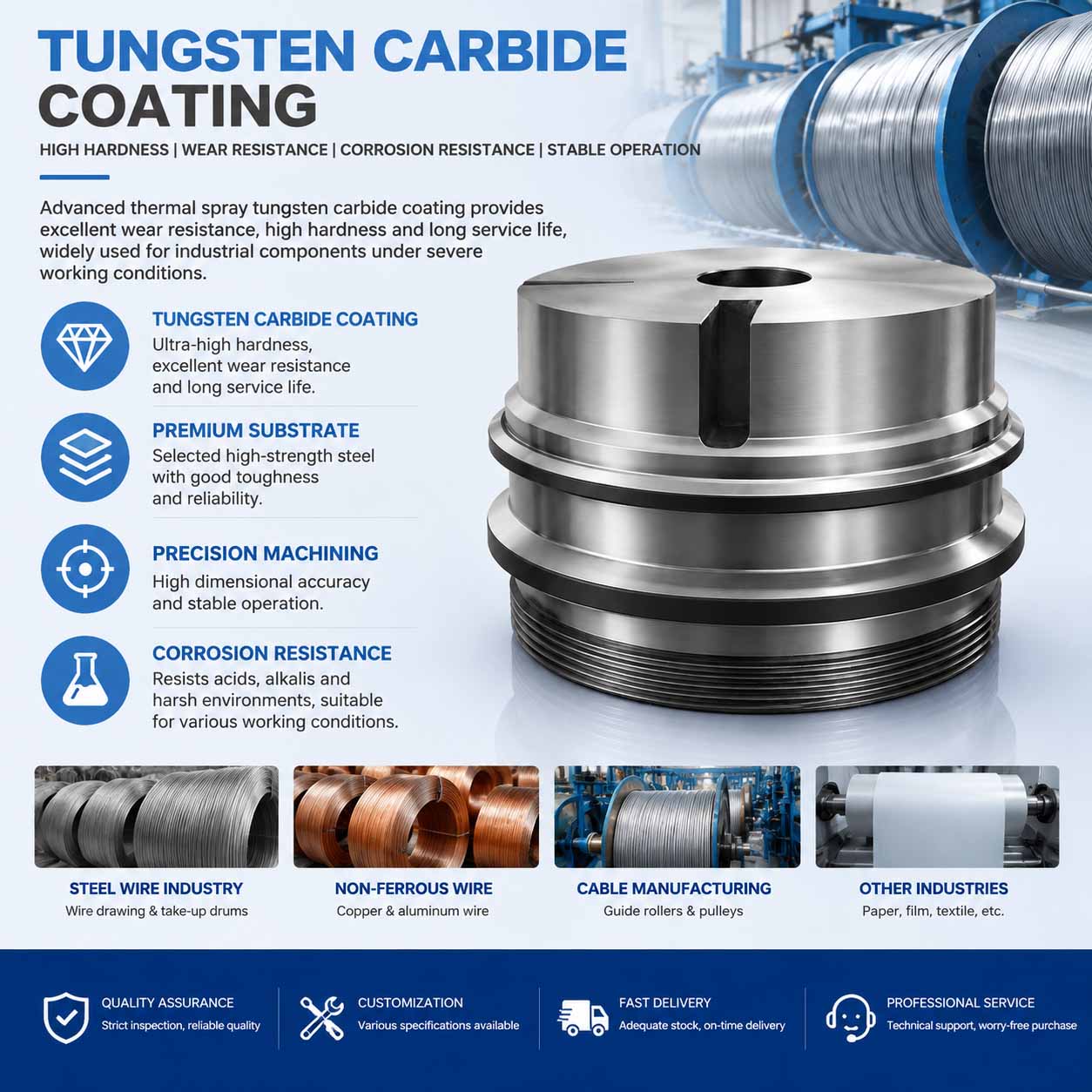
During metal wire drawing and winding processes, components such as wire drawing drums, take-up drums, tower pulleys, and steel rings are continuously exposed to high friction and wire tension. Over time, surface wear can reduce equipment performance and affect production stability.
To extend service life and maintain reliable operation, tungsten carbide coating and ceramic coating technologies are widely used as effective surface protection solutions.
We provide customized tungsten carbide coating, steel ring coating, and ceramic coating services. The typical coating thickness is 0.2–0.3 mm, adjustable according to operating conditions, helping customers reduce downtime and replacement frequency.
Coating Materials and Process Selection
According to different working environments, two main coating solutions are available:
Tungsten Carbide Coating
Applied using High Velocity Oxygen Fuel (HVOF) thermal spray technology, tungsten carbide coatings provide:
- Dense coating structure
- High bonding strength
- Excellent wear resistance
- Hardness up to HV1100+
They are suitable for high-stress wear applications, including steel rings, tower pulleys, wire drawing drums, and take-up drums.
Ceramic Coating
Ceramic coatings mainly use materials such as chromium oxide (Cr₂O₃) and aluminum oxide-titanium oxide (Al₂O₃-TiO₂).
They offer:
- Excellent high-temperature resistance
- Good corrosion resistance
- Electrical insulation performance
- Low friction characteristics
Ceramic coatings are commonly used for guide rollers, wire passing rollers, and components requiring anti-sticking performance.
The correct coating should be selected according to wire material, production speed, tension, and working environment. Our engineers can provide suitable coating recommendations based on actual operating conditions.
Application Areas
Tungsten carbide and ceramic coating services are widely used for:
- Wire drawing machine tower pulleys
- Wire drawing drums and take-up drums
- Cable production line guide rollers
- Wire passing rollers
- Vertical wire drawing drums
- Refurbishment of worn pulleys, steel rings, and other components
Whether for new component protection or repair of worn parts, thermal spray technology can restore dimensions and improve surface performance.
Custom Manufacturing and Repair Process
New Component Coating
- Receive drawings or samples and confirm substrate, dimensions, and coating requirements.
- Perform surface preparation, including cleaning and sandblasting.
- Apply tungsten carbide or ceramic coating to the specified thickness.
- Perform grinding and polishing to achieve final dimensions and surface finish.
- Inspect coating thickness, hardness, and bonding strength.
Used Component Refurbishment
- Evaluate wear condition and repair feasibility.
- Remove damaged layers and prepare the surface.
- Reapply coating with sufficient machining allowance.
- Precision machine back to original dimensions.
- Complete quality inspection before delivery.
Refurbishment can significantly reduce replacement costs, especially for large or customized steel rings and rollers.
Maintenance Recommendations
To maximize coating service life:
- Regularly inspect coating wear and prevent excessive wear exposing the substrate.
- Keep wire surfaces clean to reduce abrasive particle damage.
- Ensure proper alignment during installation to avoid uneven loading.
- Repair coating cracks or peeling promptly to prevent further damage.
Frequently Asked Questions
Can tungsten carbide coating thickness be customized?
Yes. The standard thickness is usually 0.2–0.3 mm, but it can be adjusted according to application requirements. Excessive thickness should be avoided as it may affect coating bonding strength.
How to choose between tungsten carbide and ceramic coatings?
Tungsten carbide is preferred for severe abrasive wear and high-load friction conditions. Ceramic coatings provide better high-temperature resistance, corrosion resistance, and lower friction. Selection depends on the actual working environment.
Can worn tower pulleys be repaired?
In most cases, yes. If the substrate has no serious cracks or deformation, thermal spraying can restore dimensions and improve surface performance close to new-part conditions.
What is the processing time?
The lead time depends on component quantity, size, and process requirements. Small batch orders are usually completed within 3–7 working days after receiving the components.
Do you provide on-site spraying services?
Our standard service is factory-based coating processing. On-site service for large components can be discussed in advance.
How is coating bonding strength guaranteed?
Through strict surface preparation, optimized spraying parameters, and proper post-processing, coating bonding strength can exceed 70 MPa, meeting the requirements of most industrial applications.
