

Coating Service Overview
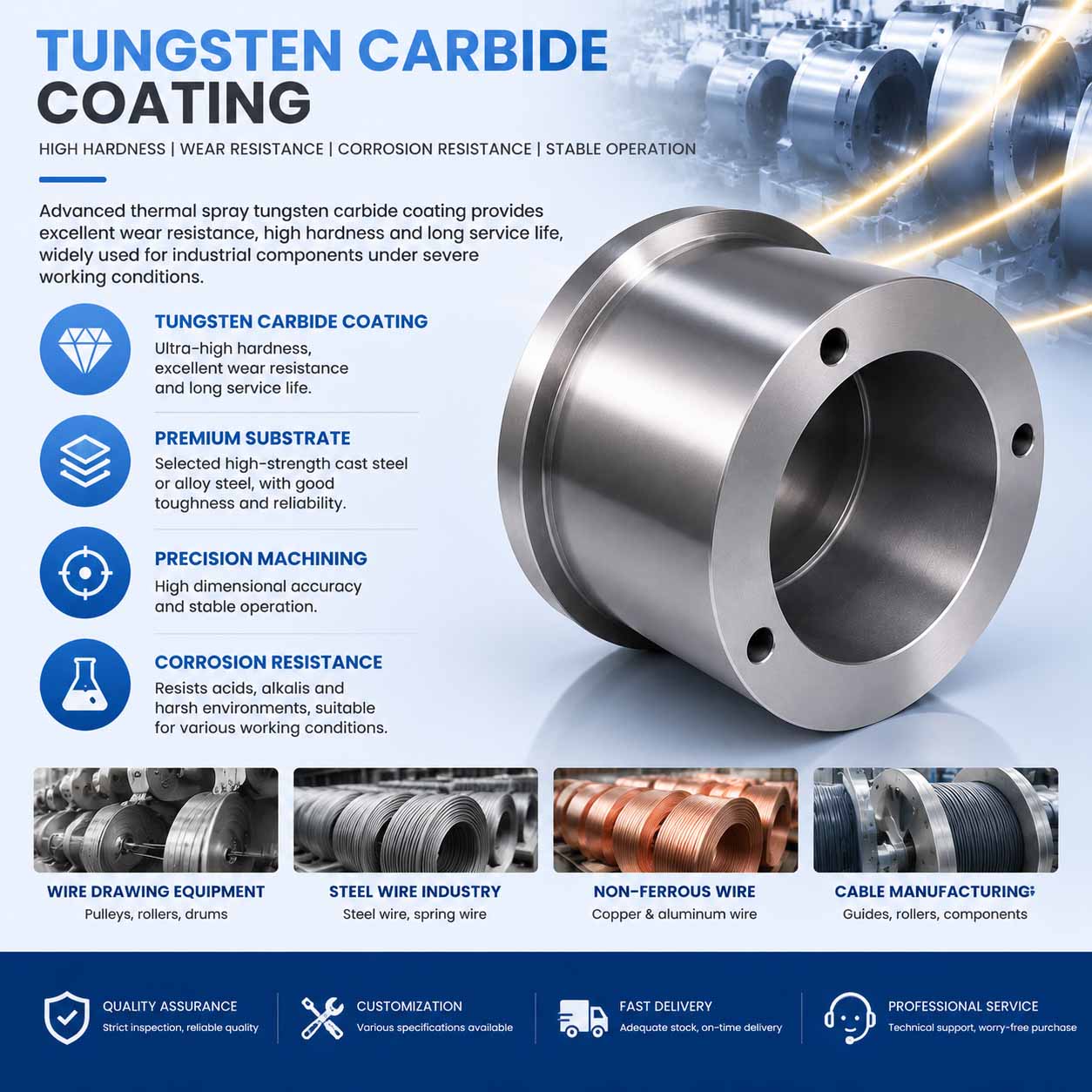
During metal wire drawing processes, tower pulley steel rings are critical components that withstand continuous friction and high wire tension. Without surface protection, steel rings can suffer rapid wear, frequent replacement, and reduced production efficiency.
Tungsten carbide coating technology forms a dense and high-hardness protective layer on the steel ring surface, significantly improving wear resistance and extending service life. It has become a widely adopted solution in the wire drawing industry.
Characteristics of Tungsten Carbide Coating
Tungsten carbide (WC) coating features extremely high hardness and excellent resistance to abrasive wear. Using High Velocity Oxygen Fuel (HVOF) thermal spray technology, the coating is deposited with a dense structure, strong bonding strength, and low porosity, effectively resisting friction and micro-cutting caused by high-speed wire movement.
Typical coating parameters:
- Coating material: Tungsten Carbide (WC)
- Coating thickness: 0.2–0.3 mm
- Hardness: HV1100–1300
- Bonding strength: ≥70 MPa
- Surface finish: Can be precision-ground to Ra <0.2 μm
Application Areas
Tungsten carbide coated steel rings are widely used in wire drawing and stranding equipment, especially for high-speed processing of copper wire, steel wire, and alloy wire.
Typical applications include:
- Water tank wire drawing machine tower pulleys
- Inverted wire drawing machine drums
- Vertical wire drawing drums
- Take-up machine guide rollers
In industries such as cable manufacturing, steel wire rope production, welding wire manufacturing, and spring wire processing, tungsten carbide coated rings help reduce downtime and improve production stability.
Custom Coating and Repair Services
We provide both new steel ring coating services and refurbishment solutions. Worn tower pulley steel rings can be restored through recoating and precision grinding, reducing replacement costs significantly.
New Component Coating Process
- Receive drawings or samples and confirm dimensions and tolerances.
- Select suitable substrate materials (commonly 45# steel or alloy steel).
- Perform surface preparation and apply tungsten carbide coating to the required thickness.
- Precision grind to final dimensions and surface finish.
- Inspect hardness, bonding strength, dimensions, and coating quality.
Repair Process
- Clean and inspect used components.
- Remove old coating and prepare the surface by sandblasting.
- Apply new tungsten carbide coating with machining allowance.
- Grind to original dimensions or customer specifications.
- Complete final inspection and delivery.
Selection and Maintenance Recommendations
When selecting tungsten carbide coated steel rings, consider wire material, drawing speed, lubrication conditions, and operating environment.
Recommended guidelines:
- Copper wire drawing: 0.2 mm coating thickness is usually sufficient.
- Steel wire drawing: 0.3 mm coating thickness is recommended for higher loads.
- Wet drawing applications: Corrosion-resistant tungsten carbide materials with suitable binders are recommended.
Maintenance recommendations:
- Regularly inspect coating wear to prevent substrate exposure.
- Keep wire surfaces clean to reduce abrasive particle damage.
- Ensure correct alignment during installation to avoid uneven loading.
- Use soft cleaning tools and avoid impact damage to the coating surface.
Frequently Asked Questions
Will tungsten carbide coating peel off?
Under normal operating conditions, tungsten carbide coating has strong adhesion and is not easy to peel. Local damage may occur due to substrate fatigue, overload, or impact.
Is a thicker coating always better?
No. Excessive coating thickness increases internal stress and may cause cracking. A thickness of 0.2–0.3 mm provides a good balance between wear resistance and bonding reliability.
Can worn steel rings be repaired to new-part performance?
Yes. If the substrate has no serious fatigue or deformation, repaired components can achieve performance close to new parts, with service life restored to over 90% in suitable conditions.
Are tungsten carbide steel rings suitable for all wire drawing machines?
Most wire drawing machines can use tungsten carbide coated rings, but coating materials and thickness should be selected according to specific operating conditions.
What is the delivery time?
Custom new components usually require 5–10 working days. Repair services generally take 3–7 working days depending on quantity and wear condition.
When should a steel ring be repaired or replaced?
Repair is recommended when coating wear exceeds approximately 0.15 mm, visible grooves appear, or wire surface quality begins to decline. Timely repair helps prevent damage to the substrate.
