

Coating Service Overview
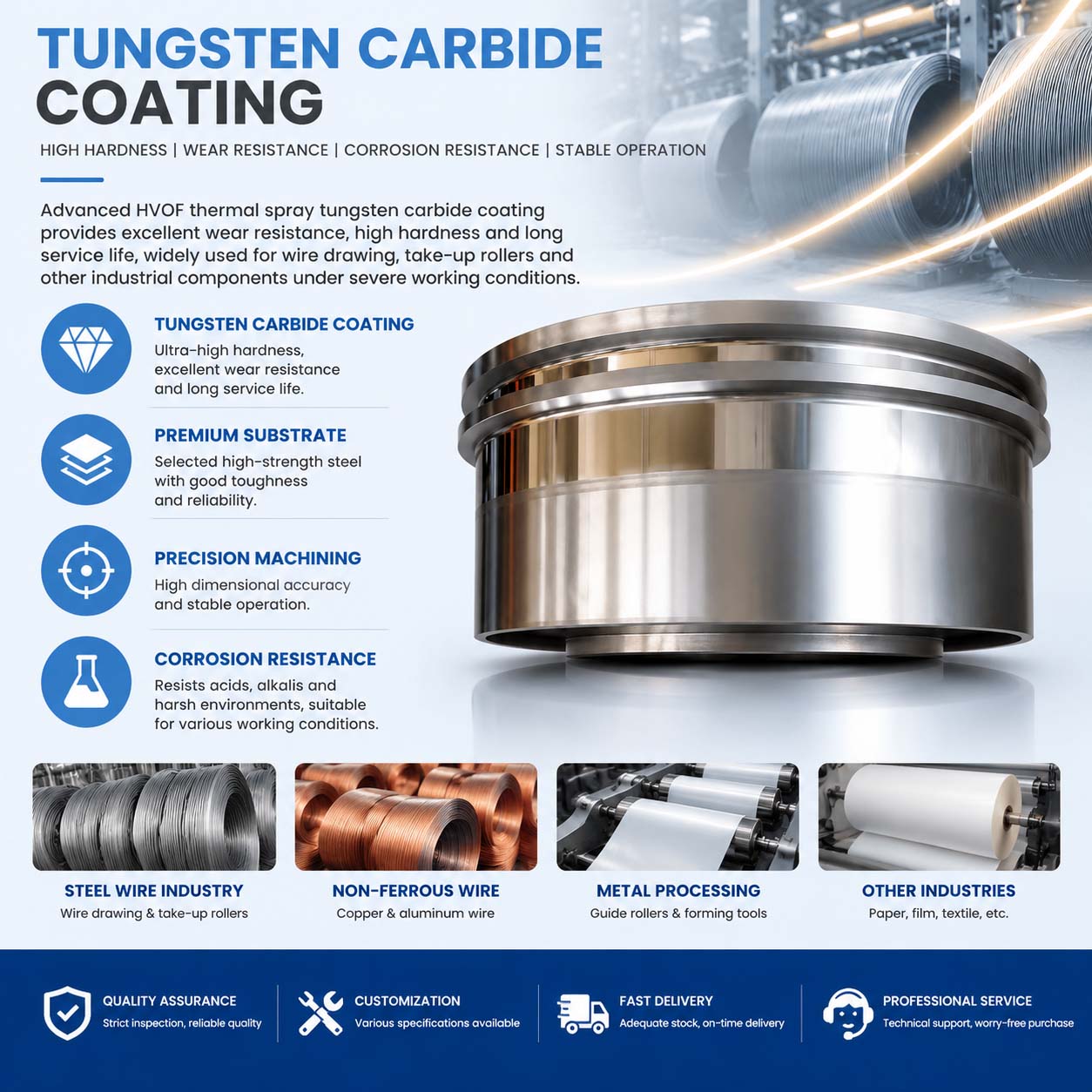
In steel and wire manufacturing industries, wire drawing and take-up rollers are critical components that are continuously exposed to high-speed friction and severe wear. Their surface condition directly affects production efficiency, product quality, and equipment reliability.
Through advanced thermal spray technology, a dense and high-hardness tungsten carbide (WC) coating is applied to the roller surface, significantly improving wear resistance, extending service life, and reducing maintenance costs.
This article introduces the key features, applications, processing advantages, and common questions regarding tungsten carbide coating services for wire drawing and take-up rollers.
Coating Material and Process
We use tungsten carbide (WC) as the coating material and apply it through High Velocity Oxygen Fuel (HVOF) spraying technology.
During the HVOF process, tungsten carbide powder is heated and accelerated at extremely high speed onto the workpiece surface, forming a coating with:
- High bonding strength
- Low porosity
- Excellent hardness
- Superior wear resistance
Coating specifications:
- Coating material: Tungsten Carbide (WC)
- Coating thickness: 0.2–0.3 mm (adjustable according to requirements)
- Spray process: HVOF thermal spray coating
The tungsten carbide coating effectively resists sliding wear and abrasive wear caused by continuous contact with steel wire, copper wire, and other metal wires.
Applicable Components and Industries
Tungsten carbide coating is widely used for key components in wire processing equipment, including:
Wire Drawing Rollers (Tower Pulleys)
During wire drawing operations, wires repeatedly pass through tower pulleys, causing friction and surface grooves. Tungsten carbide coatings reduce wear, maintain roller accuracy, and improve wire surface quality.
Take-Up Rollers
Take-up rollers remain in continuous contact with wire during winding processes. The coating prevents surface scratches, improves wear resistance, and helps maintain stable wire tension.
Guide Rollers and Wire Passing Rollers
Guide rollers control wire movement and direction. Tungsten carbide coatings reduce friction, minimize vibration, and improve production consistency.
Typical applications include:
- Steel wire production
- Welding wire manufacturing
- Cable conductor processing
- Wire drawing and winding production lines
Advantages of Tungsten Carbide Coating
Extended Service Life
The high hardness coating effectively withstands wire friction and wear, providing several times longer service life compared with untreated components.
Reduced Maintenance Frequency
Improved wear resistance reduces replacement cycles and minimizes production downtime.
Improved Surface Quality
The dense and smooth coating surface reduces wire scratches and maintains product appearance.
Repair of Used Components
Worn tower pulleys and take-up rollers can be recoated and restored to original dimensions, reducing replacement costs.
Selection and Customization
When selecting a tungsten carbide coating solution, consider:
- Substrate material and dimensions: Different metal substrates require suitable surface preparation to ensure coating adhesion.
- Operating conditions: Wire material, line speed, tension, and lubrication conditions affect coating design.
- Coating thickness: Standard thickness is 0.2–0.3 mm, adjustable according to wear requirements.
- Post-processing: Precision grinding is usually required after coating to achieve the required dimensions and surface finish.
We provide both new component coating and refurbishment services. Customized solutions can be developed according to drawings, samples, and operating conditions.
Maintenance Recommendations
Proper maintenance can further extend coating life:
- Maintain proper lubrication to reduce dry friction.
- Inspect coating surfaces regularly and repair abnormal wear promptly.
- Avoid impact loads and overload operation to prevent coating damage.
- Use soft tools for cleaning to avoid scratching the coating surface.
If local coating damage occurs, repair can often be performed without replacing the entire component.
Frequently Asked Questions
Why is the coating thickness usually 0.2–0.3 mm?
This thickness provides a good balance between wear resistance and coating stress. Excessive thickness may increase the risk of cracking or peeling, while insufficient thickness may reduce service life.
What is the difference between HVOF coating and conventional flame spraying?
HVOF provides much higher particle velocity, producing denser coatings with stronger bonding strength, lower porosity, and significantly improved wear resistance.
Can severely worn wire drawing rollers be repaired?
Yes. The surface can be pre-treated and recoated. For severe wear, additional rebuilding processes may be required before tungsten carbide spraying.
Can tungsten carbide coatings achieve a mirror finish?
After spraying, precision grinding and polishing can achieve a smooth surface finish suitable for wire production applications.
What is the typical delivery time?
Depending on component size and complexity, standard processing usually takes approximately 3–7 working days. Expedited service can be discussed for urgent requirements.
Do you provide on-site spraying services?
Currently, coating services are performed in our factory. Components need to be shipped to our facility for processing.
