

Coating Service Overview
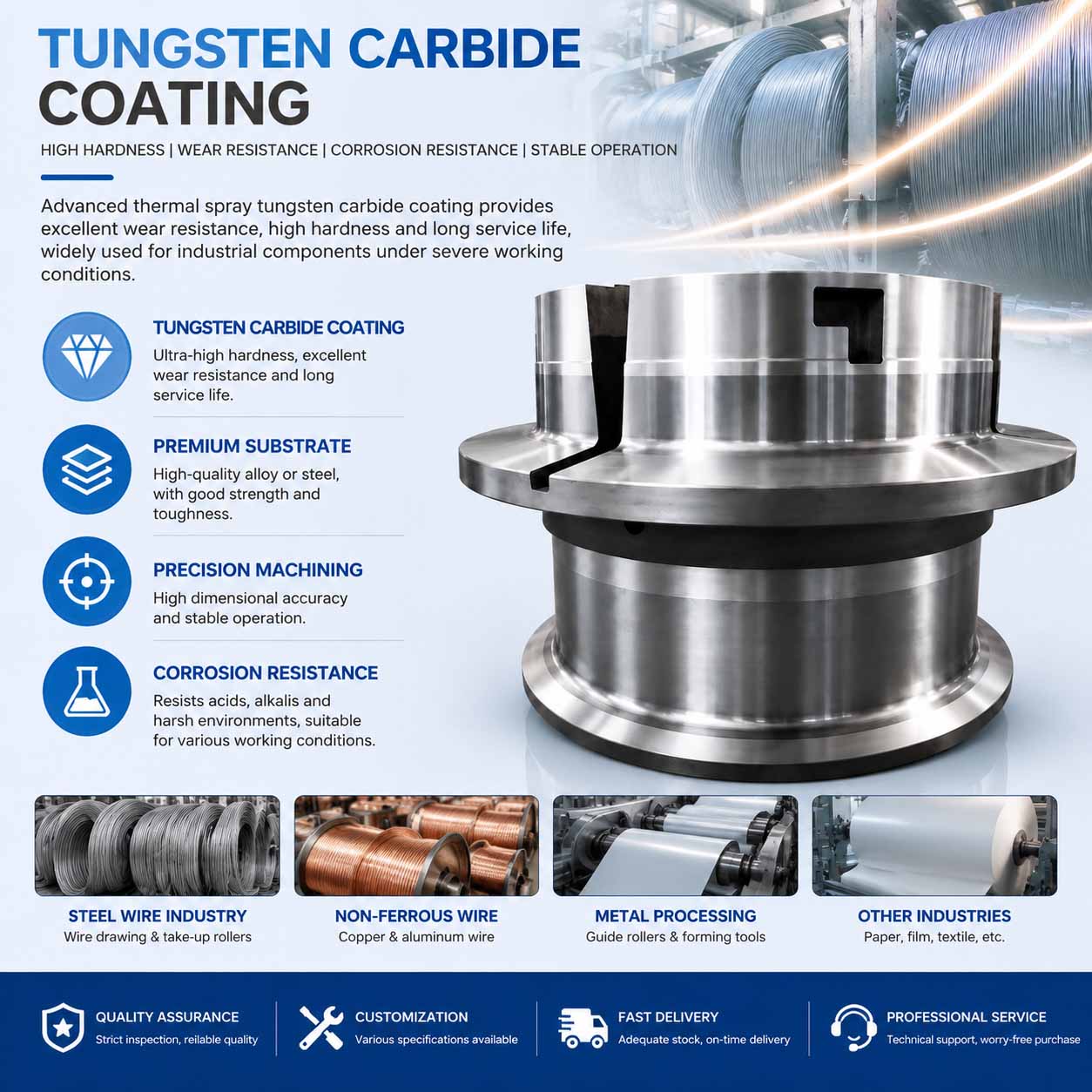
In steel wire and metal wire production, wire drawing and take-up rollers (including tower pulleys, guide rollers, and winding rollers) are continuously exposed to high-speed friction from moving wires, resulting in surface wear and reduced service life.
By applying advanced thermal spray technology, especially tungsten carbide (WC) coating, the surface hardness and wear resistance of rollers can be significantly improved. This extends equipment life, reduces maintenance frequency, and improves production stability.
This article introduces a tungsten carbide coating solution with a typical coating thickness of 0.2–0.3 mm, covering material characteristics, applications, processing requirements, and maintenance methods.
Coating Material and Parameters
The coating uses tungsten carbide (WC) applied through advanced thermal spray processes such as High Velocity Oxygen Fuel (HVOF) spraying.
The coating thickness is typically controlled at 0.2–0.3 mm, providing an excellent balance between wear resistance and bonding strength.
Due to its high hardness and excellent toughness, tungsten carbide coatings effectively resist sliding wear and fretting wear caused by continuous contact with steel wire, copper wire, and other drawn materials.
Application Areas
Tungsten carbide coatings are widely used on key components of wire drawing equipment:
Wire Drawing Tower Pulleys
During wire drawing, wires repeatedly pass around tower pulleys and create friction grooves on the surface. Tungsten carbide coatings reduce groove wear and help maintain stable wire surface quality.
Take-Up Rollers
Take-up rollers are continuously in contact with wires during winding. The coating reduces surface scratches, improves wear resistance, and helps maintain stable wire tension.
Guide Rollers and Wire Passing Rollers
Guide rollers control wire direction during processing. Tungsten carbide coatings reduce friction, minimize wire vibration, and improve production consistency.
Typical applications include steel wire ropes, welding wires, cable conductors, and other wire drawing and winding production lines.
Selection and Processing Recommendations
When selecting a tungsten carbide coating solution, the following factors should be considered:
Substrate Material
Steel, aluminum alloy, and other substrates require proper surface preparation, including sandblasting, to ensure strong coating adhesion.
Coating Thickness
A thickness of 0.2–0.3 mm is commonly used in wire drawing applications. Excessive thickness may affect dimensional accuracy, while insufficient thickness may reduce service life.
Post Processing
After spraying, precision grinding is usually required to achieve the required surface finish and ensure smooth contact with the wire.
For optimal performance, customers should provide equipment parameters such as roller dimensions, wire speed, tension, and wire material.
Maintenance and Repair
Regular inspection and proper maintenance can significantly extend the service life of coated rollers:
- Wear inspection: Check groove depth regularly. If the coating is worn through, repair should be performed promptly to protect the substrate.
- Cleaning: Remove wire debris and contaminants to prevent abnormal wear caused by embedded particles.
- Recoating repair: Used tower pulleys and guide rollers can be refurbished by removing the damaged coating, reapplying tungsten carbide, and restoring original dimensions through grinding.
Proper maintenance can extend coating service life by more than 30%, depending on operating conditions.
Frequently Asked Questions
Why is a 0.2–0.3 mm coating thickness commonly selected?
This thickness provides a good balance between wear resistance and bonding strength. Excessive thickness may create residual stress, while thinner coatings may not provide sufficient service life.
Will tungsten carbide coating peel off?
With proper surface preparation and process control, tungsten carbide coatings provide strong adhesion and are stable under normal operating conditions. Excessive overload or substrate fatigue may cause local damage.
Can tungsten carbide coating be applied to aluminum alloy pulleys?
Yes. However, aluminum alloy has a lower melting point, so spray temperature must be carefully controlled. Low-temperature HVOF processes are commonly used.
How is surface roughness controlled?
After spraying, precision grinding can achieve surface roughness around Ra 0.4–0.8 μm, meeting wire contact requirements and reducing surface damage.
Does the old coating need to be completely removed before repair?
Yes. The damaged coating should be removed and the substrate re-prepared to ensure strong bonding of the new coating. Partial repair may cause interface defects.
What is the difference between tungsten carbide and ceramic coatings?
Tungsten carbide coatings offer higher toughness and wear resistance, making them ideal for metal wire friction applications. Ceramic coatings provide better high-temperature resistance and corrosion protection but are more brittle. The choice depends on the working environment and performance requirements.
